Deception Technology Explained: How Fake Assets Trap Attackers
Deception technology turns your entire network into a trap, ensuring that any interaction with a fake asset proves an intrusion has occurred.

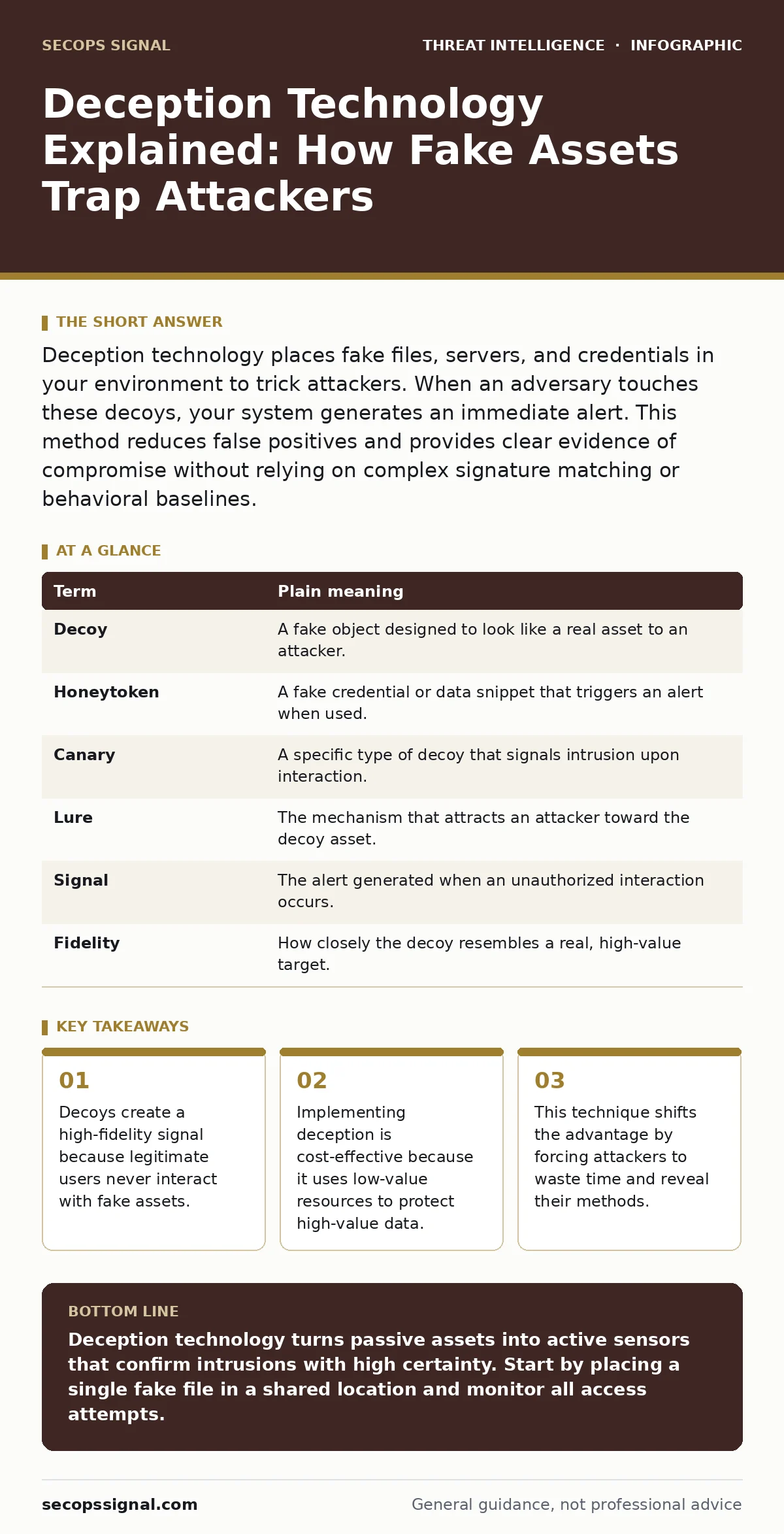
Deception technology places fake files, servers, and credentials in your environment to trick attackers. When an adversary touches these decoys, your system generates an immediate alert. This method reduces false positives and provides clear evidence of compromise without relying on complex signature matching or behavioral baselines.
The Museum Security Analogy
Imagine a museum filled with priceless artifacts. Traditional security relies on guards watching cameras and checking badges. If a thief wears a stolen badge, the guards might not notice until damage is done. Deception technology works differently. You place convincing fake artifacts in plain sight. These fakes look valuable but are tagged with invisible sensors. When a thief picks up a fake painting, the alarm triggers immediately. The thief reveals their presence the moment they touch something they should never touch.
Key Terms in Deception
Understanding the vocabulary helps you discuss this strategy with your technical team. These terms define how the traps are built and detected.
| Term | Plain meaning |
|---|---|
| Decoy | A fake object designed to look like a real asset to an attacker. |
| Honeytoken | A fake credential or data snippet that triggers an alert when used. |
| Canary | A specific type of decoy that signals intrusion upon interaction. |
| Lure | The mechanism that attracts an attacker toward the decoy asset. |
| Signal | The alert generated when an unauthorized interaction occurs. |
| Fidelity | How closely the decoy resembles a real, high-value target. |
Why Traditional Defenses Fall Short
Firewalls and antivirus software look for known bad patterns. They struggle with new threats or insiders who have legitimate access. Deception does not try to block traffic. Instead, it invites interaction with objects that serve no legitimate business purpose. If a process accesses a fake database, it is not a normal operation. This distinction eliminates the noise of false positives. You stop guessing whether an alert is real. You know it is an intrusion because no valid user ever needs that resource.
Building Effective Decoys
A decoy must look real to an attacker but serve no function for staff. A fake server with a realistic operating system version is a strong example. It should not host real data. It should not be part of your production workflow. If your team needs to access it for testing, it is not a decoy. It is a shared resource. The goal is isolation. The decoy exists solely to be touched by someone who does not belong there. High fidelity increases the chance an attacker will engage. Low fidelity might be dismissed as a glitch.
The First Practical Step
You do not need expensive hardware to start. Create a fake file that looks like a sensitive document. Name it something generic like "passwords.txt" or "client_list.csv". Place it in a directory where attackers look, such as a shared drive or a developer folder. Ensure no legitimate user needs this file. Monitor access to this specific file. Any read or copy operation generates an alert. This simple action creates your first high-fidelity signal. It costs nothing but attention to detail.
- Create a dummy file with a tempting name.
- Place it in a location accessible to potential intruders.
- Set up an alert for any access to that specific file path.
See also: 7 Remote Access Tool Mistakes That Invite Unauthorized Control · Detect QR Code Phishing: Log Analysis and Blind Spots
Hidden Costs and Trade-offs
Deception is not a silver bullet. It requires maintenance. If your decoys become too obvious, attackers will ignore them. If they are too realistic, you risk accidental interaction by your own staff. You must clearly document what is fake. This documentation helps your incident response team distinguish between a trap and a real asset. You also need to update decoys regularly. Attackers learn to recognize stale patterns. Rotating your fake assets keeps the strategy effective.
Integrating with Your Defense
Deception works best when combined with other security practices. When a decoy is triggered, you need to know what happened next. This is where indicators of attack come into play. You look for subsequent movements in the network. Did the attacker move laterally? Did they try to escalate privileges? Deception provides the starting point. It confirms the breach. Other tools help you understand the scope.
You can also use deception to study attacker behavior. This aligns with purple teaming efforts. By observing how adversaries interact with your traps, you learn their tactics. You can then adjust your real defenses to block those specific methods. This feedback loop improves your overall security posture over time.
Common Mistakes to Avoid
Many organizations fail because they deploy decoys incorrectly. Placing a decoy in a highly restricted area is useless. Attackers cannot reach it. Placing it in a public area is too noisy. You must find the balance. Another mistake is ignoring the alert. If you do not investigate every decoy interaction, the strategy fails. You must have a clear process for digital forensics and incident response. The alert is just the beginning. The investigation determines the damage.
Beyond Simple Files
As you mature, you can expand beyond single files. Honeytokens are small, fake credentials embedded in databases or code. They are hard to detect but easy to monitor. When an attacker uses a honeytoken to query a database, you know they have breached your data layer. This is more advanced than a file trap. It requires more setup but provides deeper insight. You can also mimic phishing infrastructure to test your users. This helps you understand how well your training works.
Key takeaways
- Decoys create a high-fidelity signal because legitimate users never interact with fake assets.
- Implementing deception is cost-effective because it uses low-value resources to protect high-value data.
- This technique shifts the advantage by forcing attackers to waste time and reveal their methods.
Deception technology turns passive assets into active sensors that confirm intrusions with high certainty. Start by placing a single fake file in a shared location and monitor all access attempts.
Frequently asked questions
Does deception technology replace antivirus software?
No, deception complements traditional tools by detecting intrusions that signatures miss, but it does not prevent malware from executing on real systems.
How do I prevent my own staff from triggering decoys?
You must clearly document all decoy locations and ensure they are never part of legitimate workflows or automated processes.
Is this technology only for large enterprises?
No, small organizations can implement basic file-level decoys with minimal cost and technical overhead, making it accessible to most businesses.
What happens if an attacker ignores the decoy?
The decoy provides no protection if ignored, which is why it must be placed strategically where attackers are likely to search for sensitive data.
How this guide was produced: written by the SecOps Signal editorial team with AI assistance, checked against the public references listed below, and reviewed when the facts change. See our editorial policy or report an error.