Neutralize Phishing Infrastructure: 3 Technical Controls That Work
Most organizations focus on user training, but the real defense lies in breaking the attacker's chain of command by isolating credentials and validating email paths.
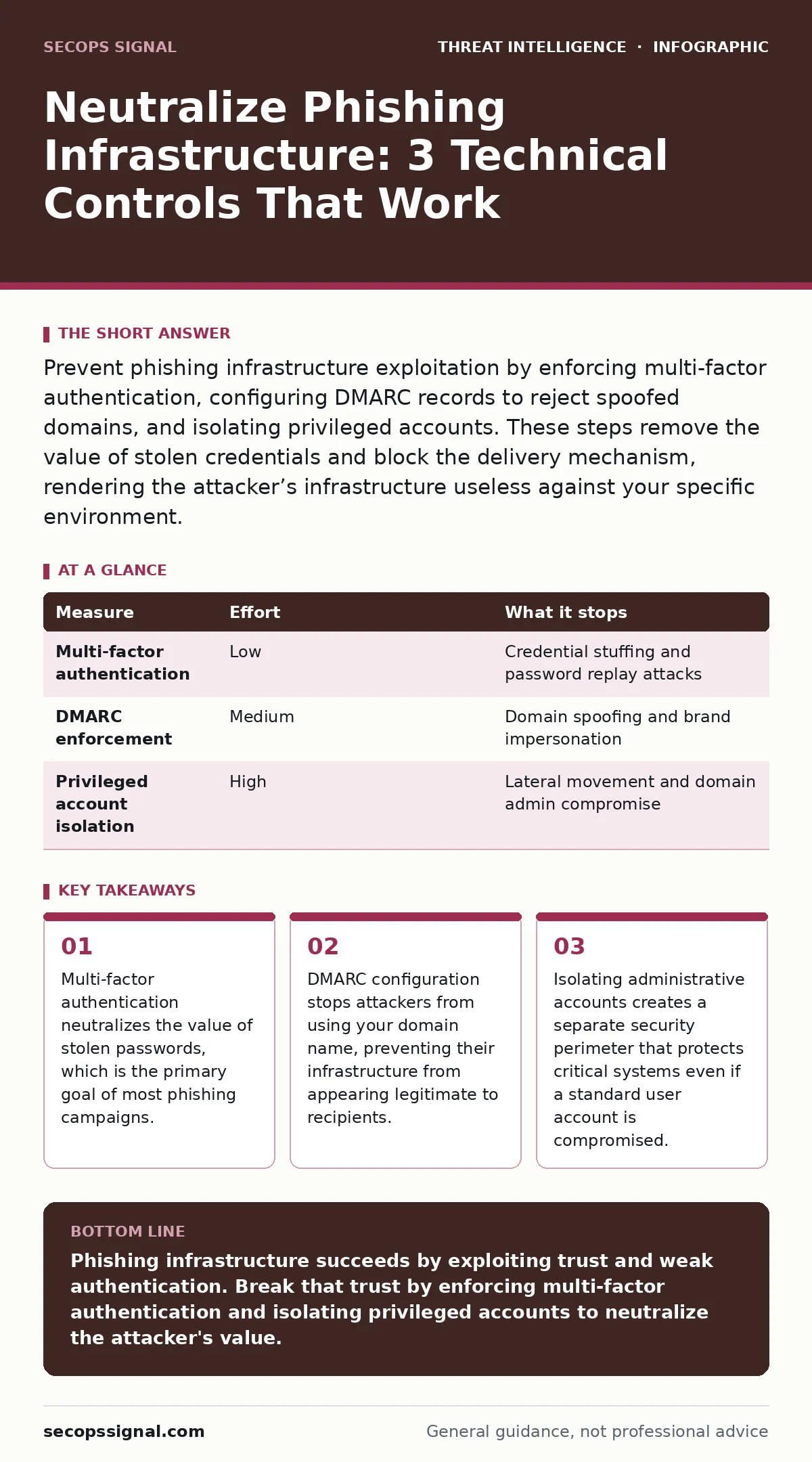
Prevent phishing infrastructure exploitation by enforcing multi-factor authentication, configuring DMARC records to reject spoofed domains, and isolating privileged accounts. These steps remove the value of stolen credentials and block the delivery mechanism, rendering the attacker’s infrastructure useless against your specific environment.
Why Training Alone Fails Against Modern Infrastructure
Phishing infrastructure has evolved from simple email blasts to sophisticated, persistent networks. Attackers use automated tools to test credentials and rotate domain names rapidly. You cannot train your way out of a technical vulnerability. Imagine an employee who has completed every security awareness module. They still click a link because the email arrives from a trusted supplier’s domain. The infrastructure behind that email is designed to bypass human judgment. Technical controls must replace the assumption that users will always recognize a threat.
The goal of phishing infrastructure is not just to steal data. It is to gain a foothold within your network. Once inside, the attacker moves laterally. This movement depends on valid credentials and trust relationships. By breaking these dependencies, you render the infrastructure ineffective. You do not need to stop every email. You need to stop the impact of the ones that get through.
Priority One: Eliminate Password-Only Access
Multi-factor authentication (MFA) is the single most effective control against credential theft. It adds a second layer of verification that the attacker cannot replicate. When a phisher steals a password, that password becomes useless if the attacker cannot also possess the second factor. This second factor is usually a time-based code or a cryptographic key stored on a device.
Implement MFA on all accounts that access email, cloud services, and administrative consoles. Use hardware security keys or authenticator apps. Avoid SMS-based codes, as these can be intercepted through SIM swapping attacks. The effort to deploy MFA is low, but the risk reduction is massive. It stops the initial compromise in the vast majority of cases. Without valid credentials, the attacker’s infrastructure has no entry point.
| Measure | Effort | What it stops |
|---|---|---|
| Multi-factor authentication | Low | Credential stuffing and password replay attacks |
| DMARC enforcement | Medium | Domain spoofing and brand impersonation |
| Privileged account isolation | High | Lateral movement and domain admin compromise |
Priority Two: Enforce Email Authentication Standards
Email protocols were designed for openness, not security. This design flaw allows attackers to forge the "From" address. DMARC, SPF, and DKIM are the standards that fix this. DMARC tells receiving servers what to do when an email fails authentication. It allows you to reject emails that claim to come from your domain but are not authorized by you.
Configure DMARC with a policy of "reject" for your own domain. This does not stop attackers from sending emails to your users. It stops them from using your domain name to send emails to others. This protects your reputation and prevents your domain from being used in business email compromise schemes. It also signals to your users’ email clients that your domain is protected, which can increase trust in legitimate messages.
Priority Three: Isolate Privileged Accounts
Administrative accounts have keys to the kingdom. If an attacker compromises a standard user account, they can try to escalate privileges. This escalation is easier if admin accounts are used for daily tasks like reading email. Attackers scan for active admin sessions and try to inject themselves into those sessions.
Create separate accounts for administration. Never use these accounts for everyday activities. Do not log into the internet with an admin account. This isolation limits the attack surface. If a standard user clicks a phishing link, the attacker gains access to that user’s data. They do not gain access to the domain controller or cloud console. This containment strategy reduces the blast radius of any successful breach. It forces the attacker to find a new path, which is much harder and noisier.
The Hidden Cost of Complex Password Policies
Many organizations require complex passwords that change every 90 days. This practice creates a hidden vulnerability. Users write down passwords or use predictable patterns to remember them. Attackers know this. They target these patterns. Instead of complexity, focus on length and uniqueness. A long passphrase is harder to crack than a short complex password.
Password managers generate and store unique passwords for every site. This ensures that a breach at one vendor does not compromise your corporate accounts. You should mandate the use of a password manager. This removes the burden from the user and increases the entropy of the credentials. Entropy is a measure of randomness. Higher entropy means more possible combinations, which makes guessing attacks computationally infeasible.
See also: Clone Phishing Prevention Checklist: Stop Impersonation Attacks · Email Filtering Explained: How Gatekeepers Stop Digital Threats
What Does Not Work: The Myth of the Firewall
Network firewalls inspect traffic based on IP addresses and ports. Phishing attacks often use legitimate web services like Gmail, Microsoft 365, or social media platforms. The traffic looks identical to normal business activity. A firewall cannot distinguish between a user checking email and a user clicking a malicious link within that email.
Relying on perimeter defenses gives a false sense of security. The threat is inside the allowed traffic. You must inspect the content, not just the connection. This requires email security gateways and endpoint detection capabilities. These tools analyze the payload and behavior. They look for indicators of compromise that a firewall ignores. Without content inspection, your perimeter is transparent to the attacker.
Integrating Intelligence into Daily Operations
Threat intelligence provides context for your alerts. It helps you distinguish between noise and a real attack. You do need a full-time analyst to use this data. Automated tools can apply intelligence feeds to block known malicious domains and IP addresses. This reduces the volume of alerts your team must review.
Consider the intelligence cycle when building your defenses. You collect data, process it, and then act on it. This continuous loop keeps your defenses current. Phishing infrastructure changes quickly. Static rules become obsolete. Dynamic updates from intelligence sources ensure your blocks remain effective. This approach scales better than manual rule creation.
Quick Wins for Immediate Risk Reduction
You can implement several controls today that provide immediate protection. These steps require minimal technical expertise but offer significant risk reduction. Start with the highest impact items first. Do not wait for a perfect solution. Partial protection is better than none.
- Enable multi-factor authentication on all administrative accounts immediately.
- Publish a DMARC record with a "none" policy to monitor traffic, then move to "quarantine".
- Audit user accounts and disable any that are not actively used.
These actions stop the most common and damaging attacks. They do not require new hardware or expensive software. They rely on configuration changes to existing systems. The cost is time, not money. The benefit is a significantly reduced attack surface.
Key takeaways
- Multi-factor authentication neutralizes the value of stolen passwords, which is the primary goal of most phishing campaigns.
- DMARC configuration stops attackers from using your domain name, preventing their infrastructure from appearing legitimate to recipients.
- Isolating administrative accounts creates a separate security perimeter that protects critical systems even if a standard user account is compromised.
Phishing infrastructure succeeds by exploiting trust and weak authentication. Break that trust by enforcing multi-factor authentication and isolating privileged accounts to neutralize the attacker's value.
Frequently asked questions
Does multi-factor authentication stop all phishing attacks?
MFA stops attacks that rely on stolen passwords, but it does not stop attacks that trick users into clicking malicious links or downloading malware directly.
How long does it take to implement DMARC?
Initial monitoring takes minutes, but moving to a reject policy requires weeks of testing to ensure legitimate emails are not blocked.
Can I use SMS for multi-factor authentication?
SMS is vulnerable to SIM swapping and interception. Use authenticator apps or hardware keys for stronger security.
Do I need a SIEM to detect phishing?
A SIEM helps correlate logs, but basic email security tools can block most phishing attempts without complex log management.
How this guide was produced: written by the SecOps Signal editorial team with AI assistance, checked against the public references listed below, and reviewed when the facts change. See our editorial policy or report an error.