Purple Teaming for Small Teams: Practical Defense Testing
You can validate your security controls without hiring a dedicated offensive team by using structured, hypothesis-driven testing cycles.

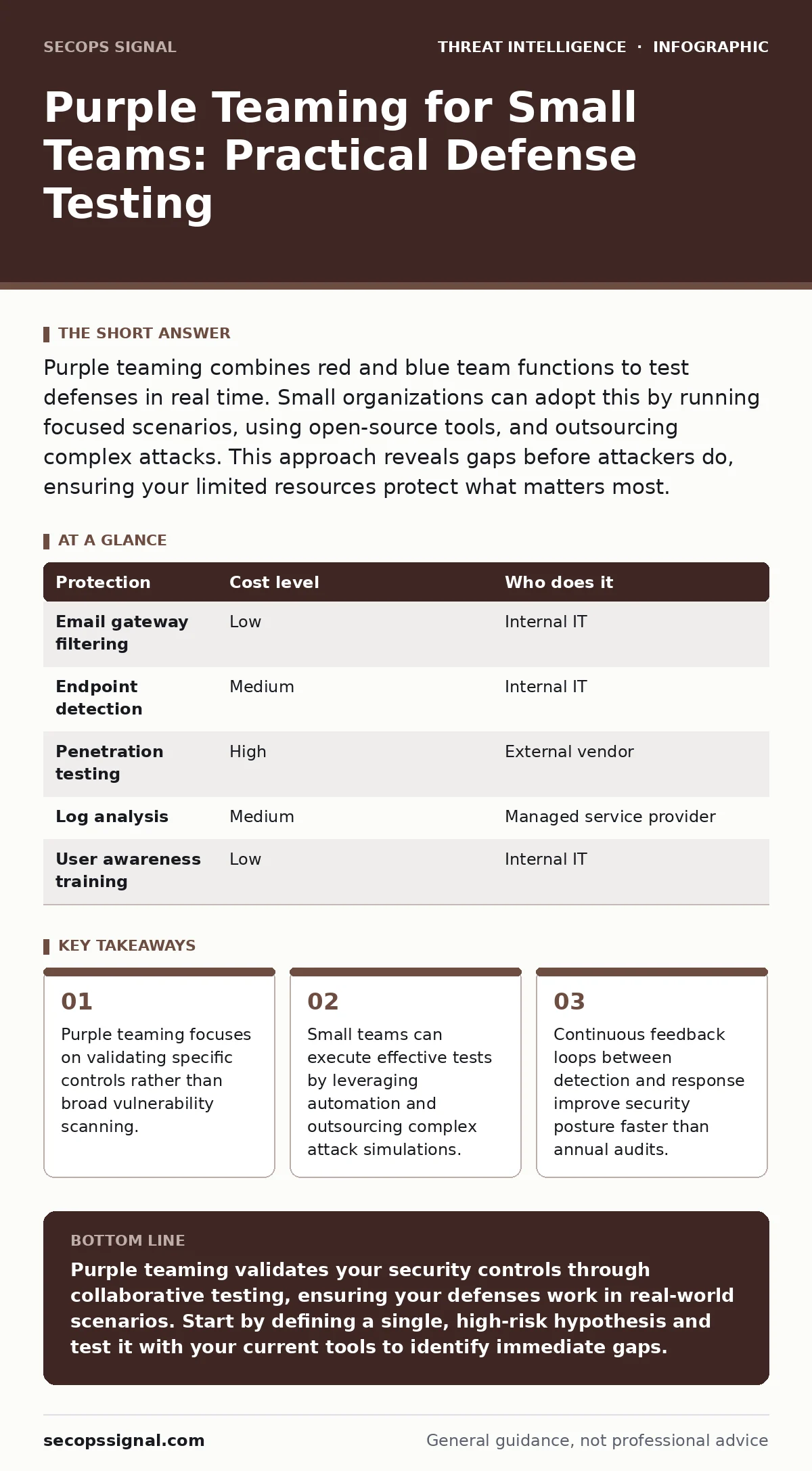
Purple teaming combines red and blue team functions to test defenses in real time. Small organizations can adopt this by running focused scenarios, using open-source tools, and outsourcing complex attacks. This approach reveals gaps before attackers do, ensuring your limited resources protect what matters most.
Moving Beyond Siloed Security
Traditional security often separates offense from defense. Red teams simulate attacks to find weaknesses, while blue teams monitor and respond to threats. These groups rarely interact during the process. Purple teaming merges these activities into a collaborative cycle. The goal is not just to find vulnerabilities but to verify that your detection and response mechanisms work as intended.
For smaller organizations, this integration is practical. You likely lack the staff to maintain separate red and blue teams. By combining these roles, you maximize the value of every security hour. You test a hypothesis, measure the result, and adjust your controls immediately. This iterative process prevents security from becoming a static checklist.
Why Scale Changes the Approach
Large enterprises often use purple teaming to satisfy compliance requirements or map to the MITRE ATT&CK framework. This framework catalogs known adversary tactics and techniques. Small teams should use it differently. You cannot test every technique. You must prioritize based on your specific risk profile.
Consider what an attacker gains from your environment. If you hold financial records, data exfiltration is your primary concern. If you provide remote services, remote desktop abuse is a likely entry point. Focus your purple team exercises on these high-value targets. This targeted approach ensures you are testing the defenses that actually matter to your business continuity.
| Protection | Cost level | Who does it |
|---|---|---|
| Email gateway filtering | Low | Internal IT |
| Endpoint detection | Medium | Internal IT |
| Penetration testing | High | External vendor |
| Log analysis | Medium | Managed service provider |
| User awareness training | Low | Internal IT |
Affordable Methods for Validation
You do not need expensive commercial platforms to practice purple teaming. Start with open-source tools and internal knowledge. Define a clear objective for each test. For example, you might want to verify that your firewall blocks unauthorized outbound connections.
Use indicators of attack to structure your tests. These are observable events that suggest malicious activity. If your firewall should block traffic to known malicious domains, simulate that traffic. Check if your SIEM (Security Information and Event Management) system generates an alert. If it does not, you have identified a gap in your detection logic. This method is repeatable and requires minimal financial investment.
What to Delegate to Experts
Some aspects of purple teaming require specialized skills. Simulating advanced persistence mechanisms or evading modern endpoint protection is complex. Attempting these tests without expertise can lead to false negatives or system instability.
Delegate these high-complexity tasks to external security consultants. They can perform digital forensics and incident response simulations to test your recovery procedures. Ensure they follow a strict scope of work. Define exactly which systems they can touch and which data they can access. This protects your operations while providing a realistic assessment of your resilience.
Integrating with Daily Operations
Purple teaming should not be a separate, disruptive event. Integrate it into your regular maintenance windows. Schedule tests during low-activity periods to minimize impact on users. This approach reduces the risk of accidental service disruption.
Use log management best practices to support your tests. Ensure that all relevant events are being collected and stored. If your logs are incomplete, you cannot accurately assess your detection capabilities. Regularly review log retention policies to ensure you have enough historical data for analysis. This foundation is necessary for any meaningful security testing.
See also: How Tactical Threat Intelligence Works: From Data to Defense
Questions for IT Providers
When outsourcing parts of your purple teaming efforts, you must ask the right questions. Vague proposals lead to vague results. You need to understand the methodology and the expected outcomes.
- Does the provider use a framework like MITRE ATT&CK to structure their tests?
- How do they measure the success of a detection rule?
- Can they provide a report that maps findings to specific remediation steps?
- Do they collaborate with your internal team during the test to share insights in real time?
- How do they handle false positives during their simulations?
Building a Feedback Loop
The value of purple teaming lies in the feedback. After each test, hold a brief review session. Discuss what worked and what failed. Identify any gaps in your detection or response procedures. Update your security policies based on these findings.
This continuous improvement cycle makes your security posture more resilient over time. You are not just fixing a single vulnerability; you are improving your ability to detect and respond to new threats. This adaptability is your strongest defense against evolving attack methods.
Key takeaways
- Purple teaming focuses on validating specific controls rather than broad vulnerability scanning.
- Small teams can execute effective tests by leveraging automation and outsourcing complex attack simulations.
- Continuous feedback loops between detection and response improve security posture faster than annual audits.
Purple teaming validates your security controls through collaborative testing, ensuring your defenses work in real-world scenarios. Start by defining a single, high-risk hypothesis and test it with your current tools to identify immediate gaps.
Frequently asked questions
How often should a small team perform purple teaming exercises?
Aim for quarterly tests focused on different attack vectors. This frequency balances resource constraints with the need for regular validation of your security controls.
Can I use free tools for purple teaming?
Yes, many open-source tools can simulate common attacks. Focus on tools that match your specific infrastructure and the threats you are most likely to face.
What is the difference between purple teaming and penetration testing?
Penetration testing is a one-time assessment by external experts. Purple teaming is an ongoing, collaborative process that involves your internal team to improve detection and response capabilities continuously.
How do I measure the success of a purple team exercise?
Success is measured by whether your detection systems identified the simulated attack and whether your response procedures were executed correctly and efficiently.
How this guide was produced: written by the SecOps Signal editorial team with AI assistance, checked against the public references listed below, and reviewed when the facts change. See our editorial policy or report an error.