Honeytokens Best Practices: Detecting Silent Intrusions Early
Honeytokens act as silent tripwires within your data stores, triggering alerts when accessed by unauthorized accounts that bypass perimeter defenses.

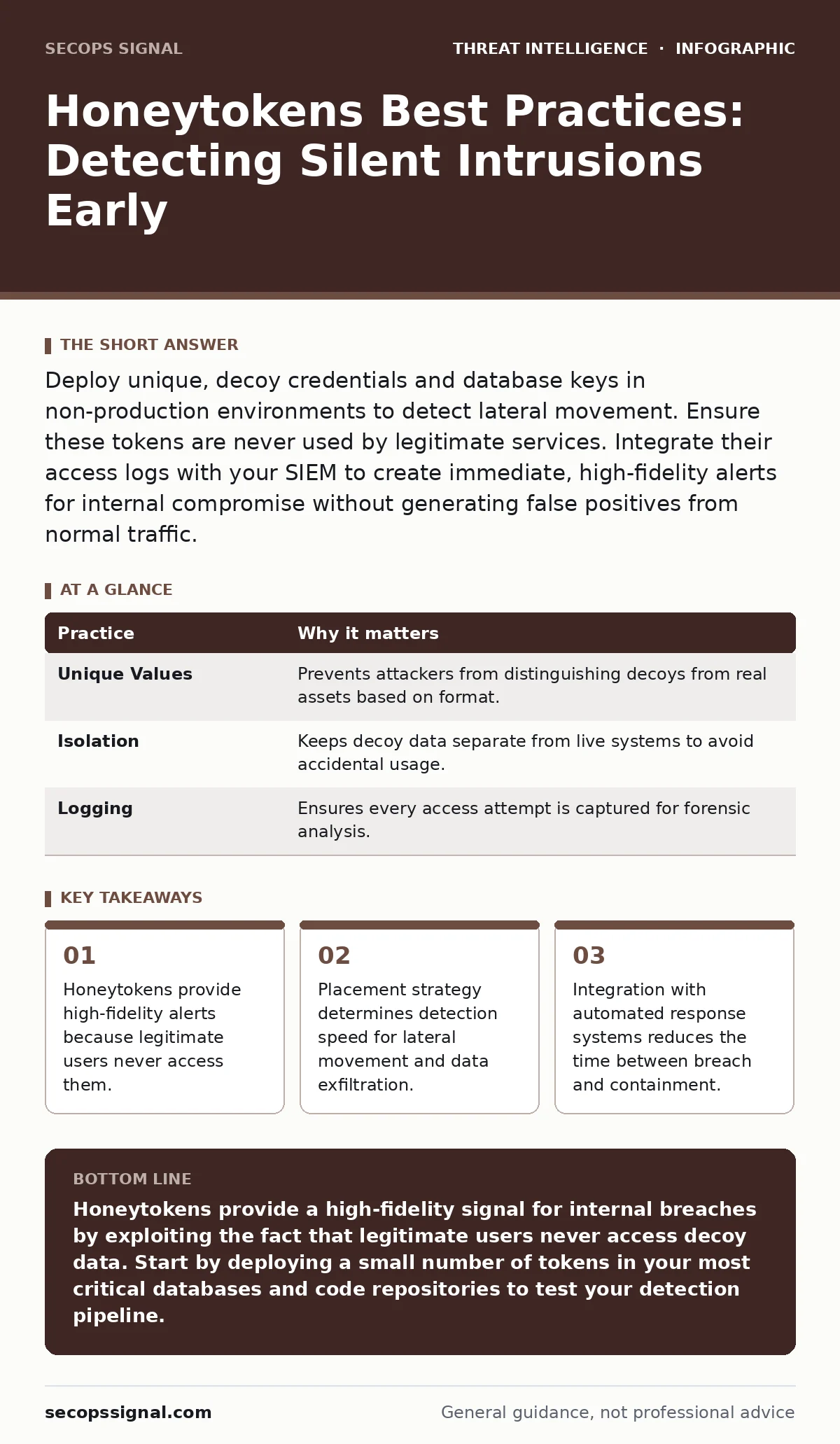
Deploy unique, decoy credentials and database keys in non-production environments to detect lateral movement. Ensure these tokens are never used by legitimate services. Integrate their access logs with your SIEM to create immediate, high-fidelity alerts for internal compromise without generating false positives from normal traffic.
The Mechanics of Silent Detection
Honeytokens are decoy data elements placed in your infrastructure to detect unauthorized access. Unlike honeypots, which are entire systems designed to attract attackers, honeytokens are small, lightweight artifacts. They can be fake API keys, dummy database rows, or fabricated credentials. The core mechanism is simple: if anyone accesses a honeytoken, it is an adversary. Legitimate processes and users have no reason to interact with these objects.
This approach shifts detection from the perimeter to the interior of your network. Perimeter defenses often fail against compromised credentials or insider threats. By placing detection points inside your data stores, you catch attackers who have already breached the outer layers. This method complements existing log management strategies by providing a signal that is impossible to ignore.
1. Use Unique, Randomly Generated Values
Every honeytoken must have a unique identifier that does not resemble real data. If you use predictable values, attackers may recognize them as decoys and ignore them. Randomness ensures that the token stands out in logs and does not match any legitimate data pattern. You should generate these values using cryptographically secure random number generators.
Tip: Create a separate database table or configuration file solely for storing honeytoken values. This isolation prevents accidental mixing with production data and simplifies rotation procedures when you need to update your decoys.
| Practice | Why it matters |
|---|---|
| Unique Values | Prevents attackers from distinguishing decoys from real assets based on format. |
| Isolation | Keeps decoy data separate from live systems to avoid accidental usage. |
| Logging | Ensures every access attempt is captured for forensic analysis. |
2. Embed Tokens in Non-Production Code Repositories
Attackers frequently search code repositories for hardcoded credentials, API keys, or database connection strings. These repositories are often less protected than production systems. Placing honeytokens in version control systems like Git allows you to detect when an attacker is mining for secrets. If a token is accessed or committed, you know an unauthorized actor is present.
Tip: Add honeytokens to public-facing or internal-only repositories that contain historical code. Do not place them in active development branches where legitimate developers might accidentally trigger the alert during routine commits.
3. Place Decoys in Database Tables
Databases are prime targets for exfiltration. Attackers often query tables looking for sensitive information such as email addresses, financial records, or personal identifiers. Inserting honeytokens into these tables creates a trap. When an attacker runs a query that returns the decoy data, the database logs the access. This provides precise timing and context for the breach.
Tip: Use a stored procedure or a trigger to log the access of the honeytoken row. This ensures that even if the attacker only reads the data without modifying it, the event is recorded and sent to your monitoring system.
4. Create Fake Service Accounts
Service accounts are used by applications to access resources. Attackers often compromise these accounts to move laterally across the network. Creating fake service accounts with honeytoken passwords allows you to detect when an attacker is testing credentials or attempting to escalate privileges. These accounts should have no real permissions but should appear legitimate in directory listings.
Tip: Disable these accounts in your identity management system but leave them visible in directory searches. This ensures they do not interfere with legitimate authentication flows while remaining visible to attackers scanning for targets.
See also: Deception Technology Explained: How Fake Assets Trap Attackers · Indicators of Attack Explained: Why Behavior Beats Artifacts
5. Integrate Alerts with SIEM Systems
Detecting an access attempt is useless if you do not know about it. You must integrate honeytoken logs with your SIEM (Security Information and Event Management) platform. This allows you to correlate honeytoken triggers with other security events. For example, a honeytoken access followed by a large data transfer indicates active exfiltration.
Tip: Create a dedicated rule in your SIEM for honeytoken alerts. Set the severity to critical and ensure it bypasses standard noise filters. This guarantees that security teams see the alert immediately without digging through irrelevant logs.
6. Automate Response with SOAR
Speed is critical when an internal breach is detected. Manual response introduces delays that allow attackers to expand their foothold. Using SOAR (Security Orchestration, Automation, and Response) platforms, you can automate initial containment steps. When a honeytoken is triggered, the system can automatically disable the associated account or block the source IP address.
Tip: Start with low-risk automated actions, such as isolating the affected host or sending an immediate page to the security team. Avoid destructive actions like deleting data until a human analyst has verified the incident.
7. Rotate Tokens Regularly
Attackers who discover a honeytoken may note its value and ignore it in the future. They might also try to mimic the token to blend in with legitimate traffic. Rotating your honeytokens ensures that old decoys are no longer valid. This forces attackers to find new targets and resets the detection baseline.
Tip: Establish a quarterly rotation schedule. Update the values in your database, code repositories, and directory listings simultaneously. Ensure your SIEM rules are updated to recognize the new values.
8. Validate with Purple Teaming
Your detection strategy is only as good as your testing. Purple teaming involves collaboration between offensive and defensive teams to improve security posture. Use controlled tests to verify that your honeytokens are triggering alerts correctly. This helps identify gaps in your logging or integration logic.
Tip: Schedule regular drills where the offensive team attempts to access honeytokens in a controlled manner. Review the resulting logs to ensure the signal was clear, timely, and actionable. This practice aligns with broader digital forensics and incident response planning.
9. Document and Train Your Team
Even the best technical controls fail if the team does not understand them. Document the location and purpose of each honeytoken. Train your security analysts on how to interpret honeytoken alerts. They need to know that these alerts indicate a confirmed breach, not a potential threat.
Tip: Include honeytoken procedures in your incident response playbook. Specify the exact steps to take when an alert is received, from initial verification to containment and recovery. This reduces decision time during a real incident.
Key takeaways
- Honeytokens provide high-fidelity alerts because legitimate users never access them.
- Placement strategy determines detection speed for lateral movement and data exfiltration.
- Integration with automated response systems reduces the time between breach and containment.
Honeytokens provide a high-fidelity signal for internal breaches by exploiting the fact that legitimate users never access decoy data. Start by deploying a small number of tokens in your most critical databases and code repositories to test your detection pipeline.
Frequently asked questions
Do honeytokens work against insider threats?
Yes, because insiders must also interact with the system to access data. If an insider queries a database containing a honeytoken, the access is logged and alerted, regardless of their authorized status.
Can attackers easily detect honeytokens?
Sophisticated attackers may look for anomalies, but if the tokens are well-integrated and random, they are difficult to distinguish from real data. Regular rotation and realistic placement reduce the risk of detection by the adversary.
How many honeytokens should I deploy?
Start with a small, manageable number to validate your detection and response processes. Once you have confidence in your pipeline, expand the deployment to cover more assets. Quality of integration matters more than quantity.
Do honeytokens replace other security controls?
No, they are a detection layer that complements perimeter defenses, access controls, and monitoring. They do not prevent breaches but significantly reduce the time to detect them, which is critical for limiting damage.
How this guide was produced: written by the SecOps Signal editorial team with AI assistance, checked against the public references listed below, and reviewed when the facts change. See our editorial policy or report an error.