Shadow IT Definition: How to Find Hidden Cloud Risks
Unapproved software expands your attack surface by bypassing security controls and creating data silos that compliance frameworks cannot audit or protect.

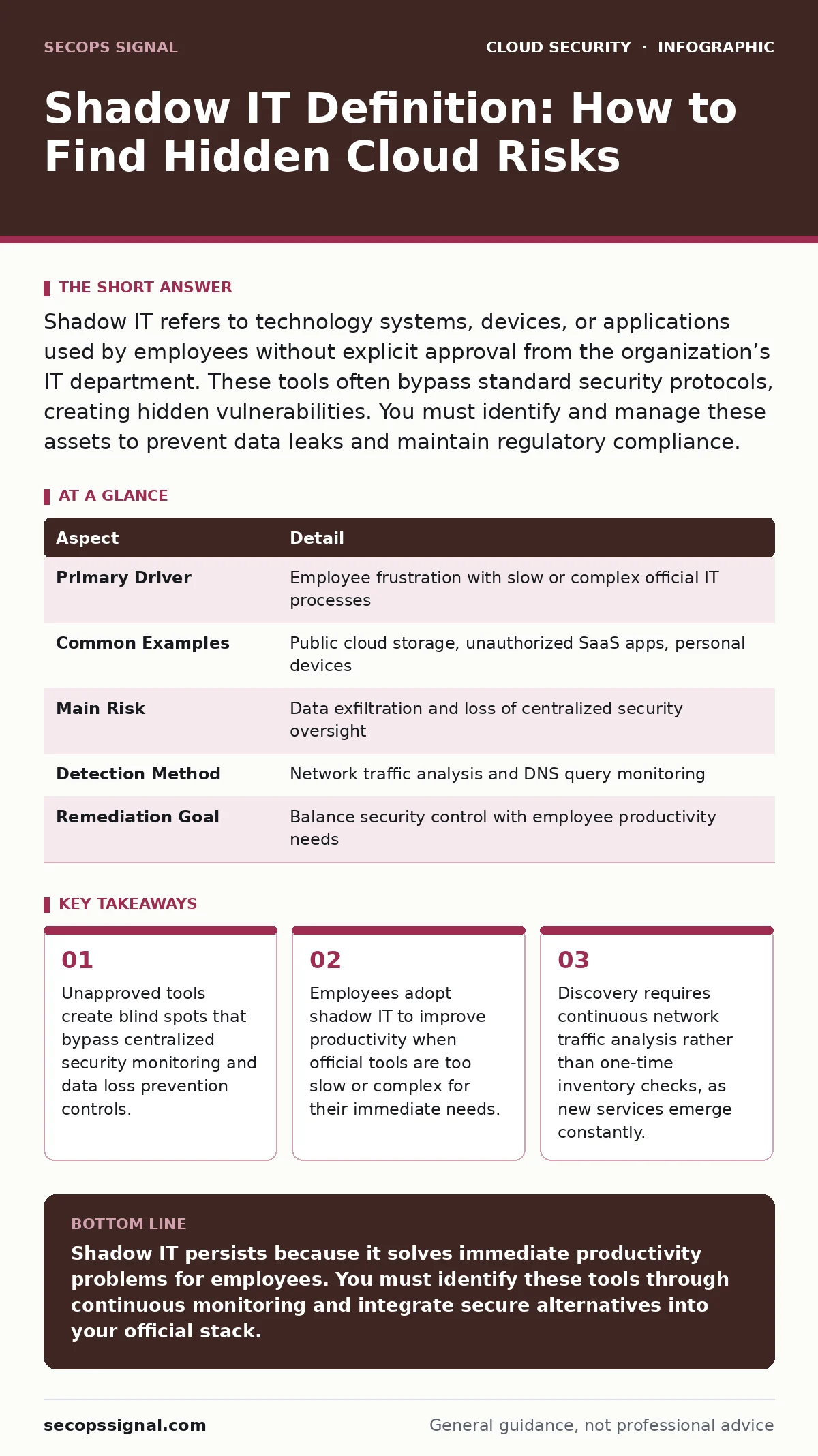
Shadow IT refers to technology systems, devices, or applications used by employees without explicit approval from the organization’s IT department. These tools often bypass standard security protocols, creating hidden vulnerabilities. You must identify and manage these assets to prevent data leaks and maintain regulatory compliance.
The Definition of Shadow IT
Imagine a team sharing sensitive customer records via a free file-hosting service because the corporate server is slow. That service is shadow IT. Shadow IT definition covers any hardware, software, or service that employees use without IT department knowledge or approval. This includes cloud storage, communication apps, and development tools. These assets operate outside the organization’s security perimeter. They bypass firewalls, endpoint detection, and access controls. The risk stems from lack of visibility, not necessarily malicious intent.
| Aspect | Detail |
|---|---|
| Primary Driver | Employee frustration with slow or complex official IT processes |
| Common Examples | Public cloud storage, unauthorized SaaS apps, personal devices |
| Main Risk | Data exfiltration and loss of centralized security oversight |
| Detection Method | Network traffic analysis and DNS query monitoring |
| Remediation Goal | Balance security control with employee productivity needs |
How Shadow IT Emerges
Employees prioritize task completion over security policy. When official tools require 3 steps to accomplish a task, and a free app requires 1 step, the free app wins. This dynamic creates a shadow infrastructure. The cloud accelerates this trend. Services require only an email address to start. No IT ticket is needed. No procurement review occurs. The employee gains immediate utility. The IT team remains unaware. This gap widens as remote work becomes standard. Physical access controls no longer restrict what software installs on a device. The boundary between personal and professional computing blurs.
The Hidden Costs of Unmanaged Tools
The immediate benefit of shadow IT is speed. The long-term cost is risk exposure. Unmanaged tools store data in locations you cannot control. They may share data with third parties for advertising. They may lack encryption at rest. You lose the ability to enforce data retention policies. Legal teams cannot guarantee compliance with privacy laws. Security teams cannot monitor for breaches. The organization becomes liable for data mishandling. Remediation costs rise when you must migrate data later. Downtime increases when dependencies on unknown tools break.
What People Usually Get Wrong
Many organizations believe banning unauthorized software solves the problem. This approach fails. Employees find workarounds. They use personal devices or mobile data to bypass blocks. This makes detection harder. Shadow IT moves to encrypted channels. The real issue is not the tool itself. It is the lack of process. IT departments often create friction. They require long approval cycles. They impose complex security steps. Friction drives users to shadow IT. The solution involves streamlining official processes. It involves providing secure, easy-to-use alternatives. You must meet users where they are.
Another common mistake is assuming shadow IT is only cloud-based. It includes local software installations. It includes USB drives. It includes personal laptops connected to the network. The scope is broad. Any unmanaged device or application counts. Treating it as only a cloud issue leaves gaps. You must monitor all entry points. You must define clear boundaries.
Identifying the Invisible Assets
Discovery requires active monitoring. You cannot rely on asset tags. You must analyze network traffic. Look for unusual DNS queries. Look for connections to unknown IP ranges. Look for data uploads to non-corporate domains. This traffic analysis reveals patterns. It shows which services are popular. It shows where data flows. Implement cloud compliance frameworks to set baselines. Use these baselines to flag deviations. Regular audits help. But audits are snapshots. Continuous monitoring is required. The landscape changes daily. New services launch constantly. Old services change APIs. Your detection must adapt.
See also: Cloud Security Examples: How Security Groups Enforce Zero Trust · Bot Management Mistakes That Expose Your Cloud Infrastructure
Managing Risk Without Stifling Work
You cannot eliminate all shadow IT. The goal is risk reduction. Start by categorizing tools. Some tools pose high risk. They handle sensitive data. Others pose low risk. They handle public information. Apply different controls to each category. For high-risk tools, enforce strict access. Integrate with federated identity systems. This ensures single sign-on and audit trails. It allows you to revoke access instantly. For low-risk tools, provide guidance. Educate users on safe practices. Allow limited use. This approach balances security with agility.
Infrastructure-as-code misconfigurations often compound shadow IT risks. Developers may deploy resources without security settings. These resources become part of the shadow estate. You must scan for these errors. You must enforce policies at deployment time. This prevents misconfigurations from becoming permanent. It keeps the environment tidy. It reduces the attack surface.
Building a Sustainable Strategy
A sustainable strategy involves collaboration. IT must work with business units. Understand their needs. Provide solutions that meet those needs securely. If a tool is popular, evaluate it formally. If it is secure, onboard it. If it is not, find a secure alternative. Communicate clearly. Explain why certain tools are blocked. Explain the risks. Users are more likely to comply if they understand the reason.
Just-in-time access helps manage privileged accounts. It limits exposure. It ensures access is granted only when needed. This reduces the chance of credential theft. Secrets in source code must be managed carefully. Hardcoded credentials in shadow apps are a major risk. Scan repositories regularly. Rotate credentials frequently. This limits the damage if a secret is exposed.
Container image scanning is another control. It ensures deployed images are secure. It prevents vulnerable software from running. This is critical for development teams. They often use diverse tools. Scanning catches issues early. It stops problems before they reach production.
The Role of Technology in Control
Technology aids control but does not replace policy. Security information and event management systems collect logs. They correlate events. They alert on anomalies. These systems must be tuned. False positives cause alert fatigue. False negatives miss threats. You must balance sensitivity with accuracy.
Bot management can help. It distinguishes human traffic from automated traffic. This helps identify unauthorized scripts. It helps protect APIs. It reduces noise. It allows security teams to focus on real threats.
Cloud network segmentation limits lateral movement. If one service is compromised, the attacker cannot move freely. Segmentation contains the blast radius. It protects other parts of the network. This is vital for cloud environments. They are complex and dynamic. Segmentation must be automated. Manual rules become outdated quickly.
Key takeaways
- Unapproved tools create blind spots that bypass centralized security monitoring and data loss prevention controls.
- Employees adopt shadow IT to improve productivity when official tools are too slow or complex for their immediate needs.
- Discovery requires continuous network traffic analysis rather than one-time inventory checks, as new services emerge constantly.
Shadow IT persists because it solves immediate productivity problems for employees. You must identify these tools through continuous monitoring and integrate secure alternatives into your official stack.
Frequently asked questions
How do I find shadow IT in my organization?
Monitor network traffic for unusual DNS queries and data transfers to unknown cloud domains. Use security information and event management systems to detect anomalies in user behavior and application usage.
Is all shadow IT a security risk?
Not all shadow IT is equally risky, but all of it lacks oversight. Tools handling public data pose less risk than those storing sensitive customer or financial information, but both bypass security controls.
Should I block all unauthorized apps?
Blocking creates friction and drives usage to harder-to-detect channels. Instead, evaluate popular unauthorized tools for security compliance and onboard safe ones, while blocking only those with critical vulnerabilities.
How does cloud compliance relate to shadow IT?
Cloud compliance frameworks require visibility into all data storage. Shadow IT creates data silos outside your control, making it impossible to prove compliance or protect against regulatory breaches.
How this guide was produced: written by the SecOps Signal editorial team with AI assistance, checked against the public references listed below, and reviewed when the facts change. See our editorial policy or report an error.