Bot Management Mistakes That Expose Your Cloud Infrastructure
Treating all automated traffic as uniform noise creates blind spots that allow credential stuffing and resource exhaustion attacks to bypass standard perimeter defenses.

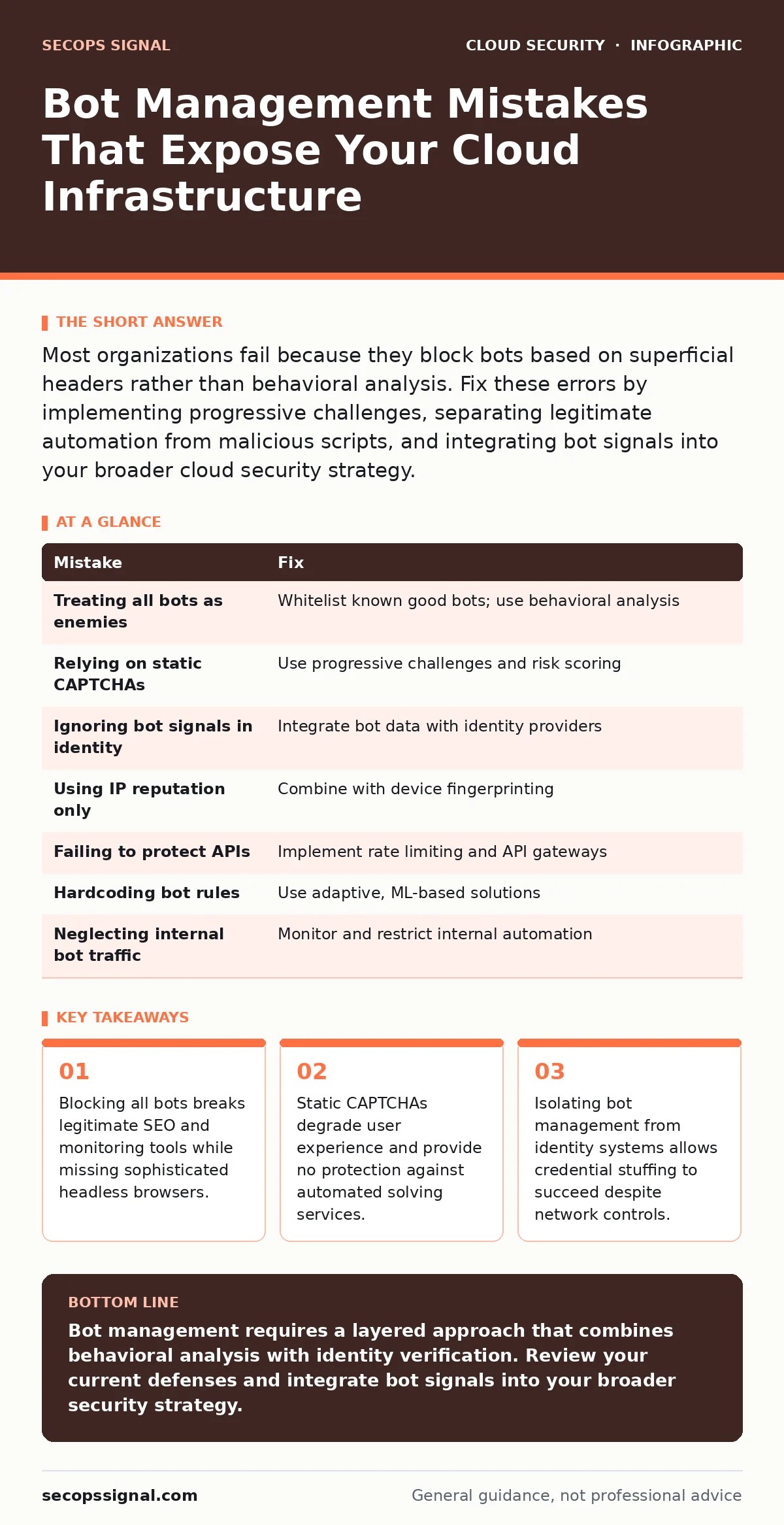
Most organizations fail because they block bots based on superficial headers rather than behavioral analysis. Fix these errors by implementing progressive challenges, separating legitimate automation from malicious scripts, and integrating bot signals into your broader cloud security strategy.
Mistake 1: Treating All Bots as Identical Enemies
You likely assume that any non-human traffic is a threat. This binary view is incorrect. Search engine crawlers, uptime monitors, and legitimate API consumers are bots. Blocking them disrupts business operations. Malicious bots mimic these legitimate agents. They use identical user-agent strings to hide. You must distinguish between helpful automation and harmful scripts.
Why it hurts:
Blocking legitimate bots causes revenue loss and operational blindness. Search engines cannot index your content, reducing visibility. Monitoring tools report false outages, wasting engineering time. Meanwhile, sophisticated attackers adapt their headers to match known good bots. They bypass your rules while you focus on noise. This creates a false sense of security.
The fix:
Maintain a whitelist of known good bot signatures. Verify these bots through challenge-response mechanisms that legitimate crawlers accept. Implement behavioral analysis for unknown agents. Look for mouse movements, keystroke dynamics, and navigation patterns. Real humans exhibit randomness. Scripts follow rigid paths. Use machine learning models to score this behavior. Integrate these signals with your cloud-native application protection platforms (CNAPP) for unified visibility.
Mistake 2: Relying Solely on Static CAPTCHAs
You place a visual puzzle on your login page. Users solve it. You believe you are safe. This approach is outdated. Automated solving services exist. They use optical character recognition and machine learning to bypass static images. Users hate clicking on traffic lights. They abandon forms when frustrated. You increase friction without increasing security.
Why it hurts:
Static CAPTCHAs provide no defense against determined attackers. Solving services cost fractions of a cent per request. Attackers scale their operations easily. Your users face increased churn due to poor experience. You waste development time implementing and maintaining these puzzles. The security gain is negligible. The operational cost is high. You create a barrier that only affects your customers.
The fix:
Replace static CAPTCHAs with progressive challenges. Start with invisible risk scoring. Analyze IP reputation, device fingerprint, and behavior. Only present a challenge when risk is high. Use challenges that are difficult for machines but easy for humans. Consider reCAPTCHA alternatives that focus on interaction patterns. Ensure your federated identity systems share risk signals. If a user logs in via a trusted provider, skip the challenge.
Mistake 3: Ignoring Bot Signals in Identity Verification
You treat bot detection and identity management as separate functions. This separation is dangerous. Bots often attempt credential stuffing. They use stolen credentials to gain access. Your bot manager blocks the traffic. Your identity system never sees the attempt. You miss the correlation. You cannot detect account takeover patterns. You leave your user base vulnerable.
Why it hurts:
Credential stuffing attacks succeed when identity systems operate in isolation. Bots rotate IP addresses and user agents. Your bot manager may flag suspicious behavior. But if that data does not reach your identity provider, the login succeeds. Attackers gain access to accounts. They steal data or make purchases. You face financial loss and reputational damage. The lack of integration creates a critical blind spot.
The fix:
Integrate bot management signals into your identity workflow. Pass risk scores from your bot manager to your identity provider. If a login attempt comes from a high-risk bot, require additional verification. Use just-in-time access principles. Grant temporary access only after successful verification. Monitor for impossible travel patterns. If a user logs in from two distant locations in minutes, block the session.
Mistake 4: Using IP Reputation as the Only Gate
You block traffic based on IP reputation lists. This method is insufficient. Attackers use residential proxies. These IPs belong to real users who rent their bandwidth. Your reputation check sees a clean IP. The traffic passes through. You are vulnerable to distributed attacks. You also block legitimate users who share IPs. Corporate networks and mobile carriers use shared addresses.
Why it hurts:
IP reputation lists are static and slow to update. Attackers pivot to clean IPs quickly. You cannot keep up. Blocking shared IPs harms legitimate users. They cannot access your services. You receive support tickets and complaints. Your reputation suffers. Meanwhile, attackers continue their operations from clean sources. You are fighting a losing battle with outdated tools.
The fix:
Combine IP reputation with device fingerprinting. Identify unique devices regardless of IP address. Track behavior across sessions. If a device exhibits bot-like behavior, block it even if the IP is clean. Use cloud network segmentation to isolate sensitive assets. Limit exposure to public-facing endpoints. Reduce the attack surface. Make it harder for attackers to reach critical resources.
Mistake 5: Failing to Protect API Endpoints
You focus on web pages. You neglect APIs. This is a critical error. APIs are the backbone of modern applications. They handle data exchange. Bots target APIs for scraping and abuse. They automate requests to extract data or perform actions. Your web protections do not cover API traffic. You leave your most valuable assets exposed.
Why it hurts:
API abuse leads to data leakage and resource exhaustion. Attackers scrape pricing data, user information, or intellectual property. They perform carding attacks on payment endpoints. Your infrastructure costs skyrocket due to excessive requests. You face compliance violations. Your customers lose trust. The damage is often silent. You may not notice until significant data is lost.
The fix:
Implement rate limiting and throttling on all API endpoints. Use API gateways to enforce policies. Validate all inputs strictly. Reject malformed requests immediately. Monitor for unusual patterns in API usage. Look for high-frequency requests from single devices. Integrate with ephemeral infrastructure to scale defenses dynamically. Block abusive traffic at the edge. Protect your core services from overload.
See also: Shadow IT Definition: How to Find Hidden Cloud Risks · Cloud Security Examples: How Security Groups Enforce Zero Trust
Mistake 6: Hardcoding Bot Rules Without Review
You set bot management rules and forget them. This is a recipe for failure. Bot tactics evolve constantly. Static rules become obsolete. You block legitimate traffic or miss new threats. You lack visibility into changing patterns. Your defenses are rigid and brittle. You cannot adapt to new attack vectors.
Why it hurts:
Hardcoded rules require manual updates. This is slow and error-prone. You miss emerging threats. You create false positives that block users. Your engineering team spends time on maintenance. They cannot focus on innovation. Your security posture degrades over time. You become a target for attackers who exploit your rigidity.
The fix:
Use adaptive bot management solutions. Leverage machine learning to detect new patterns automatically. Regularly review logs and analytics. Adjust thresholds based on observed behavior. Engage with industry communities to learn about new tactics. Integrate with misconfigured IAM roles checks to ensure proper permissions. Ensure your bot management system has the right access. But no more than necessary.
Mistake 7: Neglecting Internal Bot Traffic
You focus on external threats. You ignore internal bots. This is a blind spot. Internal scripts, CI/CD pipelines, and monitoring tools generate traffic. They may behave like bots. They may trigger false positives. Or worse, they may be compromised. They may act as a launchpad for attacks. You cannot distinguish internal automation from malicious activity.
Why it hurts:
Internal bot traffic can mask attacks. Attackers compromise internal scripts. They use them to move laterally. Your external defenses do not see this traffic. It looks legitimate. You fail to detect the breach. You lose control of your environment. The damage spreads quickly. Recovery is difficult and expensive.
The fix:
Implement strict controls on internal bot traffic. Use secrets in source code scanning to ensure credentials are secure. Monitor internal API usage. Set baselines for normal behavior. Alert on deviations. Use cloud security groups to restrict internal traffic. Ensure only authorized services can communicate. Verify the identity of internal bots. Prevent unauthorized access.
| Mistake | Fix |
|---|---|
| Treating all bots as enemies | Whitelist known good bots; use behavioral analysis |
| Relying on static CAPTCHAs | Use progressive challenges and risk scoring |
| Ignoring bot signals in identity | Integrate bot data with identity providers |
| Using IP reputation only | Combine with device fingerprinting |
| Failing to protect APIs | Implement rate limiting and API gateways |
| Hardcoding bot rules | Use adaptive, ML-based solutions |
| Neglecting internal bot traffic | Monitor and restrict internal automation |
Key takeaways
- Blocking all bots breaks legitimate SEO and monitoring tools while missing sophisticated headless browsers.
- Static CAPTCHAs degrade user experience and provide no protection against automated solving services.
- Isolating bot management from identity systems allows credential stuffing to succeed despite network controls.
Bot management requires a layered approach that combines behavioral analysis with identity verification. Review your current defenses and integrate bot signals into your broader security strategy.
Frequently asked questions
How do I distinguish between a good bot and a bad bot?
Use behavioral analysis to look for human-like patterns. Good bots often have known signatures and predictable behavior. Bad bots mimic humans but lack true randomness.
Is CAPTCHA enough to stop bots?
No. Static CAPTCHAs are easily bypassed by solving services. Use progressive challenges and risk-based authentication for better protection.
How often should I update my bot management rules?
Use adaptive solutions that update automatically. Manual updates are too slow. Regularly review logs to ensure your defenses remain effective.
Can internal bots be a security risk?
Yes. Compromised internal scripts can be used for lateral movement. Monitor internal traffic and restrict access to authorized services only.
How this guide was produced: written by the SecOps Signal editorial team with AI assistance, checked against the public references listed below, and reviewed when the facts change. See our editorial policy or report an error.