How Infrastructure-as-Code Misconfigurations Work Step by Step
Infrastructure-as-Code misconfigurations often hide in plain sight within version control, bypassing runtime defenses by embedding flawed logic directly into the deployment pipeline.

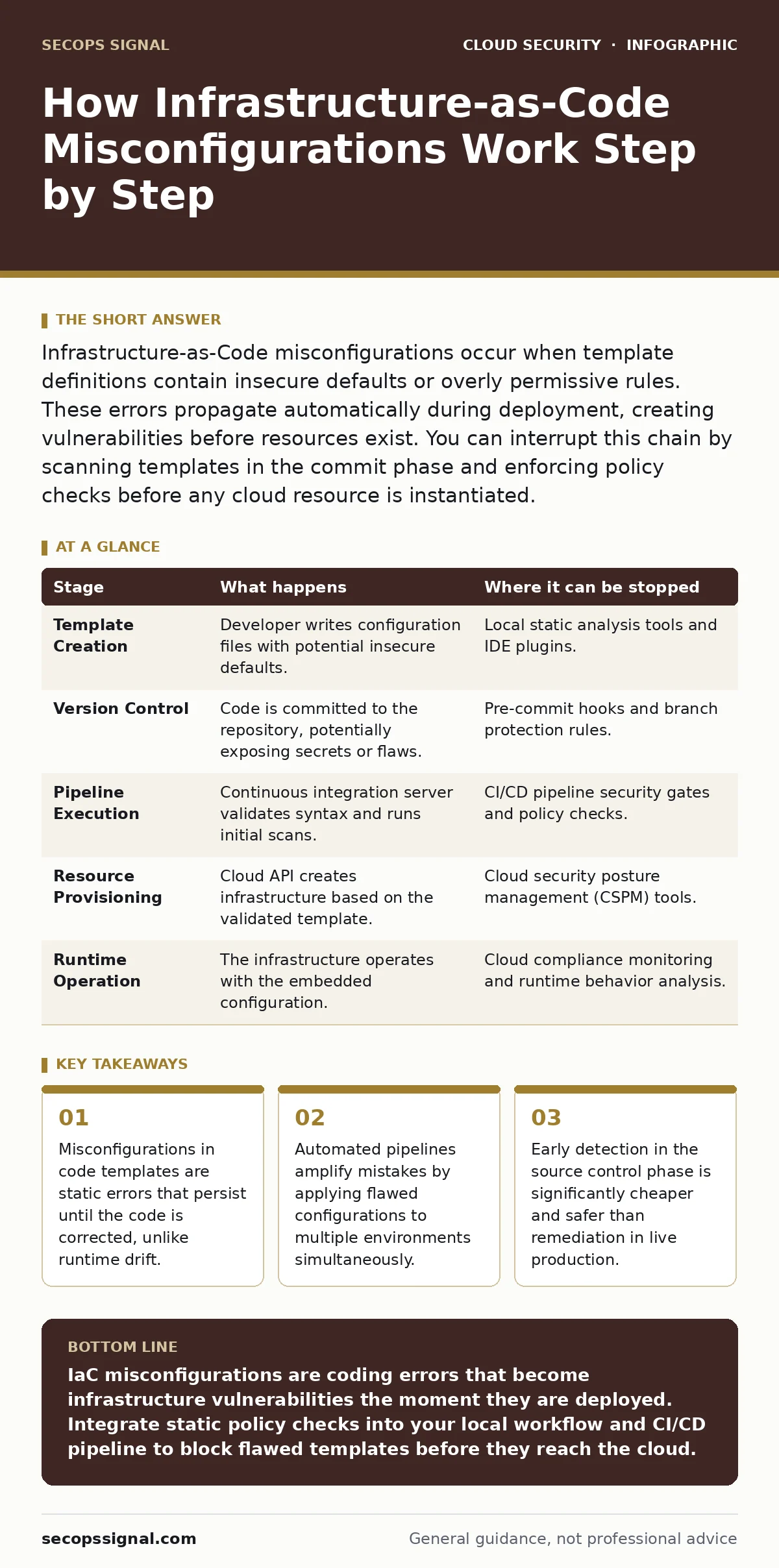
Infrastructure-as-Code misconfigurations occur when template definitions contain insecure defaults or overly permissive rules. These errors propagate automatically during deployment, creating vulnerabilities before resources exist. You can interrupt this chain by scanning templates in the commit phase and enforcing policy checks before any cloud resource is instantiated.
The Pipeline Amplification Effect
Infrastructure-as-Code (IaC) allows you to define cloud resources using human-readable files rather than clicking through a console. This approach promises consistency and speed. It also introduces a specific risk profile. When you define a security group or a storage bucket in code, you are writing logic. If that logic contains an error, the cloud provider executes it exactly as written. The danger is not the tool, but the assumption that the template is correct.
Imagine a developer copies a public example of a database configuration to save time. The example defaults to allowing connections from any IP address. The developer does not notice this because the code looks syntactically correct. When the pipeline runs, it creates a database accessible to the entire internet. This is not a hack; it is a direct result of the code you wrote. The automation that makes IaC powerful also makes it dangerous. It removes the human pause that might catch a mistake in a manual console setup.
| Stage | What happens | Where it can be stopped |
|---|---|---|
| Template Creation | Developer writes configuration files with potential insecure defaults. | Local static analysis tools and IDE plugins. |
| Version Control | Code is committed to the repository, potentially exposing secrets or flaws. | Pre-commit hooks and branch protection rules. |
| Pipeline Execution | Continuous integration server validates syntax and runs initial scans. | CI/CD pipeline security gates and policy checks. |
| Resource Provisioning | Cloud API creates infrastructure based on the validated template. | Cloud security posture management (CSPM) tools. |
| Runtime Operation | The infrastructure operates with the embedded configuration. | Cloud compliance monitoring and runtime behavior analysis. |
Stage 1: The Silent Default in Local Development
The first stage occurs on the developer’s local machine. You write a template for a web server. You specify the operating system, the installed packages, and the network rules. Many IaC frameworks provide default values for parameters you do not explicitly set. These defaults are often designed for convenience, not security. For example, a storage object might default to private access, but a network interface might default to public routing if not specified.
You rely on your memory or a quick glance at documentation to set these values. This is where the first flaw enters. You might forget to disable public access on a database port. You might leave a debug endpoint enabled. These are not complex exploits. They are simple oversights. The code runs locally without error because the syntax is valid. The security flaw is semantic, not syntactic. It looks correct to the parser but is dangerous in practice.
Stage 2: Committing the Flaw to Version Control
Once the code is written, it is committed to a version control system. This step is critical because the repository becomes the single source of truth. If the flaw is in the repository, it is preserved in history. Anyone with access to the repository can see the misconfiguration. This includes attackers who may have gained read-only access to your code base.
This stage also introduces the risk of secrets in source code. You might embed an API key or a password directly into the IaC template to make it work. This is a common mistake. It happens because you want the deployment to succeed on the first try. You treat the template as a script rather than a definition. The secret is now part of the immutable history of your project. Even if you delete it later, it remains in the commit history. This creates a permanent exposure vector.
Stage 3: The Pipeline Validation Gap
The continuous integration pipeline picks up the change. It checks for syntax errors. It might run a basic linting tool. These tools ensure the code is well-formed. They rarely check for security implications. The pipeline assumes that if the code compiles or parses, it is safe to proceed. This is a false assumption. Security is not about syntax; it is about intent and effect.
Imagine the pipeline runs a standard test suite. The tests pass because the application logic works. The security flaw in the infrastructure definition is invisible to the application tests. The pipeline then triggers the deployment. The automation treats the flawed template as a valid instruction set. It sends the request to the cloud provider’s API. The provider accepts the request because it is technically valid. The gate that should have stopped this was a policy check, not a syntax check.
Stage 4: Provisioning the Vulnerable Resource
The cloud provider receives the API call. It creates the resources defined in the template. This happens in seconds. The database is created with public access. The server is launched with an open port. The storage bucket is exposed. This stage is where the theoretical flaw becomes a real-world vulnerability. The resource exists on the internet. It is reachable. It is waiting for input.
You might think that the cloud provider’s security controls will catch this. They generally do not. The provider trusts your configuration. They assume you know what you are building. This is the principle of shared responsibility. You are responsible for the configuration; the provider is responsible for the platform. If you configure a firewall to allow all traffic, the provider allows all traffic. The speed of provisioning means the window between creation and exploitation is tiny. Automated scanners on the internet are constantly looking for new resources with known misconfigurations.
See also: 7 Code Repository Mistakes That Leak Secrets · Shadow IT Definition: How to Find Hidden Cloud Risks
Stage 5: Runtime Exposure and Exploitation
The resource is now live. Attackers scan for open ports and public endpoints. They find your database. They connect to it. They exfiltrate data. This happens without any password guessing or complex exploit. The door was left open by the code. The attacker relied on your mistake. They did not break in; they walked in.
This stage highlights the difference between traditional security and IaC security. In traditional security, you patch a server after a vulnerability is found. In IaC, the vulnerability is baked into the foundation. You cannot patch the template without redeploying the entire environment. This is where immutable infrastructure concepts become relevant. You destroy the flawed resource and replace it with a corrected one. This process takes time. During that time, the exposure exists.
Interrupting the Chain Early
You can interrupt this chain at several points. The most effective point is Stage 1. Use static analysis tools that understand IaC syntax. These tools check for known bad patterns. They flag public access, missing encryption, and overly permissive roles. Run these tools locally before you commit. This catches the error when it is cheap to fix.
The second point is Stage 3. Integrate these same tools into your pipeline. Make the scan a mandatory gate. If the scan fails, the deployment stops. This prevents flawed code from reaching the cloud. You must treat security scans like unit tests. They are not optional. They are part of the definition of done.
The Hidden Cost of Drift
Even with perfect initial configuration, drift occurs. Someone manually changes a setting in the console. The code and the reality no longer match. The code says the port is closed. The console shows it is open. This is a misconfiguration that IaC cannot see because it only reads the file, not the live state. This is why cloud security posture management (CSPM) is necessary. It compares the live state to the desired state defined in code. It alerts you when they diverge.
You must also consider misconfigured IAM roles. If the role that deploys the code has too much power, it can create resources that violate policy. Even if the template is correct, the identity running it might be flawed. This is a separate vector. It requires least-privilege access and just-in-time access controls. The deployment identity should only have permission to create what is explicitly defined.
Key takeaways
- Misconfigurations in code templates are static errors that persist until the code is corrected, unlike runtime drift.
- Automated pipelines amplify mistakes by applying flawed configurations to multiple environments simultaneously.
- Early detection in the source control phase is significantly cheaper and safer than remediation in live production.
IaC misconfigurations are coding errors that become infrastructure vulnerabilities the moment they are deployed. Integrate static policy checks into your local workflow and CI/CD pipeline to block flawed templates before they reach the cloud.
Frequently asked questions
Can I fix IaC misconfigurations without redeploying?
You can sometimes patch live resources, but this creates configuration drift. The best practice is to update the code and redeploy the resource to ensure consistency.
Do cloud providers scan my IaC templates for security?
Providers scan for platform-level vulnerabilities, but they generally do not audit your specific configuration logic for security best practices. You are responsible for your template’s security.
How do I prevent secrets from ending up in my IaC code?
Use external secret management systems. Reference the secret by its name or ID in the code, but never store the actual value in the template files.
Is static analysis enough to secure IaC?
Static analysis catches template errors. It does not catch runtime drift or identity misconfigurations. You need a combination of static scanning, runtime monitoring, and identity management.
How this guide was produced: written by the SecOps Signal editorial team with AI assistance, checked against the public references listed below, and reviewed when the facts change. See our editorial policy or report an error.