Secrets in Source Code: How Accidental Exposure Happens and Fixes That Work
Hardcoded credentials in public repositories remain a persistent risk because automated scanners often miss context-specific tokens that appear valid to the system.

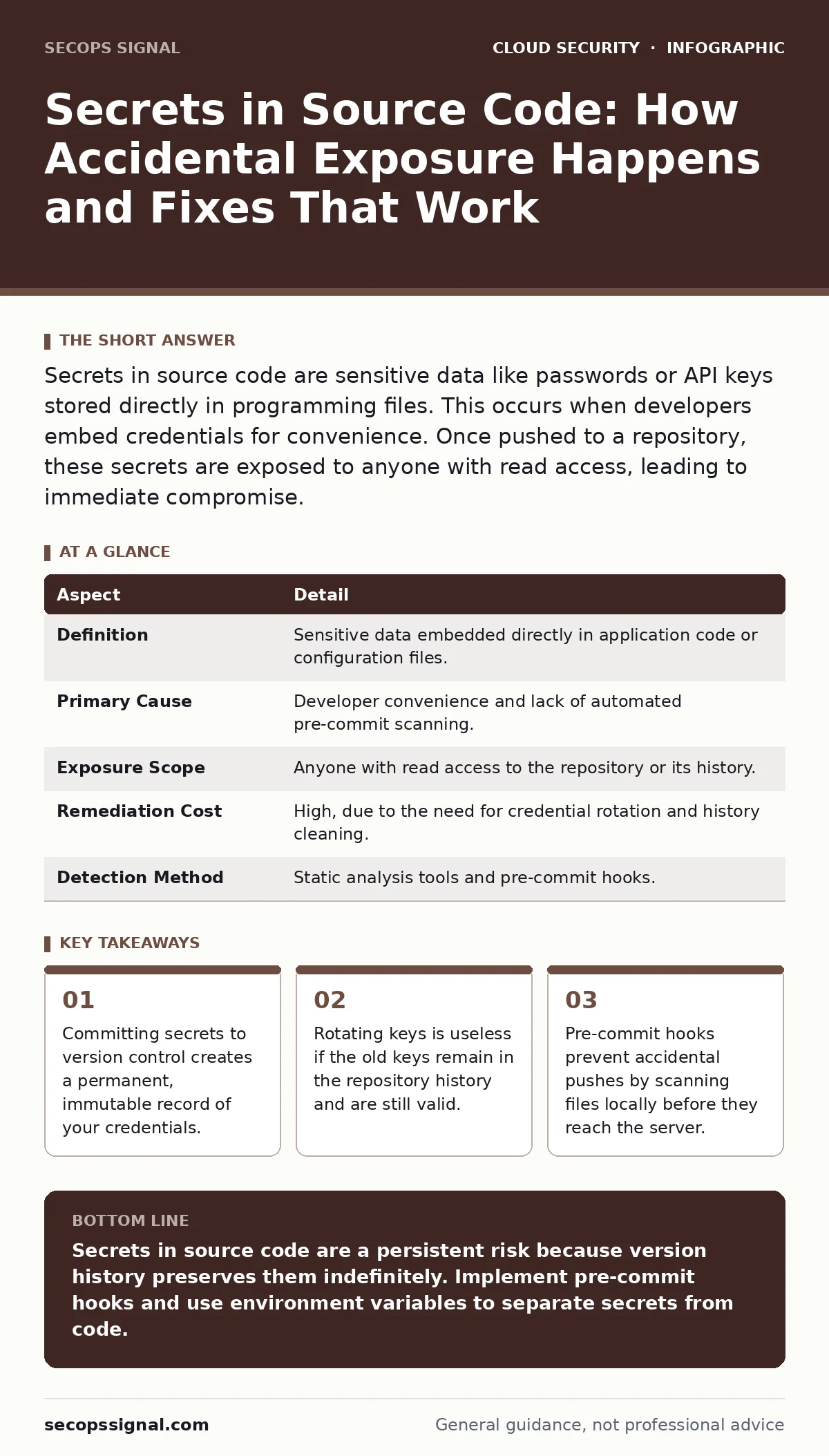
Secrets in source code are sensitive data like passwords or API keys stored directly in programming files. This occurs when developers embed credentials for convenience. Once pushed to a repository, these secrets are exposed to anyone with read access, leading to immediate compromise.
The Wallet in Your Pocket
Imagine you leave your house keys taped to the front door for easy access. It works perfectly until a stranger notices. You might think the key is safe because only you know where to look, but the location is visible to everyone. Secrets in source code operate on this same principle of convenience overriding security.
Developers often embed credentials directly into their code to make testing easier. This avoids the friction of configuring environment variables on every machine. However, source code is rarely kept private during development. It moves to shared repositories, backup servers, and sometimes public platforms. When that code moves, the keys move with it.
| Aspect | Detail |
|---|---|
| Definition | Sensitive data embedded directly in application code or configuration files. |
| Primary Cause | Developer convenience and lack of automated pre-commit scanning. |
| Exposure Scope | Anyone with read access to the repository or its history. |
| Remediation Cost | High, due to the need for credential rotation and history cleaning. |
| Detection Method | Static analysis tools and pre-commit hooks. |
How Credentials Slip In
This exposure usually happens through three mechanisms. First, developers hardcode values directly into the source file. They write the password as a string variable to ensure the application works immediately. Second, they commit configuration files that should have been ignored. These files often contain database connection strings or API endpoints. Third, they use temporary keys for testing and forget to remove them before publishing the code.
The risk compounds when using version control systems. These systems track every change made to a file. If you delete a secret from a file today, it remains in the previous versions. The history is often publicly accessible or available to all employees. This means the secret is never truly gone, only hidden in a previous commit.
Common Forms of Leaked Secrets
Not all secrets look like passwords. Modern applications rely on a complex web of services. Each service requires a unique token for authentication. These tokens often follow specific formats that automated tools can recognize.
API keys are the most common form. These long strings of characters grant access to external services. They are often mistaken for random data that does not need protection. Database connection strings are another frequent offender. These strings contain the host, port, username, and password in a single line. They provide direct access to the data layer. Private SSH keys allow remote server access. If exposed, an attacker can log into your servers without a password.
JWTs, or JSON Web Tokens, are also risky. These tokens prove a user's identity. If a developer hardcodes a token, they are effectively giving away a valid login session. This bypasses the need to guess a password entirely.
Who Gets Affected
The impact extends beyond the immediate code owner. Any service connected by that secret is compromised. If a database key is leaked, the entire dataset is at risk. If an API key for a payment processor is exposed, financial transactions can be manipulated.
Supply chain partners are also affected. If you use a library that contains a leaked secret, your application inherits that risk. The vulnerability travels with the code. Attackers often scan public repositories for these leaks. They do not need to hack your system; they only need to find the key you left behind. This makes the problem a shared responsibility across the entire software ecosystem.
What People Usually Get Wrong
Most teams believe that deleting the secret from the current file is enough. This is a critical error. Version control systems preserve history. The secret remains in the repository's past. Attackers can clone the repository and inspect every historical commit. They will find the key even if it is not in the latest version.
Another common mistake is relying solely on manual reviews. Humans are bad at spotting long strings of random characters. A reviewer might miss an API key because it looks like noise. Automated scanning is necessary to catch these patterns. Manual review is for logic and structure, not for credential detection.
Reducing the Risk
The most effective defense happens before the code is pushed. Pre-commit hooks run locally on a developer's machine. They scan the code for known secret patterns before it is sent to the server. If a secret is detected, the commit is blocked. This stops the leak at the source.
Environment variables should always be used for configuration. These variables are stored outside the codebase. They are injected into the application at runtime. This separates the code from the secrets. The code remains generic and safe, while the secrets stay in a secure vault.
Beyond Simple Scanning
For larger organizations, tools like cloud-native application protection platforms (CNAPP) provide broader visibility. These platforms connect code security with runtime security. They can detect if a leaked key is actually being used. This context helps prioritize which leaks are active risks.
Proper identity management is also key. Misconfigured IAM roles can amplify the damage of a leaked key. If a key has broad permissions, the impact is severe. Limiting permissions reduces the blast radius. This aligns with principles of just-in-time access, where privileges are granted only when needed and revoked immediately after.
You must also consider ephemeral infrastructure. Containers and serverless functions often spin up with temporary credentials. If these credentials are leaked in the code that defines the infrastructure, the temporary nature of the infrastructure does not protect you. The leak persists in the definition files.
Key takeaways
- Committing secrets to version control creates a permanent, immutable record of your credentials.
- Rotating keys is useless if the old keys remain in the repository history and are still valid.
- Pre-commit hooks prevent accidental pushes by scanning files locally before they reach the server.
Secrets in source code are a persistent risk because version history preserves them indefinitely. Implement pre-commit hooks and use environment variables to separate secrets from code.
Frequently asked questions
Can I remove a secret from my Git history completely?
You can use tools like git-filter-repo to rewrite history, but you must also force all collaborators to reclone the repository. This process is risky and can break other workflows, so prevention is always better than cure.
Is using a .env file safe for storing secrets?
.env files are safer than hardcoding, but they are often accidentally committed. You must add .env to your .gitignore file to prevent this. For production, use a dedicated secrets manager instead.
Do open-source libraries carry this risk?
Yes, if a maintainer leaks a key in an open-source library, every project using that library is exposed. Regular dependency scanning helps identify if your dependencies contain known vulnerabilities or leaked secrets.
How often should I rotate my API keys?
Rotate keys immediately if you suspect a leak. For routine operations, rotate them based on your risk tolerance and the sensitivity of the data. Automated rotation tools can help manage this without manual intervention.
How this guide was produced: written by the SecOps Signal editorial team with AI assistance, checked against the public references listed below, and reviewed when the facts change. See our editorial policy or report an error.