Cloud Compliance Explained: Rules, Risks, and Real Alignment
Cloud compliance shifts liability for infrastructure security to the provider, but you retain full responsibility for data handling and access controls.

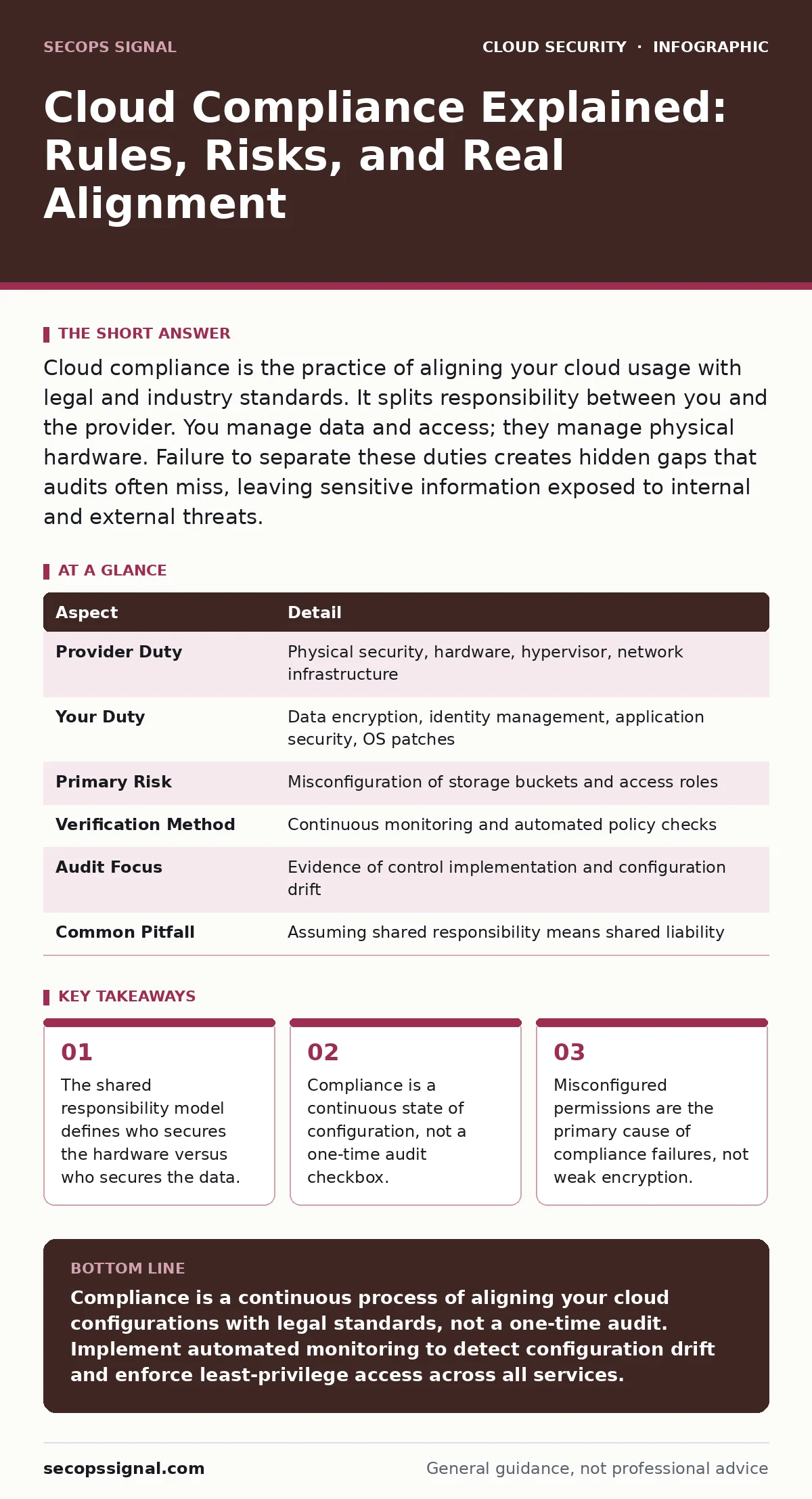
Cloud compliance is the practice of aligning your cloud usage with legal and industry standards. It splits responsibility between you and the provider. You manage data and access; they manage physical hardware. Failure to separate these duties creates hidden gaps that audits often miss, leaving sensitive information exposed to internal and external threats.
The Library Analogy for Shared Duty
Imagine you rent a secure storage unit. The facility provides the building, the locks, and the surveillance cameras. They are compliant with building codes and insurance requirements. You, however, decide what goes inside the unit. If you leave the door open, store hazardous materials, or give keys to strangers, you are liable for the consequences. The facility’s security does not cover your poor choices.
Cloud compliance works the same way. The provider secures the underlying infrastructure. You secure everything you place on top of it. Many organizations assume that because the provider is certified, their data is automatically safe. This assumption ignores the boundary where provider duty ends and your duty begins. That boundary is the source of most security incidents.
Defining the Core Mechanism
Cloud compliance is the alignment of your cloud configurations with specific regulatory or industry standards. These standards dictate how data must be stored, processed, and accessed. They vary by region and industry, such as financial regulations or healthcare privacy laws. The goal is to prove that your handling of data meets external legal requirements.
This is not just about passing an audit. It is about establishing a repeatable process for managing risk. Compliance frameworks provide a checklist of controls. You must implement these controls in your cloud environment. The provider implements their portion; you implement yours. If either side fails, the entire compliance posture collapses. You cannot outsource your regulatory obligations.
| Aspect | Detail |
|---|---|
| Provider Duty | Physical security, hardware, hypervisor, network infrastructure |
| Your Duty | Data encryption, identity management, application security, OS patches |
| Primary Risk | Misconfiguration of storage buckets and access roles |
| Verification Method | Continuous monitoring and automated policy checks |
| Audit Focus | Evidence of control implementation and configuration drift |
| Common Pitfall | Assuming shared responsibility means shared liability |
The Problem Compliance Solves
Without compliance, you have no standardized way to measure security. You might encrypt some data and leave other data plain. You might grant broad access to some users and restrict others. This inconsistency creates blind spots. Attackers look for these inconsistencies. They do not care about your internal policies; they care about what is left open.
Compliance forces consistency. It requires you to define rules for every asset. You must know where every piece of sensitive data lives. You must know who can access it. This structure reduces the attack surface. It also provides legal protection. If a breach occurs, you can demonstrate that you followed established standards. This demonstration often limits liability and preserves customer trust.
The Hidden Cost of Static Audits
Most organizations treat compliance as an annual event. They configure their cloud environment to pass a specific audit, then they move on. They assume that because they passed last year, they are still compliant today. This is a dangerous illusion. Cloud environments change constantly. New servers are launched. New users are added. Permissions are modified.
Every change introduces the risk of drift. Drift occurs when your actual configuration deviates from your intended policy. A storage bucket might be opened to the public for a temporary test and never closed. A developer might be granted administrator access for debugging and never have it revoked. These small changes accumulate. They create a gap between your documented security and your actual security.
Where It Fits With Other Defences
Compliance does not exist in a vacuum. It relies on other security mechanisms to function. For example, you cannot comply with data privacy rules if you do not know who is accessing your data. This requires strong identity management. You should look into federated identity to centralize access control and reduce the risk of orphaned accounts.
You also need to ensure that your infrastructure is secure by default. If your cloud network is flat, a breach in one area can spread to all areas. Implementing cloud network segmentation limits the blast radius of an attack. It ensures that compliance violations in one segment do not compromise the entire environment. These technical controls provide the evidence you need for compliance.
See also: Shadow IT Definition: How to Find Hidden Cloud Risks · Cloud Security Examples: How Security Groups Enforce Zero Trust
What People Usually Get Wrong
The most common error is focusing on the tool rather than the process. Teams buy expensive scanning tools and assume the job is done. They do not assign ownership for fixing the alerts. They do not integrate the findings into their development workflow. The tool generates noise, and the team ignores it. This is known as alert fatigue. It leads to critical vulnerabilities being overlooked because they are buried under hundreds of low-priority warnings.
Another error is treating compliance as a security solution. Passing an audit does not make you secure. It only makes you compliant with a specific set of rules. Attackers do not care about your audit status. They care about your weakest link. You must treat compliance as a baseline, not a ceiling. Build additional defenses on top of the baseline. Use cloud security posture management (CSPM) to continuously evaluate your environment against these baselines.
Managing Access and Secrets
Access control is the heart of cloud compliance. You must ensure that only authorized personnel can access sensitive data. This requires strict permission models. You should avoid broad permissions. Use the principle of least privilege. Grant only the access necessary for a specific task.
Consider using just-in-time access for administrative tasks. This method grants temporary access only when needed. It reduces the window of opportunity for attackers. It also simplifies auditing because access is time-bound. You can see exactly when and why someone accessed a resource.
You must also protect credentials. Storing passwords or API keys in plain text is a major compliance violation. Ensure that secrets in source code are scanned and removed before deployment. Use dedicated secret management tools to store and rotate credentials. This prevents accidental exposure and ensures that access can be revoked instantly.
The Role of Infrastructure Changes
Cloud environments are dynamic. Servers are created and destroyed frequently. This is known as ephemeral infrastructure. Traditional security tools struggle with this pace. They are designed for static environments. They cannot keep up with the rapid creation and deletion of resources.
You need security that moves with your infrastructure. Integrate security checks into your deployment pipeline. This is called shift-left security. It catches compliance issues before they reach production. It ensures that every new resource is compliant from the moment it is created. This approach reduces the burden on your security team. It also prevents non-compliant resources from ever becoming a liability.
SaaS and Identity Risks
Compliance extends beyond infrastructure to applications. Many organizations use Software as a Service (SaaS) applications. These applications often hold sensitive data. They are subject to the same compliance requirements as your infrastructure. However, they are often managed differently.
You must secure these accounts. SaaS account takeover is a common threat. Attackers target weak credentials to gain access to business applications. Ensure that multi-factor authentication is enforced for all SaaS accounts. Monitor for unusual login activity. Treat SaaS applications as part of your compliance scope. Do not leave them as an afterthought.
Key takeaways
- The shared responsibility model defines who secures the hardware versus who secures the data.
- Compliance is a continuous state of configuration, not a one-time audit checkbox.
- Misconfigured permissions are the primary cause of compliance failures, not weak encryption.
- Automated tools detect drift from policy faster than manual reviews can.
Compliance is a continuous process of aligning your cloud configurations with legal standards, not a one-time audit. Implement automated monitoring to detect configuration drift and enforce least-privilege access across all services.
Frequently asked questions
Does cloud compliance guarantee my data is safe?
No, compliance ensures you meet specific legal and industry standards. It reduces risk but does not eliminate all threats. You must still implement active security measures.
How often should I review my cloud compliance?
You should review your compliance continuously. Automated tools can check configurations in real time. Manual reviews should occur at least quarterly to assess policy effectiveness.
Who is responsible for cloud compliance?
Responsibility is shared. The provider secures the infrastructure. You secure the data, applications, and access controls. You are ultimately liable for your data handling.
Can I automate cloud compliance?
Yes, automation is essential. Use tools to enforce policies and detect drift. Manual checks are too slow for dynamic cloud environments. Automation ensures consistent application of rules.
How this guide was produced: written by the SecOps Signal editorial team with AI assistance, checked against the public references listed below, and reviewed when the facts change. See our editorial policy or report an error.