Ephemeral Infrastructure: Definition, Mechanics, and Hidden Costs
Ephemeral infrastructure treats servers as temporary resources, forcing teams to manage identity and data persistence rather than relying on long-lived machine states.

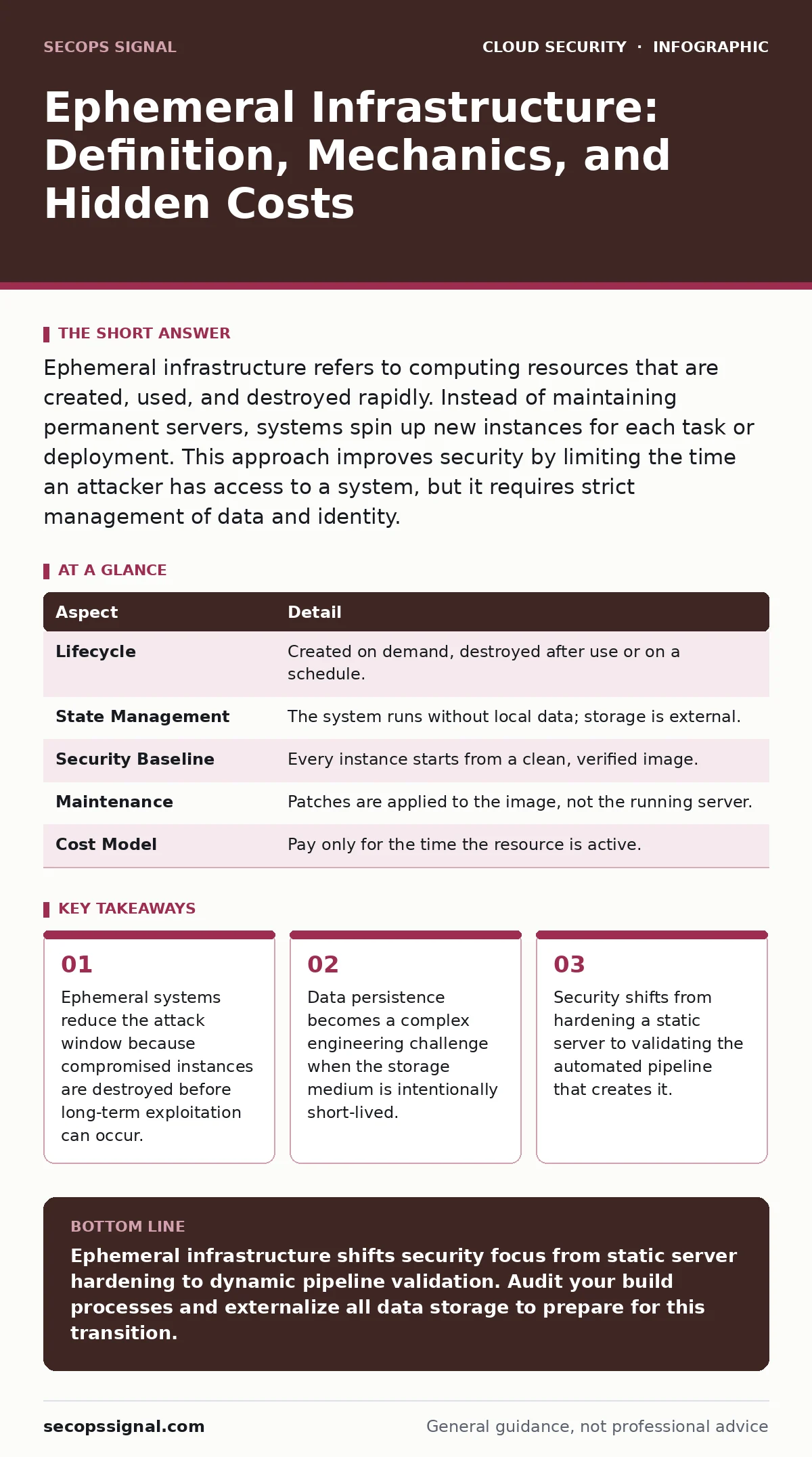
Ephemeral infrastructure refers to computing resources that are created, used, and destroyed rapidly. Instead of maintaining permanent servers, systems spin up new instances for each task or deployment. This approach improves security by limiting the time an attacker has access to a system, but it requires strict management of data and identity.
The Hotel Room Analogy
Imagine checking into a hotel. You do not buy the bed, paint the walls, or install the plumbing. You occupy the room for a night, use what is provided, and leave. The hotel resets the room for the next guest. In cloud computing, ephemeral infrastructure works the same way. Instead of maintaining a permanent server that ages and accumulates changes, you request a temporary instance. You deploy your application, run it, and then the system destroys it when the work is finished or the lease expires.
This model contrasts sharply with the traditional "pet" server approach, where you name, care for, and patch a single machine for years. In the ephemeral model, servers are "cattle." If one fails or is compromised, you do not repair it. You replace it with a fresh, identical copy from a known baseline.
| Aspect | Detail |
|---|---|
| Lifecycle | Created on demand, destroyed after use or on a schedule. |
| State Management | The system runs without local data; storage is external. |
| Security Baseline | Every instance starts from a clean, verified image. |
| Maintenance | Patches are applied to the image, not the running server. |
| Cost Model | Pay only for the time the resource is active. |
Origins in Container Orchestration
The term gained traction with the rise of containerization. Containers package an application with its dependencies, allowing it to run consistently across different environments. Orchestration tools automate the starting and stopping of these containers. When a container crashes or needs scaling, the orchestration layer kills the old container and starts a new one.
This behavior is not accidental. It is a design choice to avoid configuration drift. Configuration drift occurs when a server changes over time due to manual edits, updates, or user actions. These changes make the server unique and unpredictable. By destroying and recreating instances, you eliminate drift. The system always returns to its original, tested state. This reliability is why modern cloud platforms default to ephemeral designs for microservices and serverless functions.
Daily Operations and Automation
Using ephemeral infrastructure requires a shift in daily workflow. You no longer log into servers to install software. Instead, you define the desired state in code. This code describes the operating system, the installed libraries, and the application files. When you push changes to this code, the system builds a new image.
You deploy this image to the cloud. The cloud provider allocates hardware, installs the image, and starts the application. If you need to update a library, you modify the code, build a new image, and deploy it. The old instances are terminated, and new ones start with the updated library. This process is often called immutable infrastructure. The term "immutable" means the instance cannot be changed after it is created. If you need a change, you create a new instance. This practice prevents accidental modifications that could introduce vulnerabilities or bugs.
The Persistence Problem
The primary challenge of ephemeral infrastructure is data. If you delete the server, you delete the local disk. Applications that store user sessions, logs, or database files on the local drive will lose that data immediately. You must separate compute from storage.
You achieve this by using external storage services. Database files go to a managed database service. User uploads go to object storage. Logs go to a centralized logging system. The ephemeral instance only contains the code and the configuration to connect to these external services. This separation adds complexity to your architecture. You must ensure that the connections are secure and that the external services are highly available. If the storage layer fails, the ephemeral compute layer is useless.
Security Implications
Ephemeral infrastructure changes the security landscape. Traditional perimeter security relies on firewalls and hardened servers. In an ephemeral model, the perimeter is fluid. Instances appear and disappear constantly. You cannot rely on static IP addresses or long-lived server identities for access control.
Instead, security focuses on the pipeline. You must secure the code that builds the images. If an attacker injects malicious code into the build process, every new instance will be compromised. This is why scanning images for vulnerabilities before deployment is critical. You also need to manage secrets carefully. Storing passwords or API keys in the image is dangerous because the image is stored in a registry. Anyone with access to the registry can extract those secrets.
See also: 7 Code Repository Mistakes That Leak Secrets · Shadow IT Definition: How to Find Hidden Cloud Risks
Common Misconceptions
Many teams assume that ephemeral infrastructure automatically equals security. This is incorrect. While it reduces the window for exploitation, it introduces new risks. If your automation scripts are flawed, you will deploy broken or insecure instances at scale. Speed amplifies both success and failure.
Another misconception is that you do not need to patch. You do not patch running instances, but you must patch the base images. If the underlying operating system has a vulnerability, every new instance created from that image will have the same vulnerability. You need a process to rebuild and redeploy images when critical patches are released. This requires coordination between development and security teams.
Integration with Cloud Security Tools
Managing ephemeral resources requires specialized tools. Manual monitoring is impossible when hundreds of instances start and stop daily. Cloud-native application protection platforms (CNAPP) provide visibility into these short-lived resources. They analyze the configuration and runtime behavior of instances to detect anomalies.
You must also consider access control. Misconfigured IAM roles can allow an attacker to read data from storage buckets or spin up expensive resources. Federated identity helps manage access for external users or partners without creating long-lived accounts. By linking identity to external providers, you reduce the risk of credential theft.
Addressing Legacy Patterns
Moving to ephemeral infrastructure often exposes legacy code patterns. Applications that assume they have a persistent local disk will fail. Refactoring these applications is necessary. You may need to introduce infrastructure-as-code misconfigurations checks to ensure that new deployments do not accidentally mount local volumes.
Cloud network segmentation becomes more complex. With dynamic IPs, you cannot use static firewall rules. You must use identity-based networking. Services identify themselves using tags or labels, and network policies allow traffic based on these identities. This approach is more secure because it does not depend on network topology, which changes constantly.
Secrets Management at Scale
As mentioned, secrets must not live in the image. However, retrieving secrets at runtime adds latency. If an application needs many secrets, the startup time increases. This is a trade-off between security and performance. You must balance the frequency of secret rotation with the performance impact of fetching them.
Some teams store secrets in environment variables. This is convenient but risky. Environment variables can be leaked through logs or process listings. Using a vault service is safer, even if it is slower. The service encrypts secrets at rest and decrypts them in memory. This reduces the risk of exposure if the instance is compromised.
The Role of Immutable Practices
Immutable infrastructure and ephemeral infrastructure are closely related. Immutable practices mean that once a resource is deployed, it is never modified. This ensures consistency and auditability. You can trace every change back to a specific version of code.
This practice simplifies debugging. If a production instance behaves strangely, you can compare its configuration to the code that created it. If they match, the issue is likely in the application logic. If they do not match, someone manually changed the instance, which violates the immutable principle. Enforcing this discipline requires strict access controls. You should revoke SSH or remote desktop access to production instances. All changes must go through the deployment pipeline.
Final Considerations
Ephemeral infrastructure is not a silver bullet. It requires a mature DevOps culture. Teams must be comfortable with automation and code-based management. The initial learning curve is steep. You must rewrite applications to be stateless and refactor deployment processes.
However, the long-term benefits are significant. You gain resilience, consistency, and security. You reduce the risk of configuration drift and manual errors. You enable rapid scaling and faster release cycles. The key is to start small. Identify non-critical services and migrate them first. Learn from the process and apply those lessons to more critical systems.
Key takeaways
- Ephemeral systems reduce the attack window because compromised instances are destroyed before long-term exploitation can occur.
- Data persistence becomes a complex engineering challenge when the storage medium is intentionally short-lived.
- Security shifts from hardening a static server to validating the automated pipeline that creates it.
Ephemeral infrastructure shifts security focus from static server hardening to dynamic pipeline validation. Audit your build processes and externalize all data storage to prepare for this transition.
Frequently asked questions
Does ephemeral infrastructure eliminate the need for firewalls?
No. Firewalls are still needed to control traffic between services. However, firewall rules must be dynamic and based on identity rather than static IP addresses.
Can I use ephemeral infrastructure for databases?
Generally no. Databases require persistent storage. While you can use ephemeral instances for database proxies or read replicas, the primary database engine should run on persistent volumes.
How do I handle user sessions in an ephemeral setup?
Store sessions in an external cache like Redis or a database. Do not store session data on the local server disk. This allows any instance to handle any request.
Is ephemeral infrastructure more expensive than traditional servers?
It can be cheaper if you optimize usage. You only pay for active time. However, poor architecture can lead to excessive data transfer costs or idle resource usage.
How this guide was produced: written by the SecOps Signal editorial team with AI assistance, checked against the public references listed below, and reviewed when the facts change. See our editorial policy or report an error.