Detect Credential Stuffing: Log Signals and Hidden Blind Spots
Credential stuffing attacks often bypass traditional alerts by mimicking legitimate user behavior patterns and timing, requiring deep log correlation to uncover.

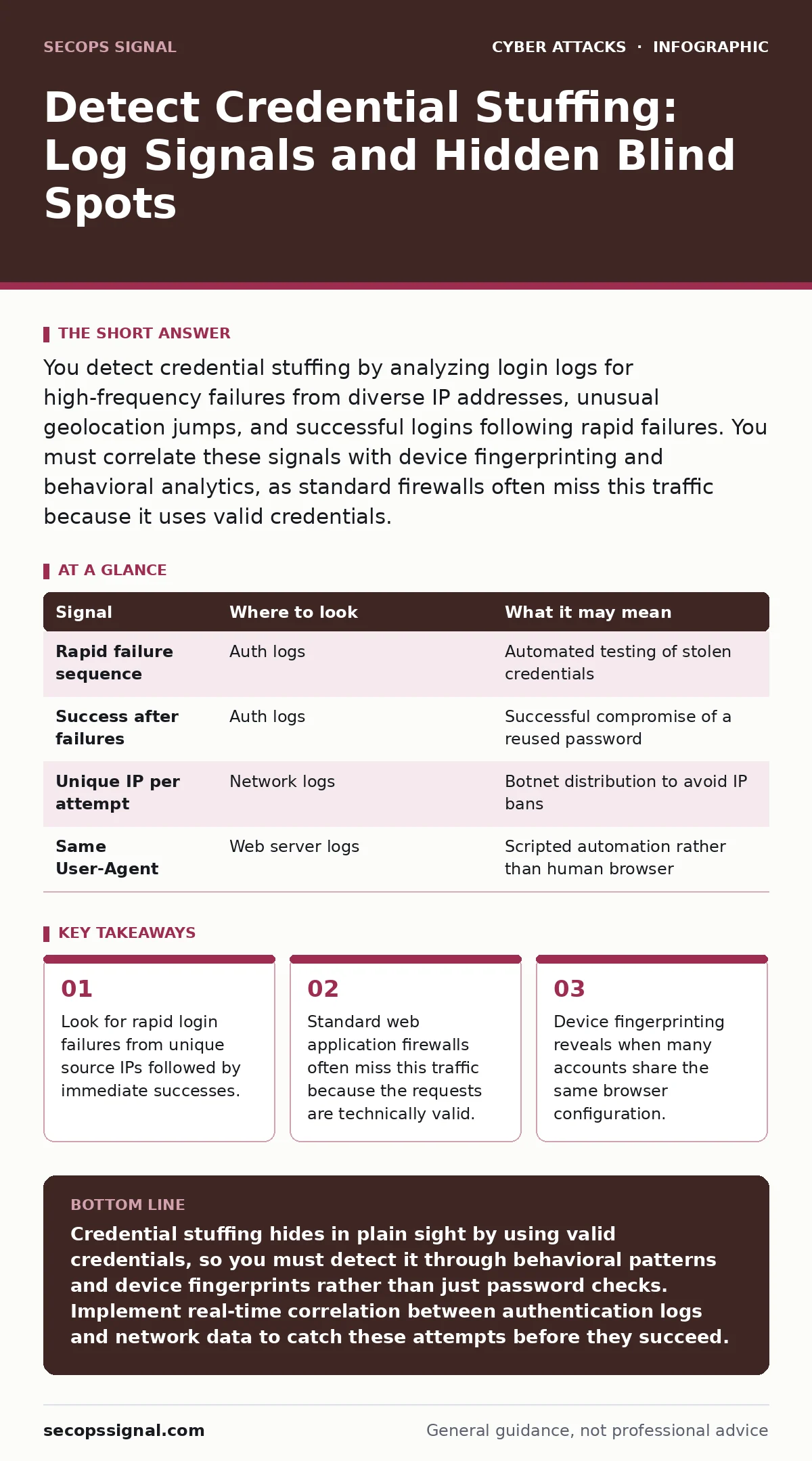
You detect credential stuffing by analyzing login logs for high-frequency failures from diverse IP addresses, unusual geolocation jumps, and successful logins following rapid failures. You must correlate these signals with device fingerprinting and behavioral analytics, as standard firewalls often miss this traffic because it uses valid credentials.
The Anatomy of a Silent Attack
Credential stuffing relies on the habit of users reusing passwords across multiple services. Attackers harvest breached credentials from past incidents and automate attempts to log into your systems. They do not guess passwords. They test known combinations at scale.
This differs from brute force attacks, which try random strings. Stuffing uses valid pairs. Because the credentials are correct, the system often accepts the login. The attack succeeds not by breaking encryption, but by exploiting human convenience.
Signals in Authentication Logs
Your primary evidence lives in your authentication logs. You must look beyond simple success or failure counts. The pattern matters more than the volume.
Imagine a user logging in from New York, then failing three times from a data center in Eastern Europe, then succeeding from that same data center. This geographic jump is a strong signal. Legitimate users rarely change physical location in minutes.
| Signal | Where to look | What it may mean |
|---|---|---|
| Rapid failure sequence | Auth logs | Automated testing of stolen credentials |
| Success after failures | Auth logs | Successful compromise of a reused password |
| Unique IP per attempt | Network logs | Botnet distribution to avoid IP bans |
| Same User-Agent | Web server logs | Scripted automation rather than human browser |
Behavioral Anomalies and Timing
Humans have rhythms. Bots have schedules. You can detect stuffing by analyzing the timing of requests.
Legitimate users pause. They think. They type. Automated scripts send requests at millisecond intervals. If you see a burst of login attempts that are perfectly evenly spaced, you are likely looking at automation.
Also examine the time of day. If your users are in one time zone, but you see a spike in logins during your nighttime hours, investigate. This does not prove an attack, but it flags suspicious activity that requires manual review.
Device and Browser Fingerprinting
Standard logs show IP addresses. Attackers rotate these addresses using proxies. You need to look at the device itself.
Device fingerprinting collects data about the browser, operating system, screen resolution, and installed fonts. If ten different accounts all log in from the exact same browser configuration and screen size, they are likely controlled by the same actor.
This method bypasses IP-based defenses. Even if the attacker uses a new proxy for each attempt, the underlying device signature remains constant. You should enable this feature on your web application firewall or identity provider.
Network-Level Indicators
Your network logs provide context that application logs miss. Look at the source of the traffic.
Residential proxies are common in these attacks. They make bot traffic look like it comes from real homes. If you see traffic from IP ranges known for proxy services, flag it.
Also watch for high connection rates from a single subnet. If one /24 block generates hundreds of login attempts in an hour, block that range. Do not wait for a successful login. Prevention is cheaper than remediation.
See also: Implement SIEM: A Step-by-Step Plan for Small Teams · Conditional Access Policies: 8 Practices for Secure Remote Work
Common Blind Spots
Many teams miss credential stuffing because they rely on the wrong tools.
Web Application Firewalls (WAFs) filter malicious payloads. They do not filter valid logins. If the password is correct, the WAF lets it through. You cannot stop stuffing with a WAF alone.
Another blind spot is single-factor authentication. If you only use passwords, you have no backup check. Adding a second factor stops the attack even if the password is stolen.
Integrating Detection Tools
You need tools that understand context. Basic log viewers are insufficient.
Identity and Access Management (IAM) systems can detect impossible travel. They flag logins that occur too quickly to be physically possible.
User and Entity Behavior Analytics (UEBA) tools establish a baseline for each user. They alert when a user deviates from their norm. For example, if a user who always logs in from one device suddenly logs in from five different devices, the system flags this.
You should also review your email filtering rules. Attackers often send phishing emails to validate stolen credentials. If you block the phishing attempt, you may prevent the initial compromise.
Responding to Detected Stuffing
When you detect an attack, act quickly. Do not wait for proof of data exfiltration.
Force a password reset for the affected accounts. Enable multi-factor authentication if it is not already on.
Review the activity of the compromised accounts. Look for data exports, permission changes, or new device registrations.
You should also update your conditional access policies. Restrict logins from high-risk countries or unknown devices. This reduces the attack surface.
Remember that credential stuffing is a continuous threat. Attackers constantly harvest new credentials. You must monitor your logs regularly.
Key takeaways
- Look for rapid login failures from unique source IPs followed by immediate successes.
- Standard web application firewalls often miss this traffic because the requests are technically valid.
- Device fingerprinting reveals when many accounts share the same browser configuration.
Credential stuffing hides in plain sight by using valid credentials, so you must detect it through behavioral patterns and device fingerprints rather than just password checks. Implement real-time correlation between authentication logs and network data to catch these attempts before they succeed.
Frequently asked questions
How do I distinguish between a bot and a human user?
Bots often have perfect timing, identical browser fingerprints, and lack mouse movement data. Humans show variability in timing and interaction patterns.
Can two-factor authentication stop credential stuffing?
Yes, if implemented correctly. Even if the attacker has the password, they cannot complete the login without the second factor, such as a hardware key or mobile app code.
What is the difference between credential stuffing and brute force?
Brute force guesses passwords randomly. Credential stuffing tests known username-password pairs obtained from previous data breaches.
Should I block all failed login attempts?
No, this can cause denial of service for legitimate users. Instead, use rate limiting and step-up authentication to verify suspicious activity without blocking all access.
How this guide was produced: written by the SecOps Signal editorial team with AI assistance, checked against the public references listed below, and reviewed when the facts change. See our editorial policy or report an error.