How to Prevent API Abuse: 5 Layers of Defense That Actually Work
Rate limiting blocks volume but misses logic flaws, so you must validate every input to stop attackers from manipulating business rules.

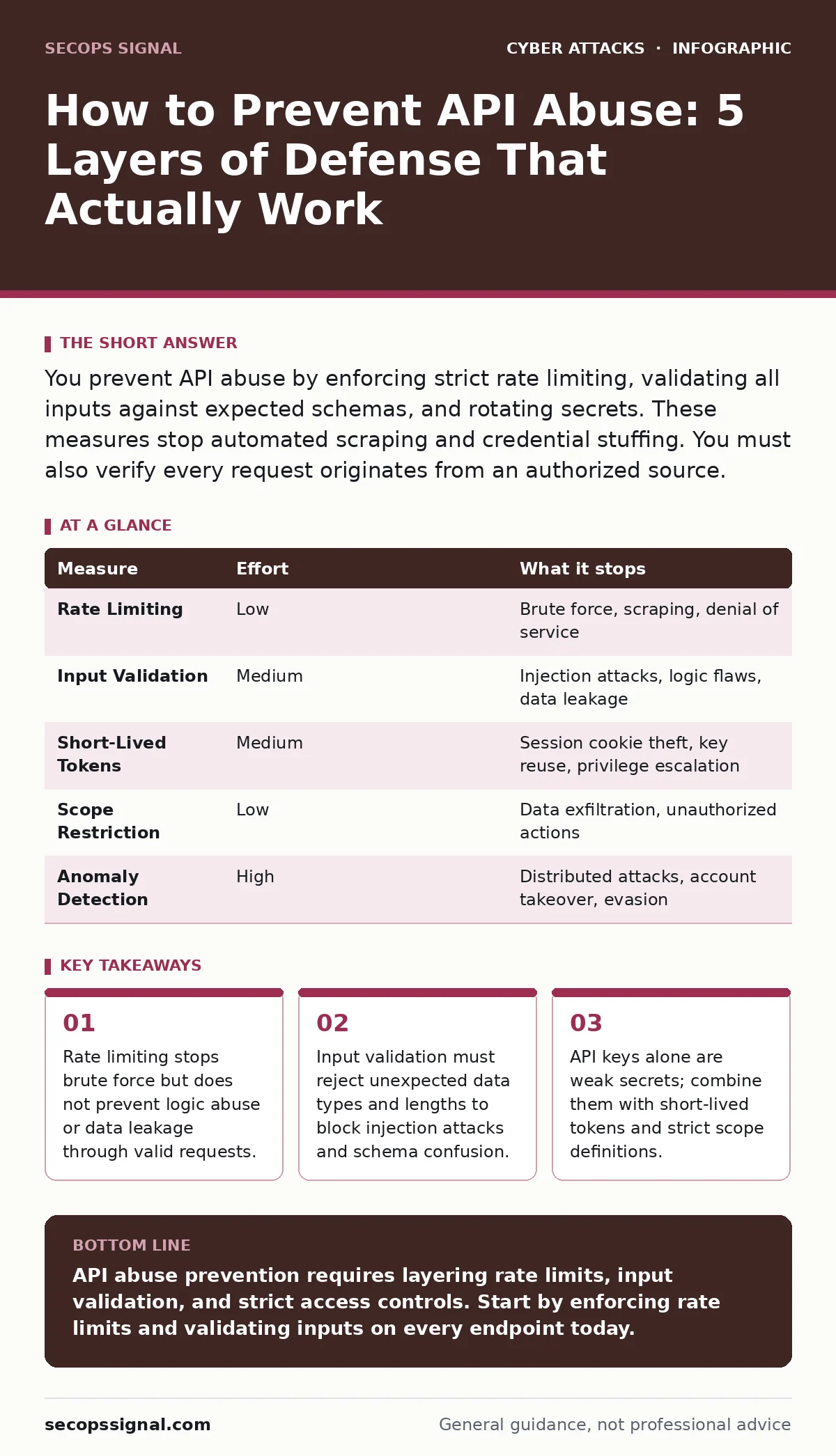
You prevent API abuse by enforcing strict rate limiting, validating all inputs against expected schemas, and rotating secrets. These measures stop automated scraping and credential stuffing. You must also verify every request originates from an authorized source.
How to Prevent API Abuse Starts With Rate Limiting
Rate limiting is the first line of defense against automated abuse. It caps the number of requests a client can make within a specific time window. This stops bots from scraping your data or guessing passwords through credential stuffing. Attackers rely on speed to test thousands of combinations quickly. Rate limiting forces them to slow down or stop entirely.
You must configure rate limits at the edge of your network, not just inside your application. This ensures resources are freed before the request reaches your server. Set different limits for different endpoints. A login endpoint needs stricter limits than a public data feed. Without differentiation, legitimate users experience lag while attackers find gaps in your policy.
Input Validation Stops Logic Flaws and Injection
Rate limiting fails when an attacker uses valid credentials to abuse business logic. Input validation checks every piece of data your API receives. It ensures the data matches the expected format, type, and length. This prevents SQL injection, where attackers insert malicious code into database queries. It also stops command injection, where users run system commands on your server.
Imagine an API endpoint that accepts a user ID to fetch profile data. An attacker might send a complex query instead of a simple number. Proper validation rejects anything that is not a plain integer. This stops the attacker from chaining multiple requests together to extract data from other users. You must validate data on every layer, from the gateway to the database driver.
Authentication and Authorization Define Access Boundaries
Authentication confirms who the user is. Authorization determines what they can do. Many APIs rely solely on API keys for both. API keys are static secrets that rarely change. If an attacker steals one, they have permanent access to everything the key permits. You must replace static keys with short-lived access tokens.
Access tokens expire after a set time, limiting the damage of a leak. You must also enforce the principle of least privilege. Each token should only grant access to the specific resources the user needs. A mobile app user should not have the same access as an internal admin. This containment strategy ensures that even if a token is stolen, the attacker cannot pivot to critical systems.
Scope and Context Reduce Attack Surface
Scope defines the specific actions a token allows. Context includes additional data about the request, such as the user’s location or device type. Combining scope with context adds friction for attackers. They must not only steal a token but also mimic the expected environment.
For example, a token issued for a desktop browser should not work from a mobile device. This mismatch triggers a security check. You must define clear scopes for each integration. A third-party service should only receive data it needs to function. Over-scoping grants unnecessary access that attackers can exploit. Tight scopes limit the blast radius of any compromise.
Monitoring and Anomaly Detection Catch Evasion
Attackers often evade rate limits by distributing requests across many accounts. They might use compromised accounts from a credential stuffing attack. Monitoring analyzes request patterns to find anomalies that rule-based systems miss. You look for unusual spikes in traffic, requests from new geographic regions, or unusual data patterns.
Anomaly detection flags behavior that deviates from the norm. If a user account suddenly downloads thousands of records, the system pauses and requires re-authentication. This breaks the automation chain. You must log every API request with sufficient detail. Logs must include user ID, timestamp, IP address, and request payload. Without detailed logs, you cannot investigate incidents or tune your defenses.
| Measure | Effort | What it stops |
|---|---|---|
| Rate Limiting | Low | Brute force, scraping, denial of service |
| Input Validation | Medium | Injection attacks, logic flaws, data leakage |
| Short-Lived Tokens | Medium | Session cookie theft, key reuse, privilege escalation |
| Scope Restriction | Low | Data exfiltration, unauthorized actions |
| Anomaly Detection | High | Distributed attacks, account takeover, evasion |
What Does Not Work On Its Own
Relying on obscurity is a failed strategy. Hiding your API endpoints or using non-standard ports does not stop determined attackers. They use automated tools to map your attack surface. These tools discover endpoints regardless of how hidden they are. You must assume your API structure is public knowledge.
Similarly, basic firewalls do not understand API semantics. They filter traffic based on IP addresses and ports. They cannot distinguish between a legitimate request and an abusive one that uses valid credentials. You need application-layer security that understands the business logic. Without this, attackers manipulate your API to perform unintended actions.
Integration With Broader Security Controls
API security does not exist in isolation. It must integrate with your broader security posture. For instance, if you detect suspicious API activity, you should trigger alerts in your intrusion prevention systems. This creates a coordinated response. You must also ensure your API does not expose sensitive data that could aid in clone phishing or typosquatting attacks.
Regularly review your API permissions. Remove access for unused integrations. This reduces the number of potential entry points. You should also educate developers on secure coding practices. Security awareness training helps teams understand the risks of improper input handling and weak authentication.
Checklist for Immediate Action
You can start reducing risk today with these three actions. Implementing these steps requires minimal development effort but yields significant security improvements.
- Enable rate limiting on all public-facing API endpoints to block automated scraping.
- Validate all input fields against strict schemas to prevent injection and logic abuse.
- Rotate all existing API keys and replace them with short-lived access tokens.
Key takeaways
- Rate limiting stops brute force but does not prevent logic abuse or data leakage through valid requests.
- Input validation must reject unexpected data types and lengths to block injection attacks and schema confusion.
- API keys alone are weak secrets; combine them with short-lived tokens and strict scope definitions.
API abuse prevention requires layering rate limits, input validation, and strict access controls. Start by enforcing rate limits and validating inputs on every endpoint today.
Frequently asked questions
Does rate limiting stop all API attacks?
No, rate limiting only stops high-volume automated attacks. It does not prevent logic abuse or data leakage through valid, slow requests.
How often should I rotate API keys?
You should rotate API keys immediately after any suspected compromise. For ongoing security, use short-lived tokens that expire automatically.
What is the difference between authentication and authorization?
Authentication verifies identity, while authorization determines what resources that identity can access. Both are required for secure API access.
Can I use standard web security tools for API protection?
Standard web tools often miss API-specific threats. You need application-layer controls that understand API semantics and business logic.
How this guide was produced: written by the SecOps Signal editorial team with AI assistance, checked against the public references listed below, and reviewed when the facts change. See our editorial policy or report an error.