What Is CNAPP: Definition, Core Components, and Security Purpose
CNAPP consolidates fragmented cloud tools into one system that fixes misconfigurations before code reaches production, reducing the window of exposure.
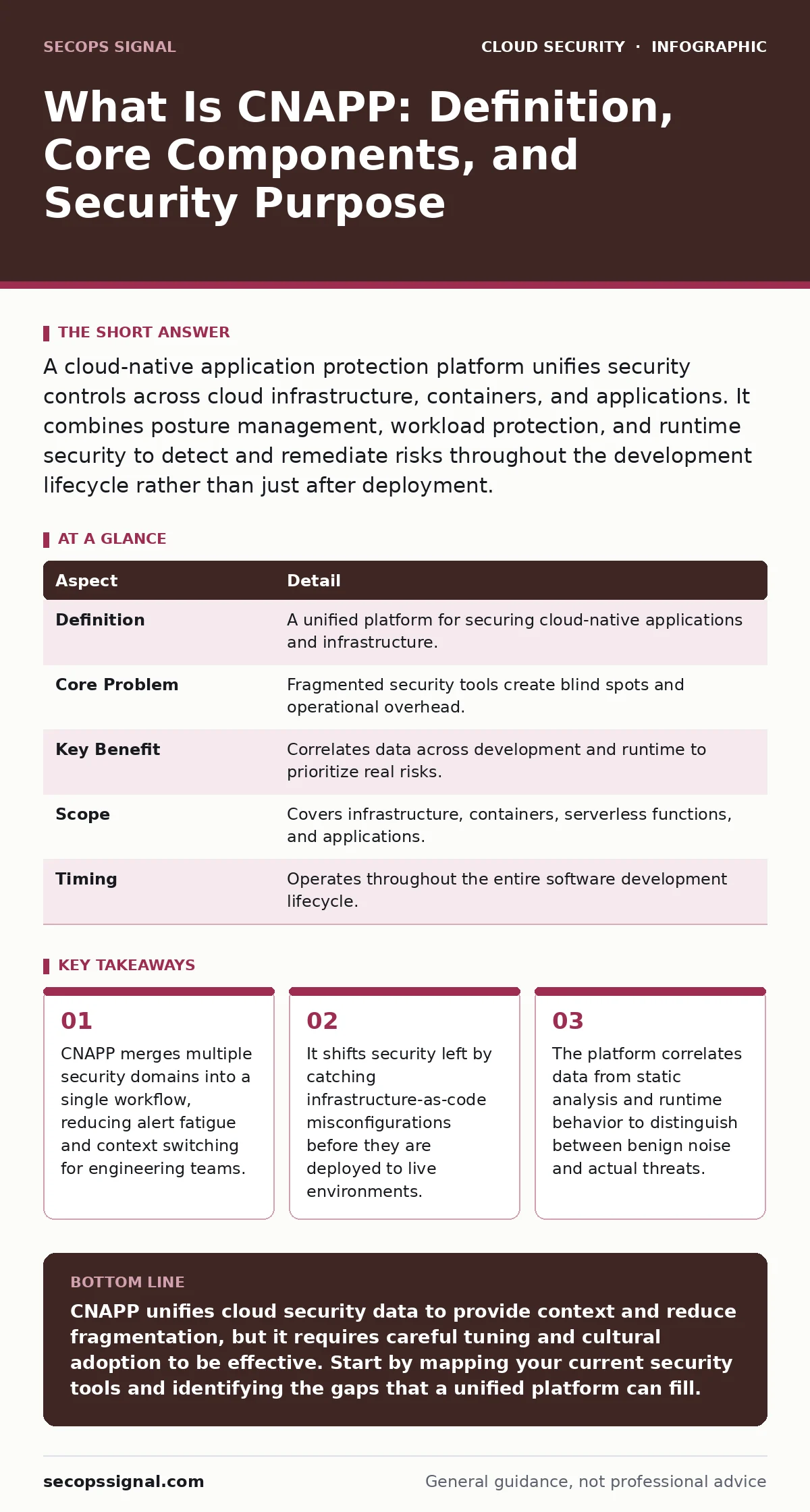
A cloud-native application protection platform unifies security controls across cloud infrastructure, containers, and applications. It combines posture management, workload protection, and runtime security to detect and remediate risks throughout the development lifecycle rather than just after deployment.
The Unified Cloud Security Console
Imagine a construction site where architects, electricians, and plumbers each use different blueprints and speak different languages. When a pipe bursts, no one knows who is responsible or how to fix it quickly. Cloud environments suffer from this same fragmentation. You likely use separate tools for scanning code, monitoring network traffic, and managing access rights. These tools generate silos of data that do not talk to each other.
A cloud-native application protection platform (CNAPP) solves this by acting as a unified console. It aggregates data from disparate sources to provide a single view of your cloud security posture. Instead of juggling five different dashboards, you look at one interface that connects the dots between your code, your infrastructure, and your running applications. This consolidation reduces the time it takes to identify the root cause of an incident.
| Aspect | Detail |
|---|---|
| Definition | A unified platform for securing cloud-native applications and infrastructure. |
| Core Problem | Fragmented security tools create blind spots and operational overhead. |
| Key Benefit | Correlates data across development and runtime to prioritize real risks. |
| Scope | Covers infrastructure, containers, serverless functions, and applications. |
| Timing | Operates throughout the entire software development lifecycle. |
The Problem of Fragmented Defenses
Cloud environments are dynamic and ephemeral. Servers spin up and down in minutes, and containers replace traditional virtual machines. Traditional security tools were built for static infrastructure. They struggle to keep pace with the speed of modern development. When you use separate tools for each layer of the stack, you create gaps in visibility.
A vulnerability in a container image might be caught by a scanner, but the network rule that exposes it is managed by a different team. The runtime monitor sees the traffic but does not know the code context. This lack of correlation means you often see symptoms without understanding the cause. You might block a port, but the underlying misconfiguration remains. CNAPP addresses this by linking the identity of the asset with its configuration and its behavior.
Core Components of the Platform
A CNAPP is not a single product but a collection of integrated capabilities. It typically includes four main pillars that work together. Understanding these components helps you evaluate whether a tool truly offers unified protection or just a bundled suite of unrelated utilities.
Cloud Security Posture Management (CSPM) is the foundation. It continuously checks your cloud configuration against best practices and compliance standards. It identifies issues like open storage buckets or overly permissive firewall rules. For more details on maintaining compliance, see our guide on cloud compliance.
Infrastructure as Code (IaC) Scanning happens earlier in the process. It analyzes your deployment scripts before they are applied. This prevents misconfigurations from ever reaching the live environment. It is far easier to fix a typo in a script than to patch a running server.
Cloud Workload Protection Platforms (CWPP) secure the actual running instances. They monitor containers, virtual machines, and serverless functions for malicious activity. This layer provides the runtime visibility that static scans cannot offer.
Cloud Detection and Response (CDR) ties these inputs together. It uses the context from CSPM and CWPP to detect complex attacks. It automates response actions, such as isolating a compromised container, to limit damage.
Where It Fits in Your Defense Strategy
CNAPP does not replace every security tool. It sits above specialized scanners and below the application code itself. It integrates with your existing security operations center (SOC) workflows. You should view it as the central nervous system for your cloud security.
It complements other controls by providing context. For example, a secret detected in code is just a string of characters until CNAPP links it to a specific service account. It helps you prioritize which secrets to rotate first. For strategies on managing these credentials, refer to our guide on secrets in source code.
It also works alongside network controls. While CNAPP identifies misconfigured IAM roles, it does not replace the need for strict network boundaries. Proper segmentation ensures that a breach in one service does not spread to others. Learn more about designing these boundaries in our guide on cloud network segmentation.
What People Usually Get Wrong
Many organizations treat CNAPP as a silver bullet that eliminates the need for other security practices. This is a dangerous misconception. The platform automates detection and response, but it does not fix poor development habits. If your team continues to write insecure code, CNAPP will simply generate more alerts.
Another common error is expecting immediate perfection. CNAPP requires time to learn your environment's normal behavior. During the initial setup, you will see many false positives. You must tune the rules to reduce noise. This tuning process is ongoing. It requires regular review of alerts to ensure the platform remains effective.
See also: Shadow IT Definition: How to Find Hidden Cloud Risks · Cloud Security Examples: How Security Groups Enforce Zero Trust
The Hidden Cost of Complexity
While CNAPP reduces tool sprawl, it introduces integration complexity. You must connect it to your cloud providers, CI/CD pipelines, and identity management systems. These integrations require careful configuration. A broken integration can lead to blind spots.
The platform also demands a shift in culture. Developers must accept security feedback in their workflow. If the tool slows down deployment, they will find ways to bypass it. You must balance security rigor with development speed. This balance requires clear policies and automated remediation where possible. For instance, using just-in-time access can reduce the risk of compromised credentials without hindering developer productivity.
Navigating Ephemeral Environments
Modern cloud applications rely heavily on ephemeral infrastructure. Containers and serverless functions exist for seconds or minutes. Traditional security tools often miss these short-lived assets. CNAPP is designed to handle this volatility. It tracks assets based on identity and metadata rather than static IP addresses.
This approach ensures that security controls apply consistently, regardless of how long an asset lives. It also helps in auditing and compliance. This is critical for industries with strict regulatory requirements.
Integrating with Existing Workflows
To get the most value from CNAPP, you must integrate it into your daily operations. Connect it to your ticketing system to automate remediation tasks. Use webhooks to send alerts to your communication channels. Ensure that your team has the skills to interpret the data it provides.
Training is often overlooked. Engineers need to understand how to read the findings and take action. Regular training sessions can help bridge the gap between security and development. This collaboration ensures that security becomes a shared responsibility rather than a bottleneck.
Key takeaways
- CNAPP merges multiple security domains into a single workflow, reducing alert fatigue and context switching for engineering teams.
- It shifts security left by catching infrastructure-as-code misconfigurations before they are deployed to live environments.
- The platform correlates data from static analysis and runtime behavior to distinguish between benign noise and actual threats.
CNAPP unifies cloud security data to provide context and reduce fragmentation, but it requires careful tuning and cultural adoption to be effective. Start by mapping your current security tools and identifying the gaps that a unified platform can fill.
Frequently asked questions
Does CNAPP replace my existing vulnerability scanners?
No, CNAPP integrates with them to correlate findings. It does not perform the scanning itself but uses the data to prioritize and contextualize risks.
Can CNAPP protect serverless functions?
Yes, it monitors serverless executions for anomalous behavior and checks configurations against best practices, just like it does for containers.
Is CNAPP suitable for hybrid cloud environments?
Yes, many CNAPP solutions support hybrid and multi-cloud setups, providing a unified view across different cloud providers and on-premises resources.
How long does it take to implement CNAPP?
Implementation varies based on environment complexity. Initial setup may take weeks, but full integration and tuning can take months to achieve optimal performance.
How this guide was produced: written by the SecOps Signal editorial team with AI assistance, checked against the public references listed below, and reviewed when the facts change. See our editorial policy or report an error.