How to Implement Cloud Network Segmentation: A Step-by-Step Guide
Most segmentation failures stem from implicit trust in default subnets rather than explicit policy gaps between workloads.

Start by inventorying traffic flows, then isolate workloads into distinct subnets. Apply strict security groups that deny all inbound traffic by default. Verify rules with controlled tests and automate updates through infrastructure-as-code to prevent drift.
Inventory Your Traffic Flows Before Changing Anything
You cannot segment what you do not understand. Before creating new boundaries, you must map how your current workloads communicate. Identify which services talk to databases, which APIs accept external requests, and which internal tools require access to logging systems. This baseline prevents you from breaking legitimate business processes when you tighten controls.
Use network flow logs or packet capture tools to record source and destination pairs. Look for unexpected connections, such as a web server directly querying a database without an application layer. These direct paths often indicate architectural debt that segmentation will expose. Document these flows in a simple table or diagram to serve as your truth source during implementation.
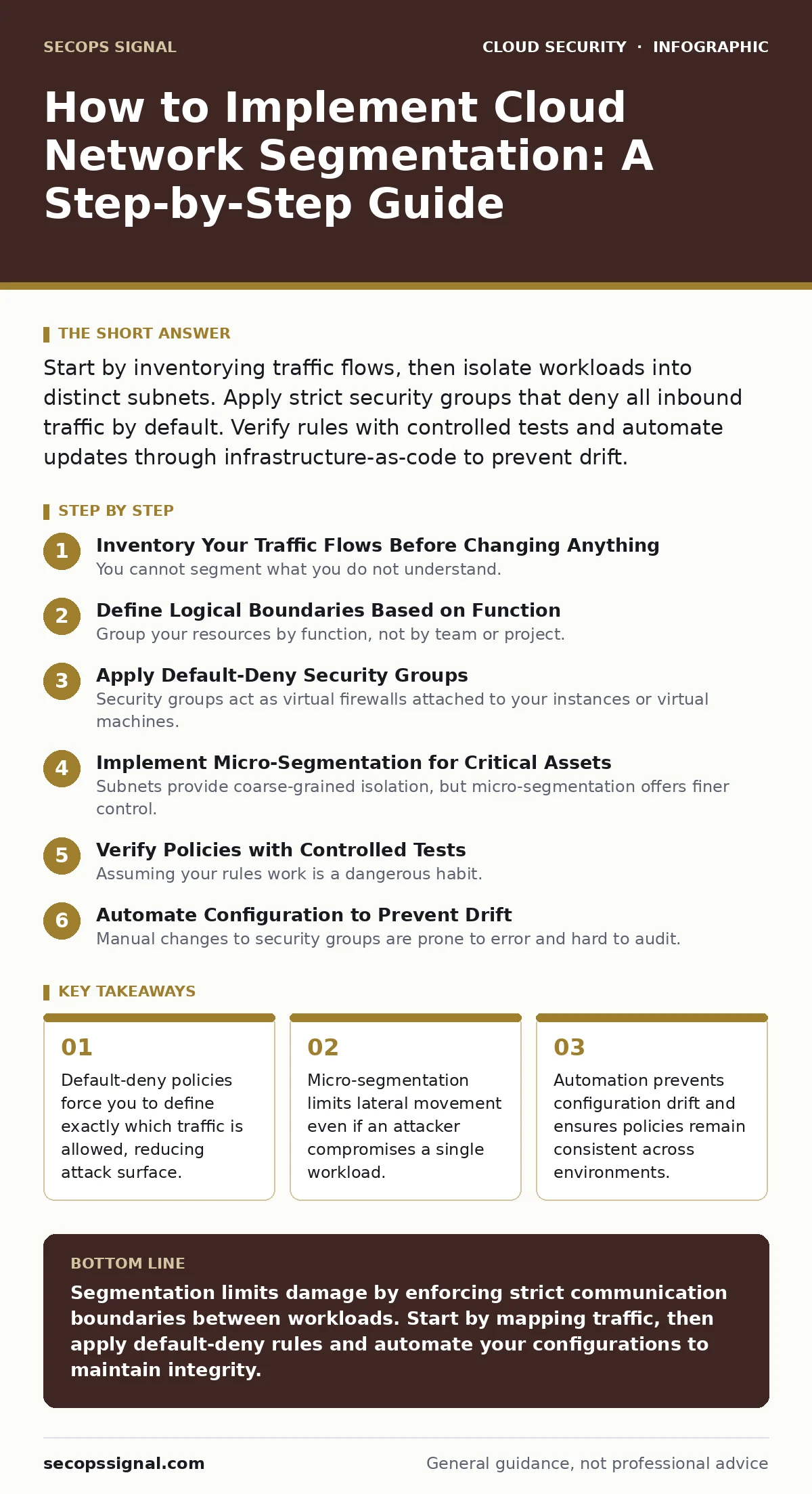
Define Logical Boundaries Based on Function
Group your resources by function, not by team or project. A common mistake is placing all development resources in one network and production in another, ignoring the fact that a compromised dev server can pivot to production if they share underlying infrastructure. Instead, create separate subnets for web-facing applications, backend services, and data stores.
Each subnet should have a clear purpose and a defined set of allowed communications. For example, a web tier subnet should only allow inbound HTTP and HTTPS traffic, while a database subnet should only accept connections from specific backend service IPs. This functional alignment ensures that security policies reflect actual business logic rather than organizational charts.
Apply Default-Deny Security Groups
Security groups act as virtual firewalls attached to your instances or virtual machines. The most critical rule is to deny all inbound traffic by default. This forces you to explicitly permit only the traffic required for each workload to function. Without this baseline, any rule you add is merely a permission on top of an open door.
Create a separate security group for each subnet or function. Assign these groups to your instances and remove any existing allow-all rules. Test basic connectivity to ensure you have not locked yourself out. If you lose access, check your outbound rules as well, as some cloud providers require explicit outbound permissions for DNS resolution or time synchronization.
Implement Micro-Segmentation for Critical Assets
Subnets provide coarse-grained isolation, but micro-segmentation offers finer control. By applying security groups directly to individual instances or pods, you can restrict traffic between workloads within the same subnet. This is particularly useful for multi-tenant applications where different customers share infrastructure but must remain isolated.
For example, if two backend services reside in the same subnet, ensure their security groups only allow traffic from the web tier and not from each other. This prevents a breach in one service from spreading to another. While this adds complexity to your rule management, it significantly reduces the blast radius of a compromise.
Verify Policies with Controlled Tests
Assuming your rules work is a dangerous habit. You must actively test that segmentation is enforced as intended. Start by attempting to connect from a web server to a database using a tool like telnet or curl. This connection should fail immediately if your security groups are correctly configured.
Document the expected behavior for each pair of workloads. Create a checklist of these tests and run them after every change. This verification process helps catch misconfigurations before they reach production. It also builds confidence in your security model, ensuring that you understand exactly how traffic flows through your environment.
- Web server cannot ping database server
- Database server cannot initiate connections to the internet
- Backend service can only reach the database on the required port
- Administrative access is restricted to specific IP ranges
See also: Shadow IT Definition: How to Find Hidden Cloud Risks · Cloud Security Examples: How Security Groups Enforce Zero Trust
Automate Configuration to Prevent Drift
Manual changes to security groups are prone to error and hard to audit. Over time, temporary permissions often become permanent, weakening your segmentation. To maintain integrity, manage your network policies through infrastructure-as-code tools. This ensures that every change is version-controlled, reviewed, and reproducible.
Define your security groups and subnet configurations in code templates. Apply these templates consistently across development, staging, and production environments. This approach aligns with principles of immutable infrastructure, where resources are replaced rather than modified, reducing the risk of configuration creep. Regularly review your code repository to ensure policies remain aligned with your security requirements.
Maintain and Audit Your Segmentation Strategy
Segmentation is not a one-time task. As your application grows, new services will be added, and existing ones will change. Each change requires a review of the network policies to ensure they remain appropriate. Schedule regular audits to compare your actual traffic flows against your intended architecture.
Use cloud security posture management (CSPM) tools to continuously monitor for misconfigurations. These tools can alert you when a security group is opened to the public or when a database becomes accessible from an unexpected subnet. Combine this automated monitoring with manual reviews to ensure your segmentation strategy evolves with your business needs.
Key takeaways
- Default-deny policies force you to define exactly which traffic is allowed, reducing attack surface.
- Micro-segmentation limits lateral movement even if an attacker compromises a single workload.
- Automation prevents configuration drift and ensures policies remain consistent across environments.
Segmentation limits damage by enforcing strict communication boundaries between workloads. Start by mapping traffic, then apply default-deny rules and automate your configurations to maintain integrity.
Frequently asked questions
Does network segmentation protect against insider threats?
It limits the scope of damage an insider can cause by restricting access to only necessary resources, but it does not prevent malicious intent.
How do I handle legacy applications that require open ports?
Isolate them in a dedicated subnet with strict access controls and monitor their traffic closely for anomalies.
How this guide was produced: written by the SecOps Signal editorial team with AI assistance, checked against the public references listed below, and reviewed when the facts change. See our editorial policy or report an error.