Why Disputed CVEs Matter for Your Security Workflow
Ignoring rejected CVE records creates blind spots that allow attackers to exploit known weaknesses before your defenses can respond.

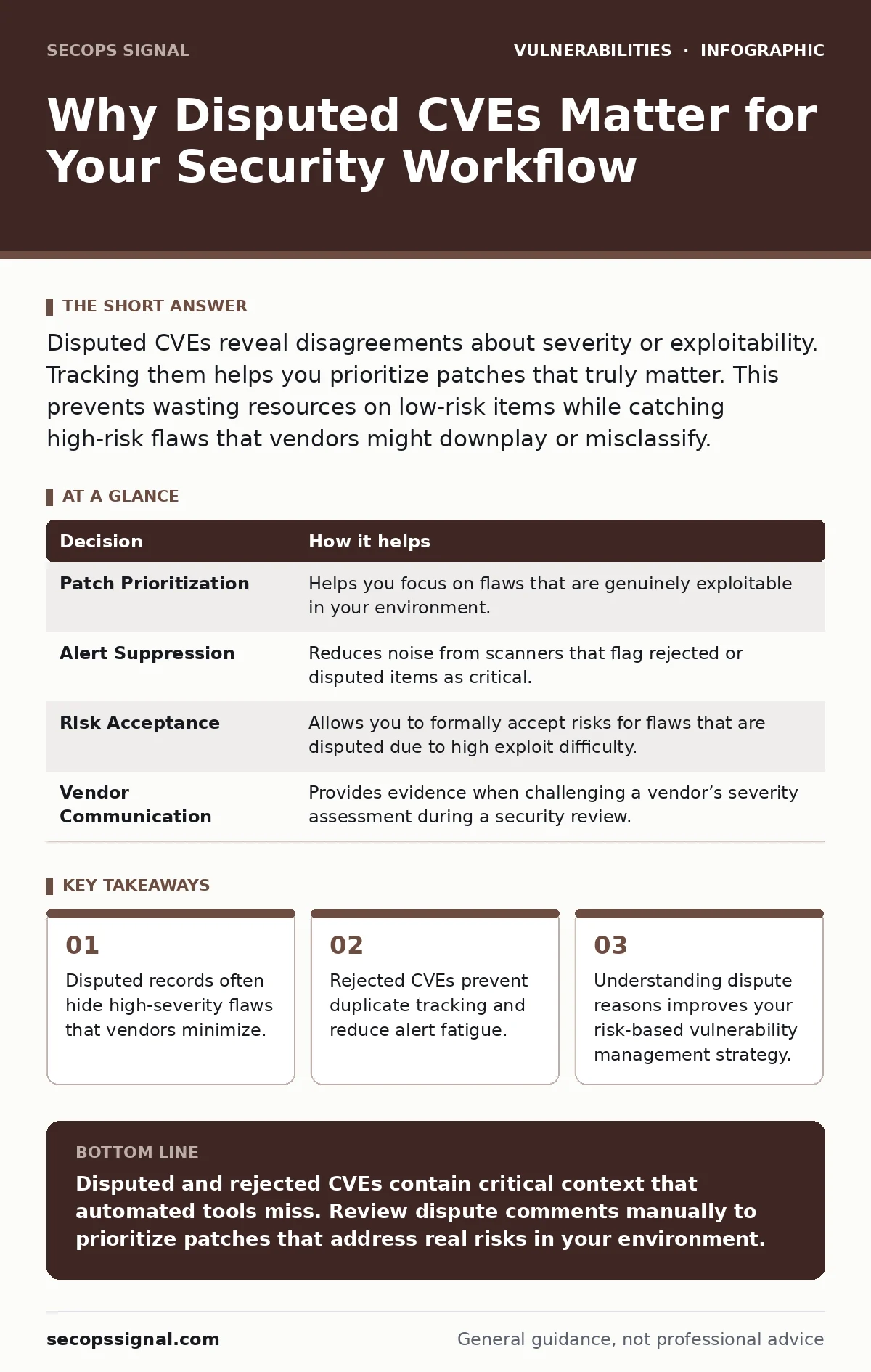
Disputed CVEs reveal disagreements about severity or exploitability. Tracking them helps you prioritize patches that truly matter. This prevents wasting resources on low-risk items while catching high-risk flaws that vendors might downplay or misclassify.
The Anatomy of a Disputed Record
A Common Vulnerabilities and Exposures identifier, or CVE, is a unique string assigned to a publicly disclosed vulnerability. The process is not always straightforward. Vendors and researchers sometimes disagree on whether a flaw exists, how severe it is, or whether it qualifies as a vulnerability at all. These disagreements result in disputed or rejected records.
You must understand these records because they influence your patching decisions. A disputed CVE might indicate a vendor is downplaying a serious issue. A rejected CVE might mean the flaw is not exploitable in practice. Both scenarios require different responses from your security team.
Ignoring these nuances leads to wasted effort or missed risks. You spend time patching low-risk items while leaving high-risk exposures open. This imbalance weakens your overall security posture.
How Teams Use Dispute Data
Security teams use CVE status data to refine their prioritization models. You check the CVE record for the "State" field. It will show "Published," "Reserved," "Rejected," or sometimes indicate a dispute through linked comments or withdrawn records.
You read the comments section of the CVE entry. Researchers often explain why they believe a flaw is critical. Vendors may argue it requires unrealistic conditions. This dialogue provides context that the base CVSS score lacks.
You cross-reference disputed CVEs with your asset inventory. If the disputed flaw affects a system you do not use, you can safely ignore it. If it affects a critical server, you investigate further.
Decisions Informed by CVE Status
The status of a CVE informs several key decisions. You need to know which patches to apply first, which alerts to suppress, and which risks to accept.
| Decision | How it helps |
|---|---|
| Patch Prioritization | Helps you focus on flaws that are genuinely exploitable in your environment. |
| Alert Suppression | Reduces noise from scanners that flag rejected or disputed items as critical. |
| Risk Acceptance | Allows you to formally accept risks for flaws that are disputed due to high exploit difficulty. |
| Vendor Communication | Provides evidence when challenging a vendor’s severity assessment during a security review. |
Using this data correctly aligns your efforts with actual risk. You stop chasing ghosts and start fixing real problems. This approach supports effective risk-based vulnerability management.
What Goes Wrong Without It
Without tracking disputed and rejected CVEs, your security workflow becomes inefficient. You may patch systems for vulnerabilities that do not exist or cannot be exploited. This wastes developer time and system resources.
You might also miss critical flaws. A vendor might reject a CVE to avoid bad publicity. If you trust the rejection blindly, you leave a known weakness unpatched. Attackers often exploit these hidden gaps.
This scenario mirrors issues with hard-coded credentials. If you accept a vendor’s claim that no secrets are exposed, you might miss embedded keys. Similarly, accepting a rejected CVE without verification can leave your data exposed.
The Hidden Cost of Disputes
Disputes create uncertainty. You may hesitate to patch because the severity is unclear. This hesitation creates a window of opportunity for attackers. They know the flaw exists and are waiting for you to ignore it.
The cost is not just technical. It is operational. Your team spends hours investigating disputes. They read technical arguments and test exploit conditions. This time could be spent on proactive defense.
You mitigate this cost by establishing clear rules. Decide in advance how you handle disputed CVEs. Do you patch them immediately? Do you wait for third-party verification? Consistency reduces decision fatigue.
See also: WordPress Plugin Update Policies: Benefits, Limits, and When to Automate · Responsible Disclosure Program: How To Build One That Works
Integrating Dispute Data into Workflow
You can integrate CVE status data into your existing tools. Most vulnerability scanners allow you to filter by CVE state. Configure your scanner to exclude rejected CVEs from your critical alerts.
For disputed CVEs, create a separate workflow. Flag them for manual review. Assign a security engineer to read the comments and test the exploit. This manual step adds value that automation cannot provide.
This process complements your penetration testing efforts. Penetration testers often discover flaws that vendors have not yet acknowledged. If a tester finds a disputed CVE, they can use the dispute comments to validate their findings.
Beyond the CVE Record
CVE status is just one piece of the puzzle. You must also consider the context of your environment. A disputed CVE might be irrelevant for your specific configuration.
For example, a dispute might hinge on the presence of a specific plugin. If you do not use that plugin, the CVE does not apply. This is similar to how file upload vulnerabilities depend on whether your system accepts uploads.
You should also review your compensating controls. If you have strong network segmentation, a disputed remote code execution flaw might be less risky. Your controls reduce the likelihood of exploitation.
However, do not assume controls are perfect. They can fail. Always verify that your controls are in place and functioning. This verification is key to making informed decisions about disputed CVEs.
Building a Sustainable Process
Sustainability requires documentation. Record your decisions about disputed CVEs. Note why you chose to patch, ignore, or accept the risk. This documentation helps new team members understand your rationale.
It also helps during audits. You can show that you considered all relevant data. You did not just patch randomly. You made informed decisions based on evidence.
This process supports broader security goals. It aligns with subdomain takeover prevention by ensuring you monitor all public-facing assets. It also aligns with WordPress plugin update policies by helping you decide which updates are urgent.
By treating CVE disputes as data points, not noise, you build a stronger defense. You anticipate attacks rather than reacting to them. This proactive stance is the hallmark of mature security operations.
Key takeaways
- Disputed records often hide high-severity flaws that vendors minimize.
- Rejected CVEs prevent duplicate tracking and reduce alert fatigue.
- Understanding dispute reasons improves your risk-based vulnerability management strategy.
Disputed and rejected CVEs contain critical context that automated tools miss. Review dispute comments manually to prioritize patches that address real risks in your environment.
Frequently asked questions
What is the difference between a disputed and a rejected CVE?
A disputed CVE indicates an ongoing disagreement about severity or validity, while a rejected CVE has been formally dismissed by the CVE Numbering Authority as not meeting vulnerability criteria.
Should I patch a CVE if it is disputed?
You should assess the dispute comments and your environment. If the exploit is plausible and affects your systems, patch it. If the dispute reveals unrealistic conditions, you may delay or accept the risk.
How do I find dispute comments for a CVE?
Visit the official CVE record on the MITRE website. Look for the "Comments" section or linked issues in the vendor’s security advisory. These sections often contain the technical debate.
Can a rejected CVE become valid later?
Yes, if new evidence emerges showing the flaw is exploitable. You should monitor previously rejected CVEs if they affect critical assets, as their status can change with new research.
How this guide was produced: written by the SecOps Signal editorial team with AI assistance, checked against the public references listed below, and reviewed when the facts change. See our editorial policy or report an error.