Difference Between Penetration Testing and Performance Testing
Security tests break your systems to find gaps, while performance tests break them to find limits. Confusing the two causes costly delays and false confidence in your infrastructure.

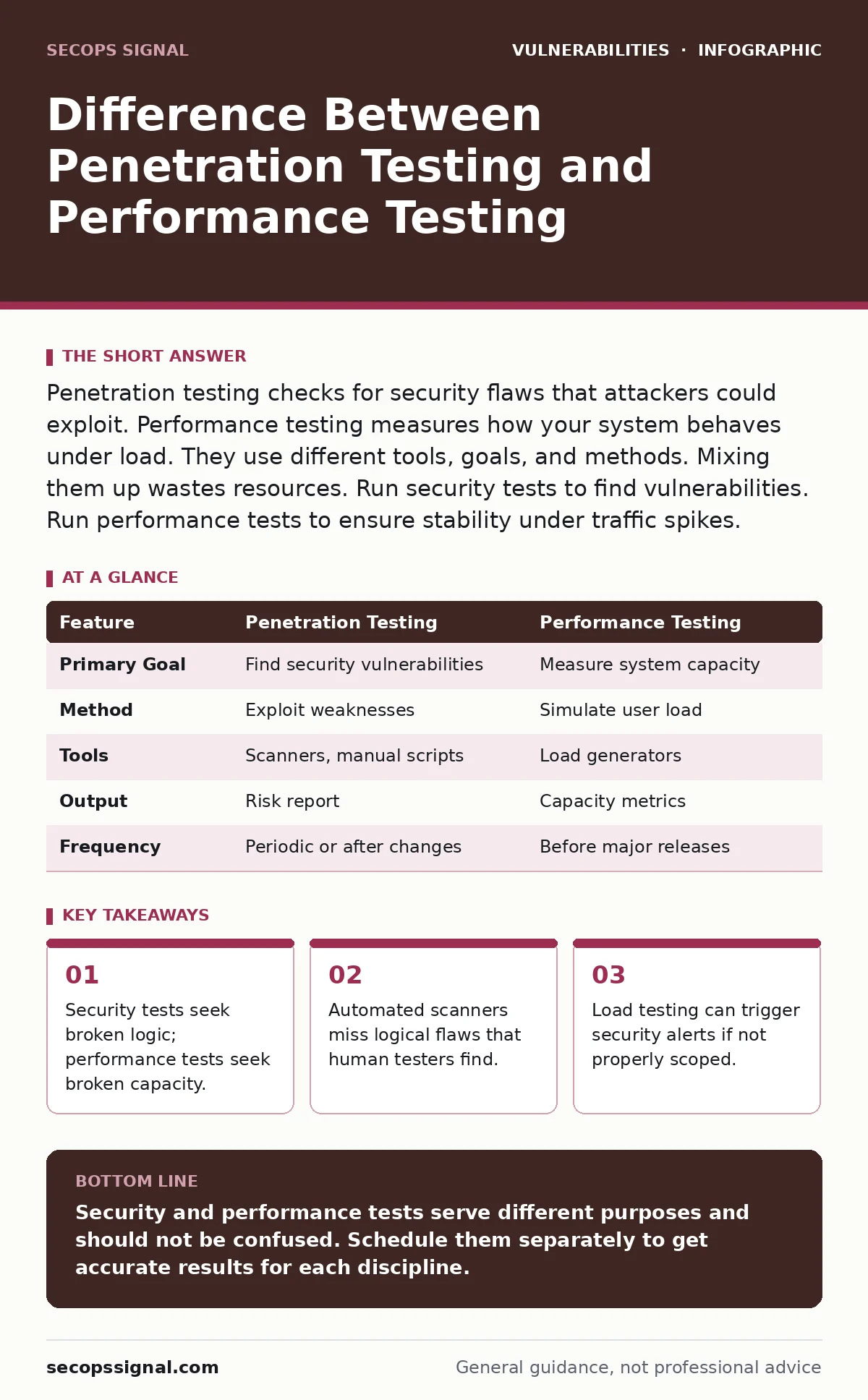
Penetration testing checks for security flaws that attackers could exploit. Performance testing measures how your system behaves under load. They use different tools, goals, and methods. Mixing them up wastes resources. Run security tests to find vulnerabilities. Run performance tests to ensure stability under traffic spikes.
What is the difference between penetration testing and performance testing?
Penetration testing evaluates security by attempting to exploit weaknesses in your systems. Performance testing evaluates stability by simulating high user traffic or data volume. One asks if your doors are locked. The other asks if your floors will collapse when everyone enters. You need both to run a secure and reliable service. They address entirely different risk categories.
Why do security teams separate these two testing types?
Separating these tests prevents false positives and resource conflicts. Security tools often send malformed packets that confuse performance metrics. Performance tools generate massive traffic that triggers intrusion detection systems. Mixing them obscures the root cause of failures. A slow response might indicate a database bottleneck or a successful denial-of-service attack. Isolating the tests gives you clear, actionable data for each team.
How does penetration testing actually work in practice?
Testers act like attackers to find entry points. They probe for hard-coded credentials that developers left in source code. They check for file upload vulnerabilities where malicious scripts might run. They verify if parameterized queries prevent database manipulation. The goal is to prove a breach is possible. This process requires deep technical knowledge and creative thinking. Automated tools catch only about half of common issues.
What does performance testing measure in your system?
Performance testing measures response times, throughput, and error rates under load. It determines how many users your server can handle before slowing down. It identifies memory leaks that crash applications after hours of use. It checks database query efficiency during peak times. Unlike security tests, it does not try to break in. It tries to break the system through volume and duration. This reveals capacity limits before real users encounter them.
When might these tests interfere with each other?
Heavy load testing can mimic a denial-of-service attack. Intrusion prevention systems may block performance test traffic, skewing results. Security scanners may trigger rate-limiting mechanisms, making the system appear slower than it is. Imagine running a penetration test while your site handles black Friday traffic. The security tool might slow down legitimate users. Coordinate schedules carefully. Use isolated environments for intense load testing. Keep security scans lightweight during peak hours.
| Feature | Penetration Testing | Performance Testing |
|---|---|---|
| Primary Goal | Find security vulnerabilities | Measure system capacity |
| Method | Exploit weaknesses | Simulate user load |
| Tools | Scanners, manual scripts | Load generators |
| Output | Risk report | Capacity metrics |
| Frequency | Periodic or after changes | Before major releases |
Which related security issues do standard tests miss?
Standard automated scans often miss subdomain takeover risks. They rarely detect open redirect vulnerabilities that aid phishing. They struggle to find session fixation flaws in complex login flows. These issues require manual review or specialized logic testing. A vulnerability prioritization strategy helps you focus on high-impact flaws. Do not rely solely on automated performance or security tools. Human insight catches the nuanced errors that scripts ignore.
How do you integrate both into your release cycle?
Integrate security checks early in the development phase. Use static analysis to catch hard-coded credentials before code runs. Run performance benchmarks on every major update. Reserve full penetration testing for pre-release or quarterly reviews. This balance keeps security and stability in check. It prevents last-minute surprises. You build a culture where both speed and safety matter.
What happens if you only do one type of test?
Choosing only performance testing leaves you vulnerable to hackers. Your system may handle millions of users but leak passwords. Choosing only penetration testing leaves you vulnerable to crashes. Your system may be secure but unusable during traffic spikes. You need a holistic approach. Balance your budget between security experts and performance engineers. Both disciplines protect your business reputation and revenue.
How do you measure success in both areas?
Security success means finding and fixing critical flaws before attackers do. Track the number of high-severity vulnerabilities resolved. Performance success means meeting response time targets under expected load. Track maximum concurrent users and error rates. Define clear thresholds for both. Review metrics together. This ensures your team understands the trade-offs between security controls and system speed.
Key takeaways
- Security tests seek broken logic; performance tests seek broken capacity.
- Automated scanners miss logical flaws that human testers find.
- Load testing can trigger security alerts if not properly scoped.
Security and performance tests serve different purposes and should not be confused. Schedule them separately to get accurate results for each discipline.
Frequently asked questions
Can I use the same tool for both tests?
No. Security tools look for flaws in logic and code. Performance tools simulate traffic volume. Using one for the other gives misleading data and misses critical issues.
How often should I run penetration tests?
Run them after major changes to your code or infrastructure. Annual tests are a minimum for most businesses. Critical systems need more frequent checks to stay secure.
Does performance testing improve security?
Indirectly. It reveals how systems behave under stress. Some security flaws only appear when resources are exhausted. However, it does not replace dedicated security assessments.
Who should perform penetration testing?
Use certified external experts for unbiased results. Internal teams may miss blind spots. External testers bring fresh perspectives and specialized skills to find hidden vulnerabilities.
How this guide was produced: written by the SecOps Signal editorial team with AI assistance, checked against the public references listed below, and reviewed when the facts change. See our editorial policy or report an error.