Compensating Controls: How to Secure Systems When Primary Defenses Fail
Compensating controls provide equivalent security when primary defenses are impossible to implement, allowing operations to continue safely without violating compliance standards.

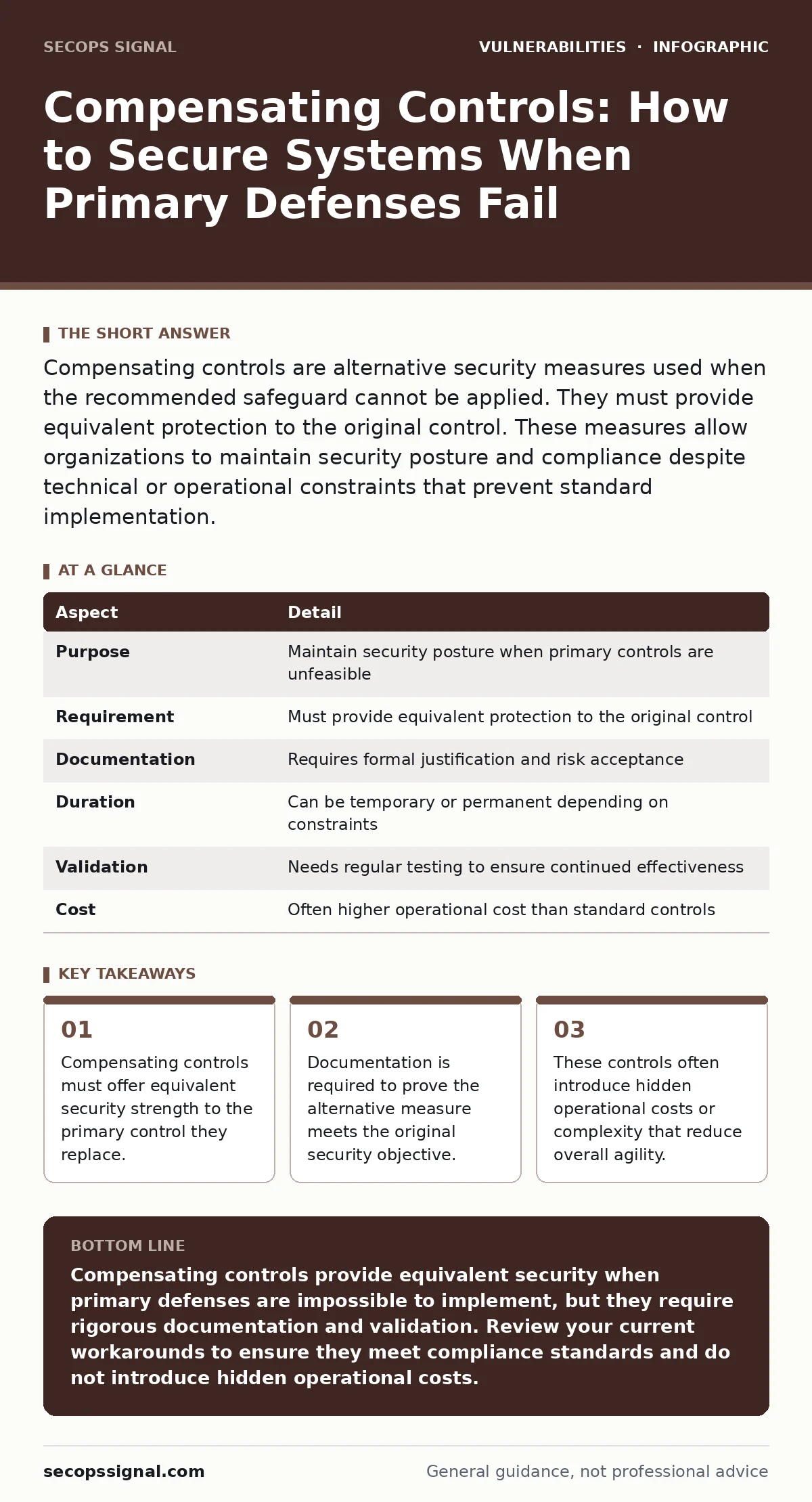
Compensating controls are alternative security measures used when the recommended safeguard cannot be applied. They must provide equivalent protection to the original control. These measures allow organizations to maintain security posture and compliance despite technical or operational constraints that prevent standard implementation.
The Broken Lock Analogy
Imagine your front door lock breaks. You cannot replace it immediately because the locksmith is unavailable. You do not leave the door open. Instead, you install a heavy-duty deadbolt on the inside and have a guard sit in the hallway. This alternative arrangement provides equivalent security to the broken lock. The guard and deadbolt are compensating controls. They solve the immediate risk while the primary solution remains out of reach.
Security frameworks rarely accept "we tried" as an answer. They require equivalent protection. If you cannot implement the standard control, you must demonstrate that your alternative achieves the same security outcome. This prevents gaps in your defense strategy while acknowledging real-world constraints.
What Compensating Controls Actually Are
A compensating control is an alternative security measure implemented when the prescribed control cannot be applied. It addresses the same risk as the original control but uses a different mechanism. The alternative must provide equivalent protection. Equivalent does not mean identical. It means the residual risk is reduced to an acceptable level.
You use these controls when technical limitations, legacy systems, or business requirements prevent standard implementation. For example, you might not be able to encrypt data at rest due to performance constraints. Instead, you restrict physical access to the server room and monitor data exfiltration. This combination compensates for the lack of encryption.
| Aspect | Detail |
|---|---|
| Purpose | Maintain security posture when primary controls are unfeasible |
| Requirement | Must provide equivalent protection to the original control |
| Documentation | Requires formal justification and risk acceptance |
| Duration | Can be temporary or permanent depending on constraints |
| Validation | Needs regular testing to ensure continued effectiveness |
| Cost | Often higher operational cost than standard controls |
The Problem They Solve
Standard security frameworks assume ideal conditions. They recommend specific technical controls based on best practices. Real environments rarely match these ideals. Legacy applications may not support modern authentication protocols. Budget constraints may prevent purchasing specific hardware. Operational requirements may demand system availability that conflicts with strict isolation.
Compensating controls bridge the gap between theoretical best practice and practical reality. They allow you to meet compliance requirements without halting business operations. Without them, you would either accept unacceptable risk or disable critical systems. This binary choice is rarely viable for organizations relying on continuous service delivery.
How They Fit With Other Defenses
Compensating controls are not standalone solutions. They integrate into your existing security architecture. They often work alongside other measures to create a layered defense. This approach aligns with the principle of defense in depth. You do not replace one control with another in isolation. You adjust the entire security posture to account for the missing primary control.
Consider how this relates to risk-based vulnerability management. You prioritize risks based on impact and likelihood. A compensating control shifts the risk profile. It reduces the impact or likelihood of a specific threat. You must reassess your risk calculations after implementing the alternative. The control does not eliminate the risk. It manages it to an acceptable level.
Common Implementation Mistakes
Many organizations misunderstand the requirements for compensating controls. The most frequent error is assuming any additional security measure qualifies. Adding a firewall does not compensate for missing encryption if the data is compromised inside the network. The alternative must address the specific risk of the missing control.
Another mistake is treating compensating controls as permanent fixes. They are often workarounds for technical debt. If you implement a compensating control, you must have a plan to address the root cause. Leaving a workaround in place indefinitely increases technical debt. It also complicates future audits and security reviews.
See also: Compliance Audits Examples: Real-World Scenarios and Outcomes
Documenting Your Justification
Auditors and security teams require proof that your alternative control works. You must document the risk, the reason the primary control cannot be used, and how the compensating control provides equivalent protection. This documentation is not optional. It is the basis for risk acceptance.
Your documentation should include the security objective, the technical constraint, the alternative measure, and the validation method. You need evidence that the control is effective. This might include logs, monitoring alerts, or test results. Without this evidence, the control is just a claim. Claims do not satisfy compliance requirements.
Validating Effectiveness Over Time
A compensating control is not a set-and-forget solution. You must validate its effectiveness regularly. Technology changes. Threats evolve. The alternative measure may become less effective over time. You need a process to review and test the control. This ensures it continues to provide equivalent protection.
Validation methods vary based on the control type. For technical controls, you might use automated scanning or penetration testing. For procedural controls, you might review logs or interview staff. The key is consistency. You must apply the same rigor to compensating controls as you do to primary controls. Neglecting validation creates hidden vulnerabilities.
The Hidden Costs of Alternatives
Compensating controls often introduce complexity. They may require additional monitoring, manual processes, or specialized staff. This increases operational overhead. You must account for these costs in your security budget. Ignoring them leads to resource strain and potential burnout.
Complexity also increases the risk of configuration errors. A complex workaround is harder to manage than a standard control. You must train staff on the alternative measure. This training takes time and resources. The total cost of ownership for a compensating control is often higher than the primary control. You must weigh this trade-off carefully.
Integrating With Broader Security Strategies
Compensating controls must align with your overall security strategy. They should not create new vulnerabilities elsewhere. For instance, if you use a compensating control that increases network traffic, you must ensure your network monitoring can handle the load. You must consider the broader impact on your infrastructure.
This integration is critical for long-term security. Isolated controls create silos. Silos make it difficult to detect advanced threats. You need visibility across all controls, primary and compensating. This holistic view allows you to identify gaps and adjust your strategy. It also supports responsible disclosure by ensuring you have accurate information about your security posture.
Key takeaways
- Compensating controls must offer equivalent security strength to the primary control they replace.
- Documentation is required to prove the alternative measure meets the original security objective.
- These controls often introduce hidden operational costs or complexity that reduce overall agility.
Compensating controls provide equivalent security when primary defenses are impossible to implement, but they require rigorous documentation and validation. Review your current workarounds to ensure they meet compliance standards and do not introduce hidden operational costs.
Frequently asked questions
Can a compensating control be weaker than the primary control?
No, a compensating control must provide equivalent protection. If it is weaker, it does not satisfy the requirement and leaves you exposed to unacceptable risk.
How long can I use a compensating control?
You can use it as long as the primary control remains unfeasible. However, you should regularly review the situation to implement the primary control when possible.
Do compensating controls satisfy all compliance frameworks?
Most major frameworks accept compensating controls if properly documented and validated. Check specific framework requirements for detailed guidance on acceptable alternatives.
What if my compensating control fails?
You must have incident response procedures in place. A failed compensating control creates a security gap. You need to detect and respond to this failure quickly to mitigate risk.
How this guide was produced: written by the SecOps Signal editorial team with AI assistance, checked against the public references listed below, and reviewed when the facts change. See our editorial policy or report an error.