Responsible Disclosure Program: How To Build One That Works
A responsible disclosure program turns security researchers into unpaid auditors, but only if you define clear rules for reporting and fix issues before they become public exploits.

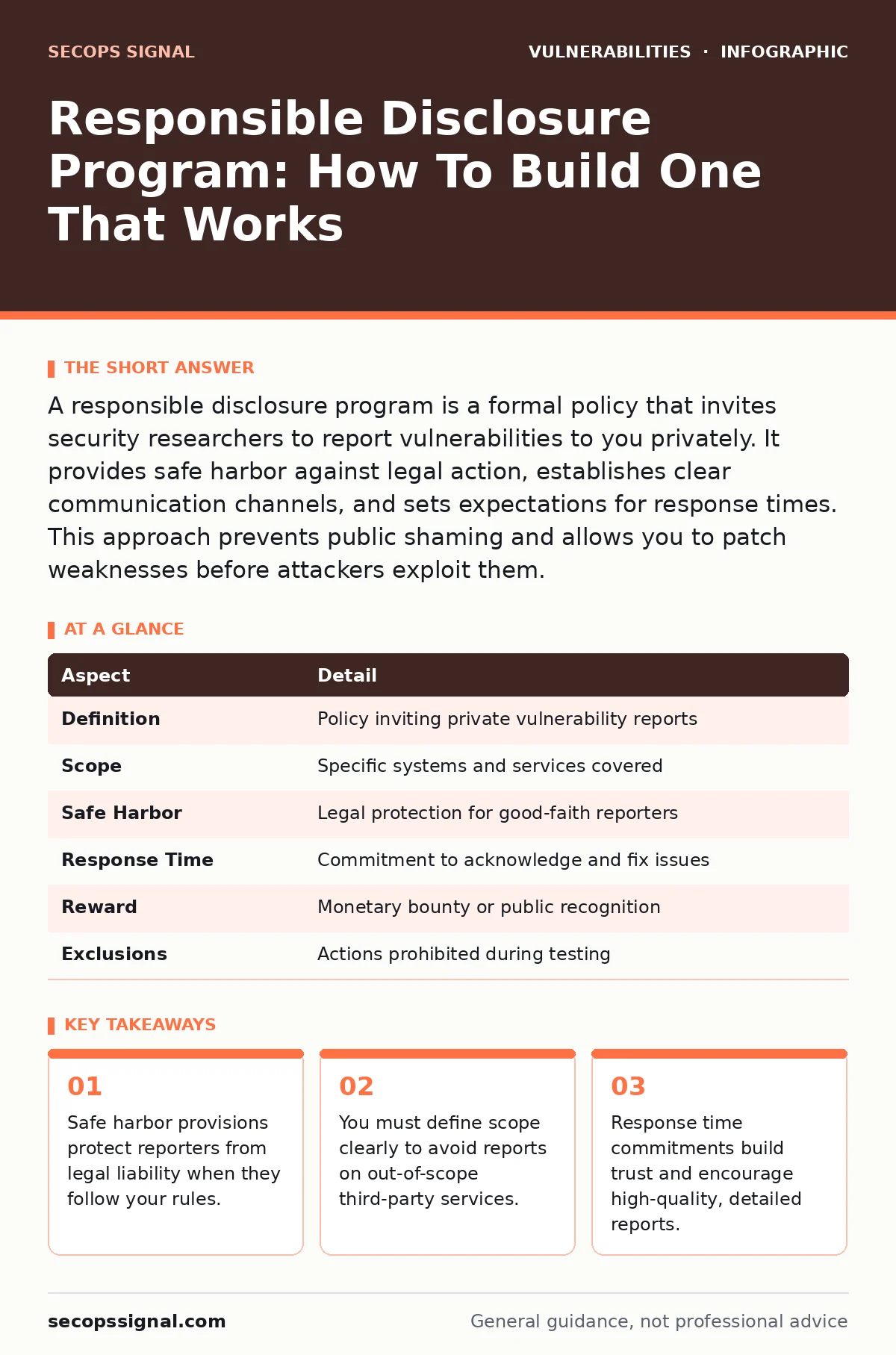
A responsible disclosure program is a formal policy that invites security researchers to report vulnerabilities to you privately. It provides safe harbor against legal action, establishes clear communication channels, and sets expectations for response times. This approach prevents public shaming and allows you to patch weaknesses before attackers exploit them.
The Post Office Analogy
Imagine you run a post office. A citizen finds a hole in the fence that allows mail to be stolen. If they shout about it on social media, customers panic and leave. If they report it to you quietly, you can repair the fence before anyone uses it. A responsible disclosure program is the official mailbox where that citizen submits the report. It transforms a potential crisis into a routine maintenance task. You acknowledge the report, fix the issue, and thank the reporter. This mechanism shifts the dynamic from adversarial to cooperative.
| Aspect | Detail |
|---|---|
| Definition | Policy inviting private vulnerability reports |
| Scope | Specific systems and services covered |
| Safe Harbor | Legal protection for good-faith reporters |
| Response Time | Commitment to acknowledge and fix issues |
| Reward | Monetary bounty or public recognition |
| Exclusions | Actions prohibited during testing |
What Is a Responsible Disclosure Program
A responsible disclosure program is a structured policy that encourages security researchers to report vulnerabilities to an organization privately. It replaces the "full disclosure" model, where researchers publish flaws immediately, with a coordinated process. The core components include a dedicated contact method, such as a specific email address or web form. It also includes a statement of safe harbor, which assures reporters they will not face legal action for testing within defined boundaries. This framework allows you to understand the risk before the public does.
How The Process Works
The workflow begins when a researcher identifies a weakness. They submit a report through your designated channel. You acknowledge receipt within a set timeframe, typically 48 hours. This acknowledgment proves you are listening and prevents duplicate reports. Next, your technical team triages the finding. You determine the severity and assign a fix. Once patched, you notify the reporter. Finally, you may issue a public acknowledgment. This cycle builds trust. If you ignore reports, researchers will bypass your program and disclose publicly.
Who It Affects And Why It Matters
This program affects your engineering team, your legal department, and your customers. Engineers must prioritize patches based on incoming reports. Legal teams must draft safe harbor language that is enforceable and clear. Customers benefit from faster remediation of critical flaws. Without a program, you rely on chance to discover issues. With a program, you tap into the global talent of security researchers. They scan your systems continuously. This external scrutiny complements internal efforts like penetration testing. It creates a layer of defense that internal teams cannot sustain alone.
Common Mistakes In Program Design
Many organizations fail by defining scope too broadly. If you include every third-party service, you will receive reports you cannot fix. You must limit scope to systems you control. Another error is ignoring non-critical findings. Even low-severity issues indicate a pattern of weakness. Dismissing them damages your relationship with the researcher. A third mistake is lacking internal triage. If a report sits unread for weeks, the researcher loses trust. They may then disclose the flaw publicly. You must have a process to route reports to the right team immediately.
See also: Mitigations and Workarounds: Practical Steps for Small Teams · WordPress Plugin Update Policies: Benefits, Limits, and When to Automate
Building Trust With Researchers
Trust is the currency of a disclosure program. You earn it by being transparent and consistent. Publish your policy clearly on your website. Link to it from your footer and terms of service. Use standard formats like HTTP security headers to signal your security posture. When you fix an issue, credit the researcher if they allow it. This recognition motivates them to return. It also signals to others that you value security. Avoid legal threats unless the researcher acts maliciously. Most researchers want to help. Treat them as partners, not adversaries.
Integrating With Risk Management
A disclosure program feeds data into your broader security strategy. Each report is a data point about your attack surface. You can use this data to improve vulnerability prioritization. If you see repeated reports on the same component, you know it needs architectural review. This aligns with risk-based vulnerability management. You focus resources on the highest-risk areas. The program also highlights gaps in your development lifecycle. For example, if you receive many reports on parameterized queries, your code review process needs improvement.
Next Steps For Implementation
Start by defining your scope. List the domains, applications, and APIs you want covered. Create a dedicated email address for reports. Draft a simple safe harbor statement. Publish the policy. Train your support team to route reports to security. Set up a tracking system for incoming issues. Review and update the policy annually. As you gain experience, consider adding bounties. Start small and expand as your capacity grows. This gradual approach ensures you can handle the influx of reports.
Key takeaways
- Safe harbor provisions protect reporters from legal liability when they follow your rules.
- You must define scope clearly to avoid reports on out-of-scope third-party services.
- Response time commitments build trust and encourage high-quality, detailed reports.
Frequently asked questions
Do I need to pay researchers for every report?
Payment is not required for a responsible disclosure program. Many programs operate on a "acknowledgment only" basis. Bounties are optional and usually reserved for critical findings or high-effort reports.
What if a researcher breaks my terms of service?
If a researcher acts maliciously or exceeds the defined scope, you can invoke legal action. However, your safe harbor clause should clearly define what constitutes good faith behavior to avoid ambiguity.
How long should I keep a report confidential?
Confidentiality lasts until the vulnerability is fully patched. You should agree on a disclosure timeline with the researcher. If you cannot fix it within that time, you may need to negotiate an extension.
Does this replace internal security testing?
No, a responsible disclosure program complements internal testing. It provides external perspective and continuous monitoring. Internal testing remains necessary for deep architectural reviews and compliance requirements.
How this guide was produced: written by the SecOps Signal editorial team with AI assistance, checked against the public references listed below, and reviewed when the facts change. See our editorial policy or report an error.