Authentication Bypass Mistakes That Leave Systems Exposed
Authentication bypass vulnerabilities often stem from subtle logic errors and misconfigurations rather than complex cryptographic breaks, allowing attackers to skip verification entirely.

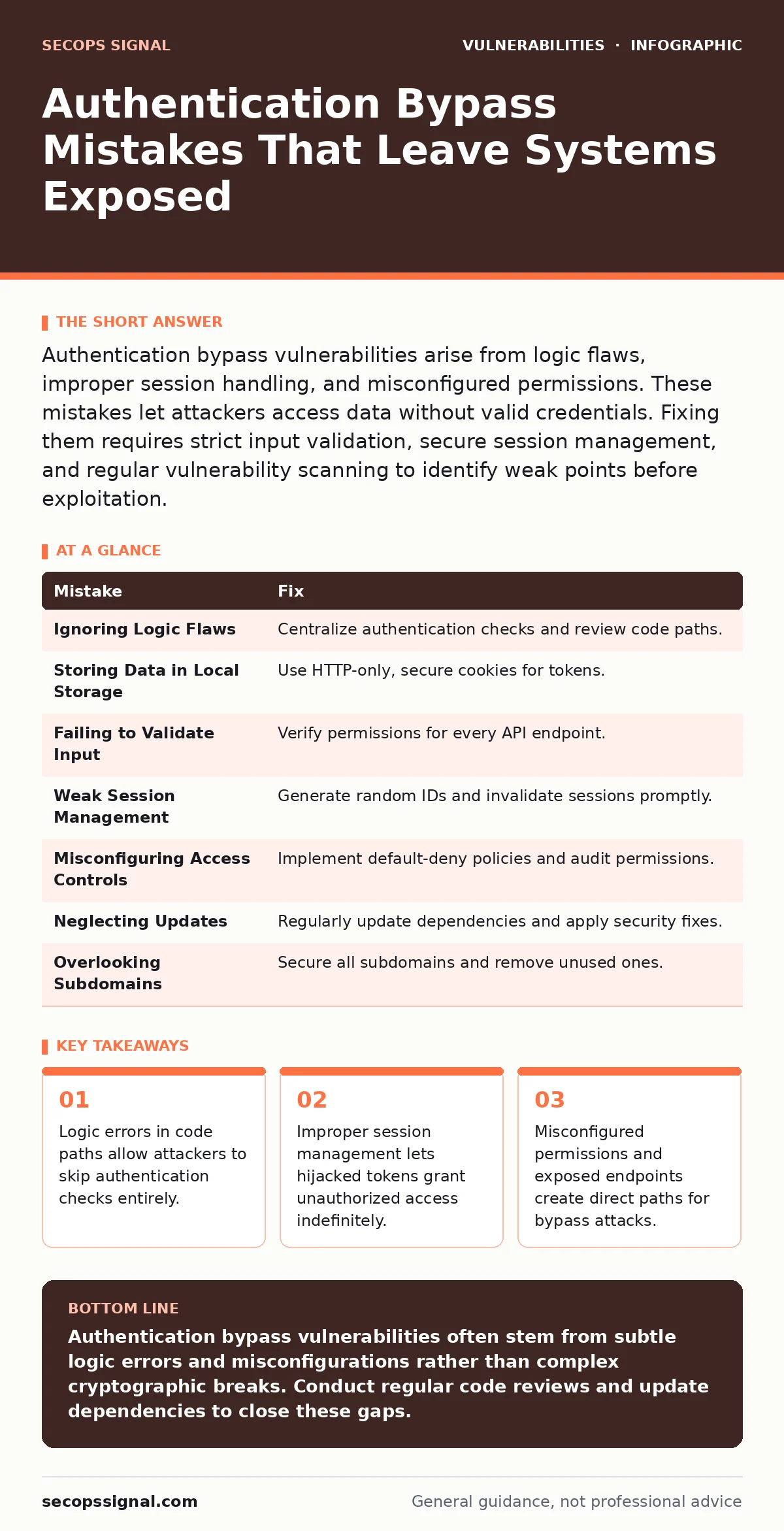
Authentication bypass vulnerabilities arise from logic flaws, improper session handling, and misconfigured permissions. These mistakes let attackers access data without valid credentials. Fixing them requires strict input validation, secure session management, and regular vulnerability scanning to identify weak points before exploitation.
Mistake 1: Ignoring Logic Flaws in Code Paths
Developers often focus on input validation while neglecting the flow of execution. Authentication bypass vulnerabilities frequently hide in conditional statements that fail to enforce checks under specific circumstances. Suppose a function checks for admin privileges only when a certain parameter is present. If an attacker omits that parameter, the code might default to allowing access. This logic error creates a backdoor that standard security tools often miss because the syntax appears correct.
Why it hurts:
Attackers exploit these gaps to access restricted areas without credentials. The consequence is immediate unauthorized access to sensitive data or administrative functions. Since the code executes normally, logs may show successful operations rather than failed logins. This makes detection difficult and allows persistent access. The breach occurs through legitimate code paths, bypassing perimeter defenses entirely.
The fix:
Implement consistent authentication checks at every entry point. Use a centralized authentication module that all functions must call before proceeding. Review code paths for conditional branches that skip verification. Ensure that default states deny access rather than granting it. Regular code reviews should specifically look for logic errors where authentication might be optional.
Mistake 2: Storing Sensitive Data in Local Storage
Many applications store user session tokens or authentication flags in browser local storage for convenience. This approach assumes the browser environment is secure, which is rarely true. Cross-site scripting attacks can easily read data from local storage. If an attacker injects a script into your page, they can extract these tokens and impersonate the user. This mistake turns a simple session into a permanent credential leak.
Why it hurts:
Exposing tokens in client-side storage allows attackers to hijack sessions without cracking passwords. The consequence is full account takeover. Since the token is valid, the application grants access as if the user authenticated correctly. This bypasses multi-factor authentication and other server-side checks. The attacker gains persistent access until the token expires or is revoked, often leading to data theft.
The fix:
Store authentication tokens in HTTP-only, secure cookies. These cookies are not accessible via JavaScript, preventing theft through cross-site scripting. Set the secure flag to ensure transmission only over encrypted connections. Implement short expiration times for tokens to limit the window of exposure. Regular vulnerability scanning can help identify if sensitive data is inadvertently stored in client-side locations.
Mistake 3: Failing to Validate Input on All Paths
Authentication systems often validate input on primary login forms but neglect secondary inputs. Suppose an API endpoint accepts a user ID in a query parameter. If the system trusts this ID without verifying it against the session, an attacker can change the ID to access another user's data. This is a form of insecure direct object reference. It allows bypassing authentication by manipulating identifiers rather than breaking credentials.
Why it hurts:
Skipping validation on secondary inputs creates direct paths for data exfiltration. The consequence is that attackers can access any record they guess or enumerate. This bypasses the need for brute-forcing passwords. The application assumes the user has permission because they are logged in, but it fails to check if they own the specific resource requested. This leads to massive data leaks and privacy violations.
The fix:
Validate all inputs against the authenticated user's permissions. Never trust client-side data for authorization decisions. Use parameterized queries to prevent injection attacks that might alter logic. Ensure that every API endpoint verifies that the requesting user has rights to the specific resource. Implement strict access controls that check ownership before returning data.
Mistake 4: Using Weak Session Management
Session management often relies on default settings that prioritize convenience over security. Developers may use predictable session IDs or fail to invalidate sessions after logout. An attacker can guess valid session IDs or reuse old ones. This is especially dangerous when sessions do not expire quickly. The consequence is that stolen or guessed sessions remain valid for extended periods, allowing persistent access.
Why it hurts:
Weak session management allows attackers to maintain access long after the initial compromise. The consequence is undetected presence within the system. Predictable session IDs enable brute-force attacks that are easy to automate. Lack of invalidation means that even if a password is changed, old sessions may still work. This undermines the effectiveness of credential resets and security alerts.
The fix:
Generate cryptographically random session IDs for every login. Invalidate sessions immediately upon logout or after a period of inactivity. Use short expiration times for session tokens to limit exposure. Implement session fixation protection by regenerating IDs after authentication. Regular risk-based vulnerability management helps identify weak session handling practices before they are exploited.
Mistake 5: Misconfiguring Access Control Lists
Access control lists define who can access what resources. Misconfigurations often grant broader permissions than necessary. Suppose a developer sets a default permission of "allow" instead of "deny" for a new feature. This mistake leaves the feature open to anyone who discovers the endpoint. Directory listing exposure can reveal these misconfigured paths. Attackers scan for these open doors to bypass authentication entirely.
Why it hurts:
Misconfigured permissions allow unauthorized users to access sensitive functions. The consequence is that authentication becomes irrelevant for those endpoints. Attackers do not need to bypass login screens; they simply access the resource directly. This is common in APIs where endpoints are not properly secured. The breach is silent, as the system records the access as legitimate due to the open permissions.
The fix:
Implement a default-deny policy for all resources. Explicitly grant permissions only to authorized users and roles. Regularly audit access control lists to remove unnecessary permissions. Ensure that new features are secure by default. Use vulnerability scanning to identify endpoints that are accessible without proper authentication. This prevents accidental exposure of sensitive data.
Mistake 6: Neglecting to Update Dependencies
Applications rely on third-party libraries for authentication features. These libraries may contain known vulnerabilities that allow bypass attacks. Developers often fail to update these dependencies, leaving known flaws unpatched. Backported security fixes from vendors may not be applied if the application uses outdated versions. This negligence turns a secure application into a vulnerable one overnight.
Why it hurts:
Outdated dependencies introduce known bypass vulnerabilities into your system. The consequence is that attackers can exploit public exploits without needing to discover new flaws. This makes breaches easier and more frequent. The application appears secure on the surface, but the underlying authentication mechanism is broken. This undermines trust and exposes sensitive data to easy extraction.
The fix:
Regularly update all third-party libraries and frameworks. Monitor security advisories for dependencies used in your application. Apply backported security fixes promptly to patch known vulnerabilities. Use automated tools to track dependency versions and alert on new releases. This ensures that your authentication mechanisms remain resilient against known threats.
Mistake 7: Overlooking Subdomain Security
Many organizations secure their main domain but neglect subdomains. Subdomain takeover can allow attackers to host malicious scripts on your subdomain. These scripts can steal authentication tokens or bypass checks. If a subdomain is not properly secured, it becomes an entry point for bypass attacks. This mistake is often overlooked because subdomains seem less critical.
Why it hurts:
Subdomain takeover allows attackers to inject malicious code into your infrastructure. The consequence is that they can bypass authentication by intercepting requests. This undermines the security of the main application. Attackers can use the subdomain to launch cross-site scripting attacks or steal session cookies. The breach originates from a seemingly minor misconfiguration, leading to significant damage.
The fix:
Secure all subdomains with the same rigor as the main domain. Regularly check for unused subdomains and remove them. Implement strict DNS policies to prevent takeover. Use subdomain isolation to limit the impact of a breach. This ensures that attackers cannot use subdomains as a foothold to bypass authentication on your primary services.
| Mistake | Fix |
|---|---|
| Ignoring Logic Flaws | Centralize authentication checks and review code paths. |
| Storing Data in Local Storage | Use HTTP-only, secure cookies for tokens. |
| Failing to Validate Input | Verify permissions for every API endpoint. |
| Weak Session Management | Generate random IDs and invalidate sessions promptly. |
| Misconfiguring Access Controls | Implement default-deny policies and audit permissions. |
| Neglecting Updates | Regularly update dependencies and apply security fixes. |
| Overlooking Subdomains | Secure all subdomains and remove unused ones. |
Key takeaways
- Logic errors in code paths allow attackers to skip authentication checks entirely.
- Improper session management lets hijacked tokens grant unauthorized access indefinitely.
- Misconfigured permissions and exposed endpoints create direct paths for bypass attacks.
Authentication bypass vulnerabilities often stem from subtle logic errors and misconfigurations rather than complex cryptographic breaks. Conduct regular code reviews and update dependencies to close these gaps.
Frequently asked questions
How do I detect authentication bypass vulnerabilities?
Use vulnerability scanning tools and conduct manual code reviews focusing on logic flows and input validation.
Can multi-factor authentication prevent bypass attacks?
Multi-factor authentication adds a layer but does not fix underlying logic flaws that allow bypass.
What is the role of risk-based vulnerability management?
It helps prioritize fixing authentication issues based on their potential impact and likelihood of exploitation.
How often should I review authentication logic?
Review authentication logic during every code change and conduct periodic comprehensive audits.
How this guide was produced: written by the SecOps Signal editorial team with AI assistance, checked against the public references listed below, and reviewed when the facts change. See our editorial policy or report an error.