HTTP Security Headers: 10 Questions That Fix Web Exposure
Misconfigured security headers can turn a secure site into an open door for injection and clickjacking attacks without changing any code.

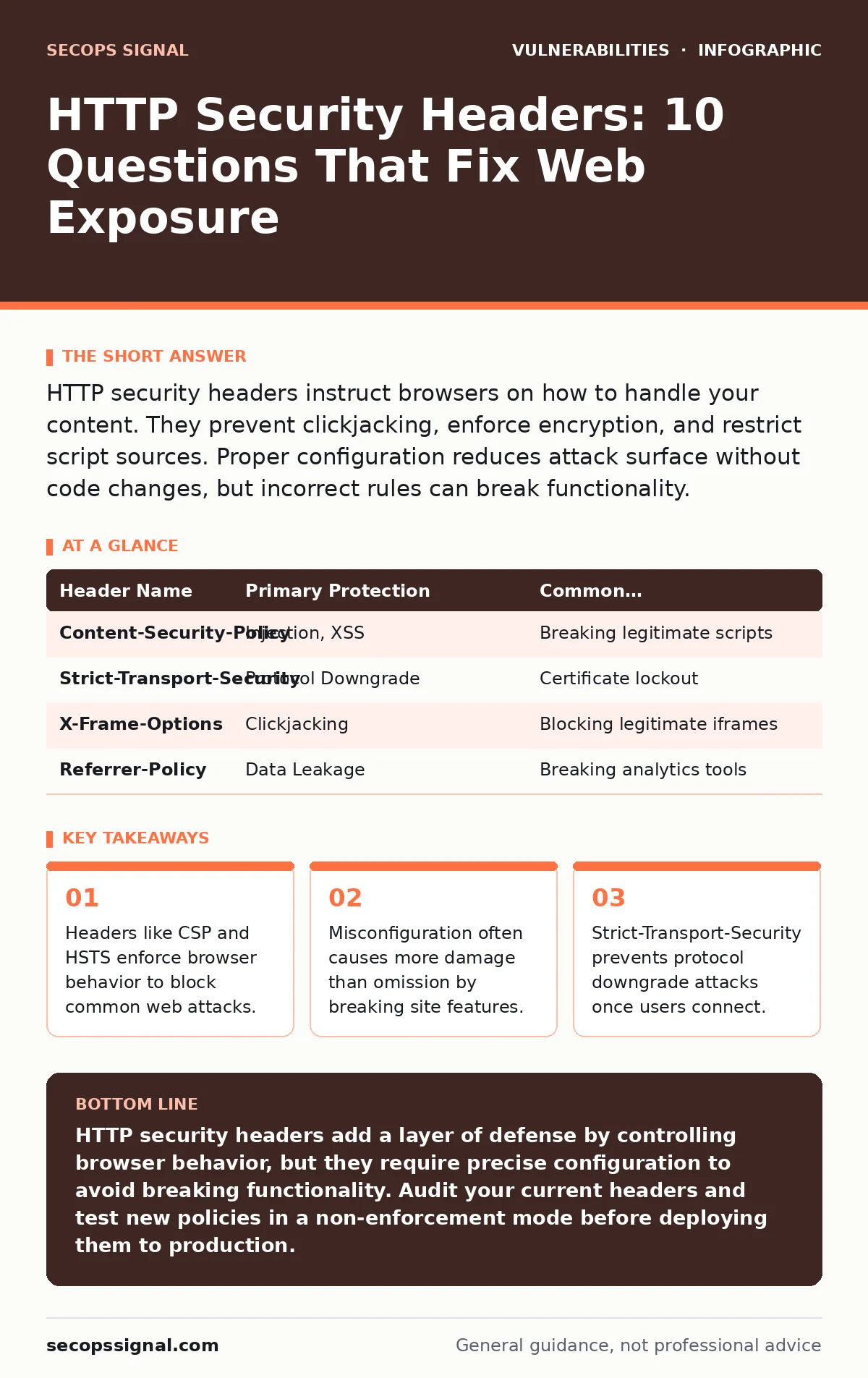
HTTP security headers instruct browsers on how to handle your content. They prevent clickjacking, enforce encryption, and restrict script sources. Proper configuration reduces attack surface without code changes, but incorrect rules can break functionality.
Do HTTP headers replace input validation?
No, headers act as a final safety net, not a primary defense. They tell the browser how to interpret data, but they do not sanitize the data itself. If you rely solely on headers to stop injection, attackers will still exploit logic flaws. Always combine header policies with secure coding practices like parameterized queries to ensure data integrity at the source.
What does the X-Frame-Options header actually do?
This header prevents your website from being rendered inside an iframe on another domain. It stops clickjacking attacks where a malicious site overlays your login form with invisible buttons. The browser refuses to display the frame if the header is set to DENY or SAMEORIGIN. This protection is simple but effective against interface hijacking.
Why is Strict-Transport-Security considered critical?
HSTS forces the browser to use HTTPS for all future connections to your domain. It prevents man-in-the-middle attacks that try to downgrade the connection to unencrypted HTTP. Once a user visits your site with HSTS enabled, the browser remembers this rule for a specified period. This eliminates the risk of the initial handshake being intercepted.
How does Content Security Policy block injection?
CSP defines a whitelist of sources from which the browser can load scripts, styles, and other resources. It restricts where JavaScript can execute, blocking inline scripts and external domains not on the list. This neutralizes many cross-site scripting attempts by limiting the execution context. You must audit your site’s dependencies before enforcing strict CSP rules.
What is the purpose of Referrer-Policy?
This header controls how much referrer information is sent when users navigate from your site to another. It prevents leaking sensitive URL parameters or internal paths to third-party services. Setting it to no-referrer or strict-origin-when-cross-origin protects user privacy. It ensures that internal identifiers do not leak into external logs or analytics.
See also: Open Redirect Myths: Why Your Assumptions About This Flaw Are Wrong
Does X-Content-Type-Options stop MIME sniffing?
Yes, it forces the browser to adhere to the declared content type rather than guessing. Without this header, a browser might interpret a text file as HTML or JavaScript. This prevents attackers from uploading malicious files that the server labels incorrectly. Setting it to nosniff ensures the browser respects the server’s content classification.
How do permissions policy headers restrict features?
Permissions-Policy replaces older feature-policy headers to control which browser features are allowed. You can disable camera, microphone, or geolocation access for iframes or the main frame. This reduces the attack surface by limiting what embedded content can do. It prevents malicious iframes from accessing sensitive hardware or location data.
What happens if I misconfigure these headers?
Incorrect settings can break functionality or expose new vulnerabilities. A too-strict CSP might block legitimate scripts, causing your application to fail. An overly broad HSTS max-age can make recovery from certificate issues nearly impossible. Testing headers in a report-only mode before enforcement is a standard safety practice.
Can headers protect against session fixation?
Headers alone do not prevent session fixation, but they support the broader strategy. Session fixation involves an attacker setting a known session ID for a victim. While headers like Secure and HttpOnly on cookies help, the application must regenerate session IDs after login. See our guide on session fixation for details on server-side session management.
How do headers interact with directory listing exposure?
Headers do not disable directory listing, which is a server configuration issue. However, proper X-Content-Type-Options ensures that listed files are not executed as code. If a user accesses a directory, the browser will not try to run a text file as a script. Combine header security with server settings that disable directory indexing.
| Header Name | Primary Protection | Common Misconfiguration Risk |
|---|---|---|
| Content-Security-Policy | Injection, XSS | Breaking legitimate scripts |
| Strict-Transport-Security | Protocol Downgrade | Certificate lockout |
| X-Frame-Options | Clickjacking | Blocking legitimate iframes |
| Referrer-Policy | Data Leakage | Breaking analytics tools |
What is the non-obvious cost of strict CSP?
Enforcing strict CSP requires maintaining an accurate inventory of all external resources. Every new library, font, or API endpoint must be explicitly allowed. This creates an ongoing maintenance burden that many teams overlook. A single missing host can break critical functionality, leading to emergency overrides.
How do headers relate to DLL hijacking?
HTTP headers generally do not prevent DLL hijacking, which is a local application vulnerability. DLL hijacking occurs when an application loads a library from an unsafe directory. However, secure headers ensure that the web server does not serve executable files as static content. This reduces the chance of an attacker delivering a malicious payload via the web server.
Should I implement risk-based vulnerability management for headers?
Yes, prioritize header fixes based on the sensitivity of the data handled. Public-facing pages with login forms need stricter headers than static informational pages. Not all pages require the same level of restriction. Evaluate the risk of each endpoint before applying global header policies.
Key takeaways
- Headers like CSP and HSTS enforce browser behavior to block common web attacks.
- Misconfiguration often causes more damage than omission by breaking site features.
- Strict-Transport-Security prevents protocol downgrade attacks once users connect.
- Content Security Policy requires careful tuning to balance security and functionality.
HTTP security headers add a layer of defense by controlling browser behavior, but they require precise configuration to avoid breaking functionality. Audit your current headers and test new policies in a non-enforcement mode before deploying them to production.
Frequently asked questions
Do HTTP headers protect against SQL injection?
No, headers do not sanitize input or prevent SQL injection. You must use parameterized queries and input validation on the server side to mitigate SQL injection risks.
Can I use both X-Frame-Options and CSP frame-ancestors?
Yes, but CSP frame-ancestors is the modern standard. Browsers will prioritize CSP if both are present, making X-Frame-Options redundant in most modern environments.
How do I test if my headers are working?
Use browser developer tools to inspect the network tab and response headers. Verify that the expected headers are present and correctly formatted in the server response.
Do headers protect file upload vulnerabilities?
Headers alone do not secure file uploads. You must validate file types, sizes, and content on the server. See our guide on file upload vulnerabilities for secure handling practices.
How this guide was produced: written by the SecOps Signal editorial team with AI assistance, checked against the public references listed below, and reviewed when the facts change. See our editorial policy or report an error.