How Tactical Threat Intelligence Works: From Data to Defense
Tactical threat intelligence converts raw network noise into specific defensive actions by linking technical artifacts to active adversary behaviors.
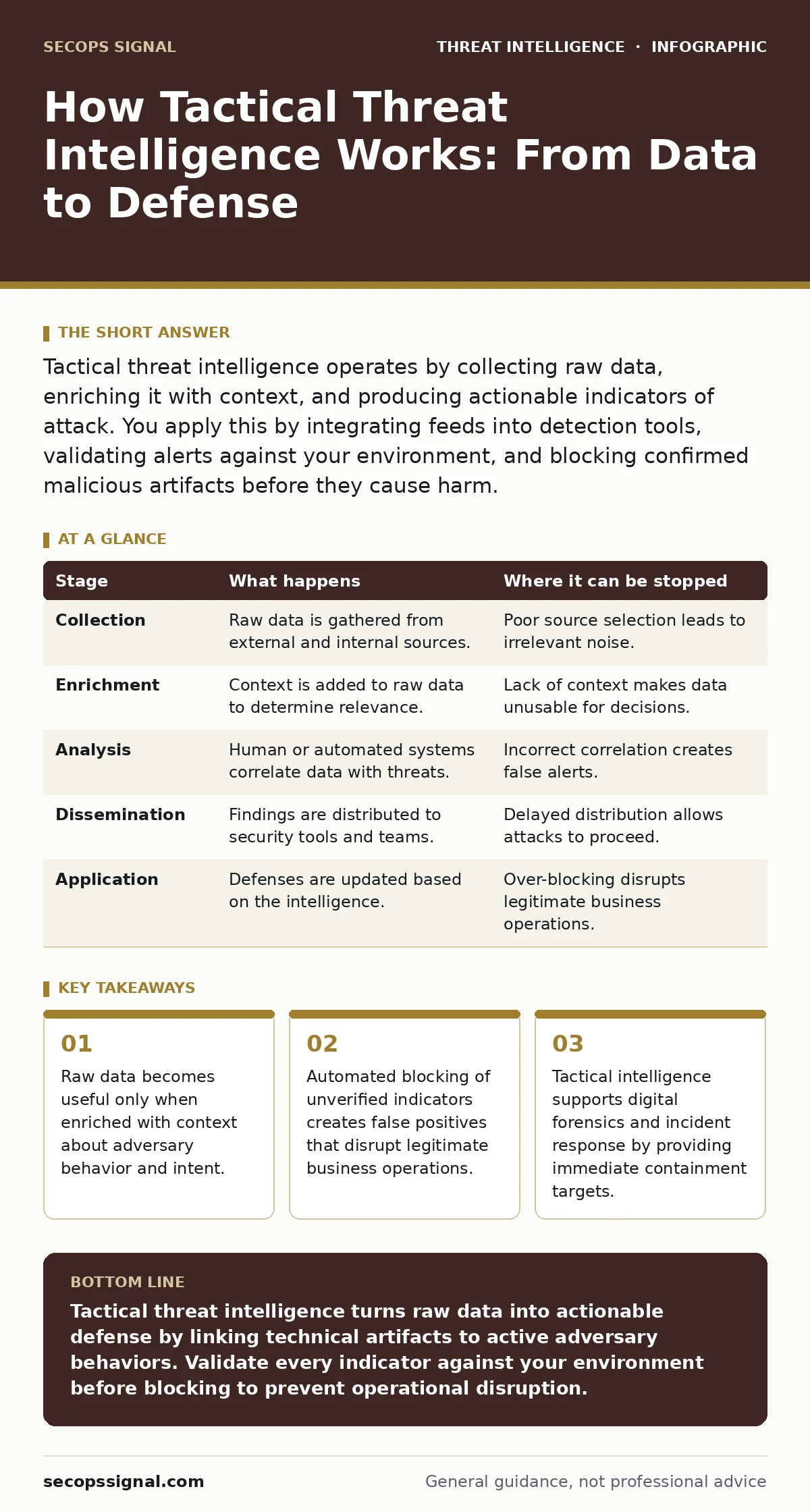
Tactical threat intelligence operates by collecting raw data, enriching it with context, and producing actionable indicators of attack. You apply this by integrating feeds into detection tools, validating alerts against your environment, and blocking confirmed malicious artifacts before they cause harm.
The Definition of Tactical Intelligence
Tactical threat intelligence focuses on the specific methods and tools adversaries use during an attack. Unlike strategic intelligence, which informs long-term planning, tactical intelligence provides immediate, actionable data for security operations. It answers the question of how an attack happens rather than why it happens. You use this type of intelligence to configure detection rules, update firewall blocks, and identify compromised systems.
This form of intelligence relies heavily on indicators of attack. These are technical artifacts, such as file hashes or network domains, that signal malicious activity. Understanding the difference between an indicator of compromise and an indicator of attack changes how you prioritize alerts. An indicator of compromise shows past infection, while an indicator of attack shows active exploitation.
Stage 1: Collection and Raw Data
The process begins with gathering raw data from multiple sources. These sources include open-source feeds, commercial subscriptions, and internal network logs. The goal is to capture a wide volume of potential threats. However, raw data is noisy and often irrelevant to your specific environment. You must collect more than you can immediately process to ensure you do not miss emerging threats.
Collection tools scrape public forums, paste sites, and malware repositories. They also ingest data from honeypots, which are decoy systems designed to attract attackers. This stage generates a high volume of false positives. Without filtering, this noise overwhelms security teams. You must define strict criteria for what data enters your pipeline.
| Stage | What happens | Where it can be stopped |
|---|---|---|
| Collection | Raw data is gathered from external and internal sources. | Poor source selection leads to irrelevant noise. |
| Enrichment | Context is added to raw data to determine relevance. | Lack of context makes data unusable for decisions. |
| Analysis | Human or automated systems correlate data with threats. | Incorrect correlation creates false alerts. |
| Dissemination | Findings are distributed to security tools and teams. | Delayed distribution allows attacks to proceed. |
| Application | Defenses are updated based on the intelligence. | Over-blocking disrupts legitimate business operations. |
Stage 2: Enrichment and Context
Raw data lacks meaning until you add context. Enrichment involves correlating a single artifact with broader threat campaigns. For example, a suspicious IP address becomes significant when linked to a known ransomware group. This step reduces noise by filtering out artifacts that do not match your industry or technology stack.
Context includes the adversary’s tactics, techniques, and procedures. It also includes the severity of the threat and the likelihood of exploitation. You can automate this enrichment using security information and event management systems. These systems cross-reference incoming data with known threat databases. This automation speeds up the process but requires careful tuning to avoid errors.
Stage 3: Analysis and Validation
Analysis determines whether the enriched data represents a real threat to your organization. Analysts review the data to confirm its validity. They check if the indicator is still active and if it matches your environment. This step prevents you from blocking legitimate traffic or ignoring true threats. Manual review is necessary for complex threats that automated systems might miss.
Suppose your system flags a domain as malicious. An analyst checks if that domain uses domain generation algorithms. These algorithms create random domains that change frequently. If the domain matches a known algorithm pattern, it is likely malicious. If it is a static domain used by a vendor, it might be a false positive. This validation step is critical for maintaining trust in your alerts.
Stage 4: Dissemination to Defense Tools
Once validated, the intelligence must reach the right defensive tools. Dissemination involves pushing indicators to firewalls, endpoint detection systems, and email gateways. You must format the data correctly for each tool. Different tools accept different formats, such as STIX or TAXII. Standardizing these formats ensures seamless integration across your security stack.
Automation plays a large role here. Security orchestration, automation, and response platforms can push updates instantly. This reduces the time between detection and defense. However, you must monitor these automated actions. A misconfigured push can block critical services. You need a feedback loop to report errors back to the analysis team.
See also: Implement Log Management: A Step-by-Step Technical Guide · Purple Teaming for Small Teams: Practical Defense Testing
Stage 5: Application and Feedback
Application is the final stage where intelligence becomes action. You block malicious IPs, quarantine infected files, and alert users to phishing infrastructure. This stage closes the loop by testing the effectiveness of the intelligence. If the block works, the threat is mitigated. If it does not, the intelligence was flawed or incomplete.
Feedback is essential for improvement. You must report false positives and negatives back to the collection and analysis stages. This continuous improvement cycle refines your detection rules. Over time, your system becomes more accurate and less noisy. This process supports digital forensics and incident response by providing a clean baseline for investigation.
The Cost of Automation
Automating tactical intelligence offers speed but introduces hidden costs. Over-reliance on automated blocking can lead to alert fatigue. When systems block too many false positives, analysts ignore real threats. You must balance automation with human oversight. Regular reviews of blocked traffic help identify patterns of false positives.
Imagine a scenario where an automated system blocks a legitimate cloud service IP. Employees cannot access critical applications. This disruption costs more than the potential threat. You must maintain a whitelist of trusted services. Regular updates to this whitelist prevent accidental blocks. This balance ensures security without hindering productivity.
Integration with Broader Security
Tactical intelligence does not exist in isolation. It feeds into purple teaming exercises, where defenders and attackers simulate real-world scenarios. These exercises test whether your tactical defenses work against actual adversary behavior. They reveal gaps in your detection rules and response procedures.
It also supports remote desktop abuse detection. Attackers often use legitimate remote access tools to move laterally. Tactical intelligence helps identify unusual remote access patterns. By combining this with network traffic analysis, you can detect unauthorized access. This integration strengthens your overall security posture.
Common Pitfalls in Implementation
Many organizations fail to implement tactical intelligence correctly. They focus on volume rather than quality. Collecting thousands of indicators without context creates noise. You must prioritize high-fidelity intelligence that matches your risk profile. Quality over quantity ensures your team focuses on real threats.
Another pitfall is ignoring the intelligence cycle. This cycle includes collection, processing, analysis, dissemination, and feedback. Skipping any stage leads to ineffective defense. You must treat intelligence as a continuous process, not a one-time setup. Regular audits of your intelligence pipeline ensure it remains effective.
Measuring Effectiveness
Measuring the effectiveness of tactical intelligence requires specific metrics. You should track the reduction in false positives over time. This metric shows how well your enrichment and analysis stages work. You should also track the time from detection to containment. Faster containment indicates effective dissemination and application.
Regular reviews of these metrics help you adjust your strategy. If false positives increase, you need better enrichment. If containment time increases, you need faster dissemination. This data-driven approach ensures your tactical intelligence remains a valuable asset. It transforms raw data into a competitive advantage.
Key takeaways
- Raw data becomes useful only when enriched with context about adversary behavior and intent.
- Automated blocking of unverified indicators creates false positives that disrupt legitimate business operations.
- Tactical intelligence supports digital forensics and incident response by providing immediate containment targets.
Tactical threat intelligence turns raw data into actionable defense by linking technical artifacts to active adversary behaviors. Validate every indicator against your environment before blocking to prevent operational disruption.
Frequently asked questions
How often should I update my tactical intelligence feeds?
Update feeds daily or in real-time to catch emerging threats. Real-time updates ensure you block active attacks before they cause harm.
Can small businesses afford tactical threat intelligence?
Yes, many open-source feeds provide high-quality data for free. You can integrate these feeds into existing security tools without significant cost.
What is the difference between tactical and strategic intelligence?
Tactical intelligence provides immediate, actionable data for defense. Strategic intelligence informs long-term planning and risk management.
How do I handle false positives in tactical intelligence?
Implement a feedback loop to report false positives to your analysis team. Regularly review blocked traffic to adjust your detection rules and whitelists.
How this guide was produced: written by the SecOps Signal editorial team with AI assistance, checked against the public references listed below, and reviewed when the facts change. See our editorial policy or report an error.