Dark web threat intelligence: what it is and how to use it
Hidden forums and illicit marketplaces expose stolen corporate credentials long before attackers deploy them against your network.

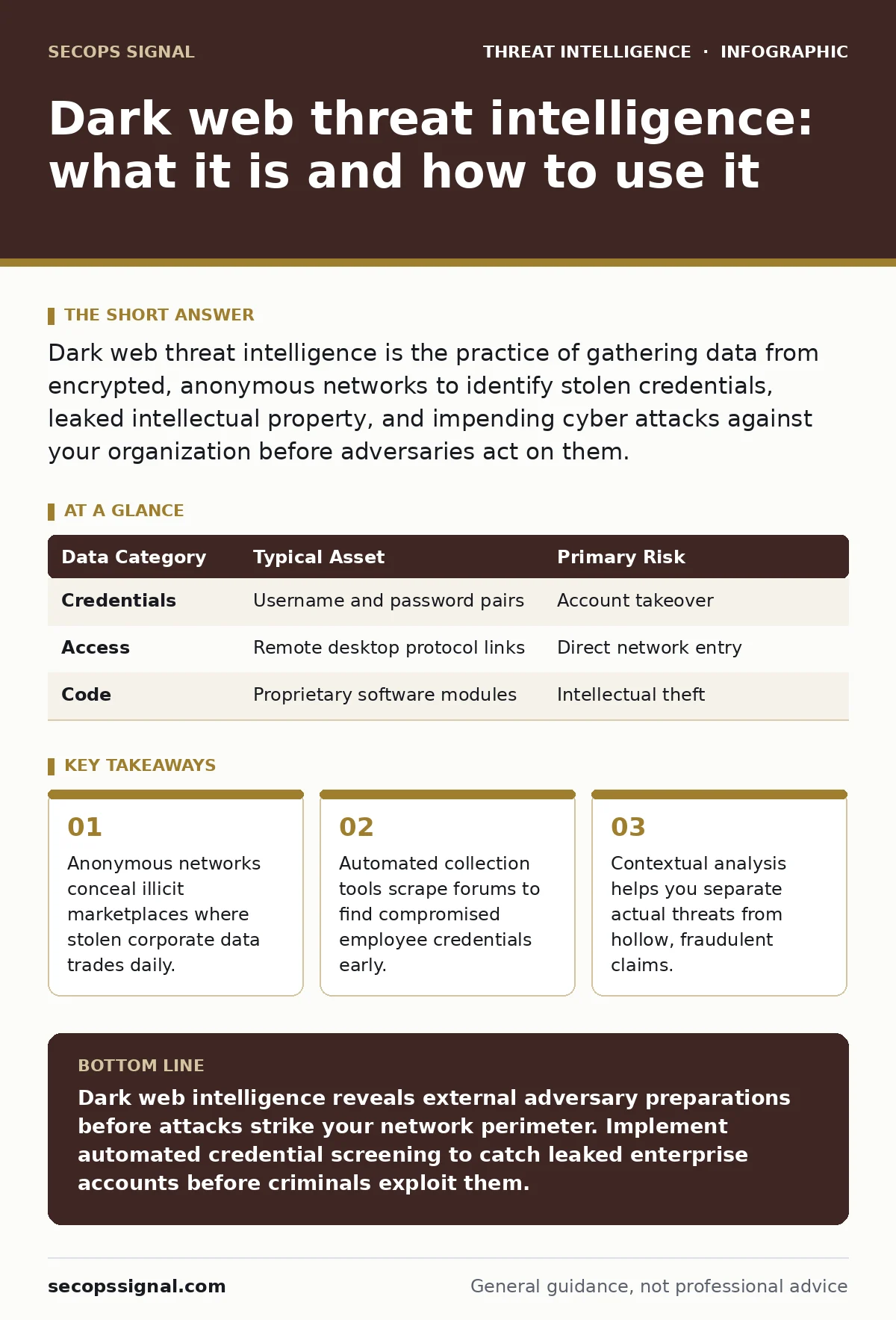
Dark web threat intelligence is the practice of gathering data from encrypted, anonymous networks to identify stolen credentials, leaked intellectual property, and impending cyber attacks against your organization before adversaries act on them.
What is the dark web and how do hidden networks operate?
The dark web is a collection of encrypted, anonymous online networks that require specific software to access, shielding both visitors and server operators from traditional tracking. These hidden services use multi-layered routing protocols to bounce connection requests across global volunteer nodes, stripping away identifying metadata. You cannot index these pages using standard search engines because automated web crawlers lack the necessary cryptographic credentials and protocol handlers required to traverse the underlying onion routing architecture.
What types of data do criminals trade on illicit marketplaces?
Illicit marketplaces trade stolen corporate credentials, compromised session tokens, proprietary source code, and internal network maps that facilitate unauthorized access. Sellers frequently bundle these assets into convenient packages designed for rapid deployment against corporate targets. Imagine discovering an entire database of employee email addresses paired with active passwords sitting on a public-facing forum. Attackers purchase these bundles to bypass multi-factor authentication checks through session hijacking and credential stuffing techniques.
| Data Category | Typical Asset | Primary Risk |
|---|---|---|
| Credentials | Username and password pairs | Account takeover |
| Access | Remote desktop protocol links | Direct network entry |
| Code | Proprietary software modules | Intellectual theft |
How does dark web intelligence differ from standard security monitoring?
Dark web intelligence differs from standard security monitoring because it looks outside your perimeter into adversary gathering grounds rather than observing internal logs within a SIEM (Security Information and Event Management, a centralized platform for aggregating and analyzing system logs). Internal tools alert you to active intrusions or anomalous user behavior happening on your servers. External intelligence uncovers what criminals plan to do before they touch your infrastructure, giving your defenders a proactive window to rotate keys and patch vulnerabilities.
What methods do automated collectors use to gather intelligence?
Automated collectors use 3 primary methods, including specialized scraping scripts, persistent crawler nodes, and credential validation bots to continuously index pages across anonymous networks. These systems monitor chat channels, marketplace listings, and paste sites for specific organizational keywords. Scripted parsers ingest unstructured text, extract relevant identifiers, and normalize the data into structured feeds. You must configure these tools carefully to avoid triggering automated honeypots deployed by malicious forum administrators to trap security researchers.
How can you separate genuine threats from scams on underground forums?
Separating genuine threats from scams requires cross-referencing seller reputations, verifying data samples against known schemas, and analyzing forum escrow transaction histories. Many actors post fabricated leaks to build artificial status or defraud prospective buyers of digital currency. Experienced analysts examine small data fragments provided by the seller to confirm structural authenticity. You should test these fragments against internal directory schemas to verify whether the exposed records match actual employee accounts.
See also: Implement Log Management: A Step-by-Step Technical Guide · Purple Teaming for Small Teams: Practical Defense Testing
What are the hidden operational costs of tracking underground forums?
Tracking underground forums introduces severe hidden operational costs, including analyst psychological fatigue, false positive distraction, and the risk of exposing investigator identity. Constantly reviewing illicit content exposes staff to graphic material and continuous deception attempts. Furthermore, chasing unverified alerts diverts scarce security resources away from genuine operational patching. Organizations often supplement internal analysis by purchasing dark web monitoring services to outsource raw data collection, though human verification remains necessary.
How do threat actors package stolen access for potential buyers?
Threat actors package stolen access by bundling valid username-password pairs with machine fingerprint data, active session cookies, and network topology summaries. Advanced sellers categorize their inventory by geographic region, revenue tier, and industry vertical to attract specific buyer profiles. Attackers test these access vectors repeatedly before listing them for sale to guarantee functional validity. You face heightened risk when threat groups trade pre-validated enterprise entry points because entry requires zero exploit development effort.
How do you integrate dark web findings into your defensive posture?
Integrating dark web findings into your defensive posture involves resetting compromised credentials, updating firewall blocklists, and refining your intelligence cycle (the formal process of planning, collecting, processing, analyzing, and disseminating threat data) to preempt attacks. Raw intelligence feeds provide little value until analysts transform them into actionable directives for engineering teams. You must establish clear workflows that route verified external threats directly to incident responders for immediate mitigation and containment actions.
What happens when threat intelligence vendors misidentify leaked data?
Vendors misidentify leaked data when they flag public test datasets or hash collisions as proprietary breaches, forcing your team to waste time on non-existent vulnerabilities. Automated analysis pipelines frequently fail to contextualize data properly, leading to false positives that erode trust in security tools. Suppose an automated alert claims your entire customer database is circulating online, only for a manual review to reveal a researcher's public benchmark dataset. This misidentification drains precious time and creates unnecessary panic among stakeholders.
Key takeaways
- Anonymous networks conceal illicit marketplaces where stolen corporate data trades daily.
- Automated collection tools scrape forums to find compromised employee credentials early.
- Contextual analysis helps you separate actual threats from hollow, fraudulent claims.
Dark web intelligence reveals external adversary preparations before attacks strike your network perimeter. Implement automated credential screening to catch leaked enterprise accounts before criminals exploit them.
Frequently asked questions
Can you completely block criminals from discussing your company on hidden forums?
No, you cannot prevent external threat actors from discussing your organization on hidden forums because these platforms operate independently of your control. However, you can monitor their chatter to detect targeting signals early.
Are all dark web data leaks authentic?
Many dark web listings contain recycled information, synthetic records, or fabricated claims designed to scam buyers. Always verify data samples against internal logs before taking corrective action.
How frequently should you check for compromised credentials?
You should monitor for compromised credentials continuously using automated collection feeds rather than relying on periodic manual reviews. Automated systems catch rapid leaks before threat actors can weaponize them.
Does dark web intelligence require specialized staff?
Effective dark web intelligence requires analysts trained to evaluate underground market credibility and interpret complex technical data fragments. Without this expertise, teams often chase false alarms instead of actual threats.
How this guide was produced: written by the SecOps Signal editorial team with AI assistance, checked against the public references listed below, and reviewed when the facts change. See our editorial policy or report an error.