Domain Generation Algorithms Explained: How Malware Hides Its Commands
Malware uses mathematical formulas to create thousands of fake web addresses, making traditional blocklists useless against shifting command centers.

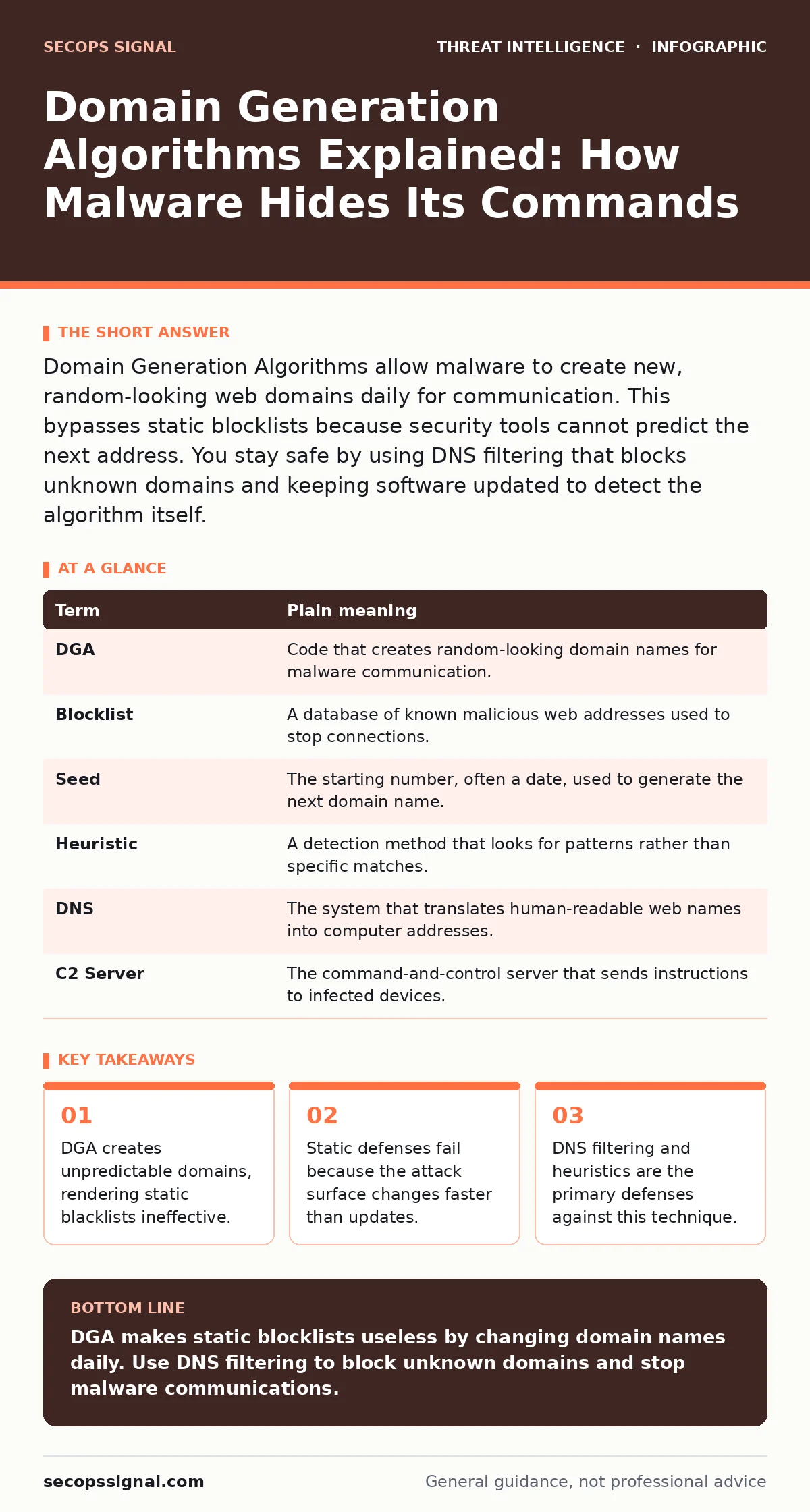
Domain Generation Algorithms allow malware to create new, random-looking web domains daily for communication. This bypasses static blocklists because security tools cannot predict the next address. You stay safe by using DNS filtering that blocks unknown domains and keeping software updated to detect the algorithm itself.
The Post Office Analogy
Imagine you need to send secret instructions to a courier, but the police know the usual drop-off boxes. If you always use Box 42, they simply watch it. To stay hidden, you agree on a rule: "Use the box number matching today’s date." On the 5th, you use Box 5. On the 20th, Box 20. The police cannot block every box. They must watch the whole street.
This is how Domain Generation Algorithms work. Instead of a fixed web address, the malware uses a mathematical formula to generate a new domain name every day. The attacker controls the formula. The malware calculates the next address. It then tries to connect to that address. If the attacker has registered it, the command flows. If not, the malware waits for the next day.
Why Static Lists Fail
Traditional security relies on blocklists. These are databases of known bad web addresses. When your computer tries to visit a site, the software checks the list. If the site is on the list, the connection stops. This works well for static threats. A phishing site usually stays at the same address for weeks.
DGA breaks this model. The malware generates thousands of possible domain names. The attacker registers a few of them. The rest remain unused. Your security tool might block the one used yesterday. But today, the algorithm generates a completely different string of letters. That new address is not on the blocklist yet. The connection succeeds before anyone can add it to the database.
The Mechanics of Randomness
The algorithm is simple code embedded in the malware. It takes a seed value, often the current date, and runs it through a mathematical function. The output is a string of characters that looks random to humans. For example, "xk9z2m.com" or "q7p1v.net".
To you, these names look like gibberish. To the malware, they are predictable. The attacker runs the same code on their server. They know which domain the malware will try to contact. They register that specific domain in advance. If the malware fails to connect, it means the attacker did not register that day’s domain. The malware simply waits for the next cycle.
This creates a high-volume problem. Attackers may register hundreds of domains at once. They do not need all of them. They only need one to work. This makes it hard for defenders to know which domains are malicious and which are just unused noise.
| Term | Plain meaning |
|---|---|
| DGA | Code that creates random-looking domain names for malware communication. |
| Blocklist | A database of known malicious web addresses used to stop connections. |
| Seed | The starting number, often a date, used to generate the next domain name. |
| Heuristic | A detection method that looks for patterns rather than specific matches. |
| DNS | The system that translates human-readable web names into computer addresses. |
| C2 Server | The command-and-control server that sends instructions to infected devices. |
What This Means for You
You do not need to understand the math. You need to understand the risk. If a device on your network is infected with DGA malware, it will constantly try to connect to new, unknown domains. This generates a lot of failed connection attempts.
Most of these attempts will fail. The attacker did not register every possible name. But even one successful connection is enough. The malware can download more tools, steal data, or join a botnet. This process happens in the background. You will not see a pop-up. You will not see a warning. The only sign is unusual network traffic.
This is why phishing infrastructure often uses similar techniques. Attackers rotate domains to avoid detection. Understanding DGA helps you see why email filters alone are not enough. The threat moves faster than static rules.
Simple Safety Habits
You can reduce your exposure with a few specific actions. These steps focus on limiting the ability of malware to communicate, rather than trying to block every possible domain.
- Enable DNS Filtering: Use a DNS service that blocks connections to newly registered domains or domains with suspicious patterns. This stops the malware from reaching its command server. It does not remove the malware, but it cuts off its instructions.
- Keep Software Updated: Vendors release updates that include new heuristic rules. These rules look for the behavior of DGA, not just specific addresses. An updated system can spot the pattern of rapid, failed DNS lookups.
- Monitor for Anomalies: If you use SIEM tools, create alerts for high volumes of DNS failures. This is a strong indicator of DGA activity. Even without advanced tools, noticing that a device is constantly trying to reach unknown sites is a red flag.
See also: Subdomain Takeover Myths: 6 Beliefs That Leave Your DNS Open · Dark web threat intelligence: what it is and how to use it
The Hidden Cost of Defense
Defending against DGA requires a shift in mindset. You cannot block what you do not know. This makes indicators of attack more valuable than indicators of compromise. An indicator of attack shows the behavior of the threat, such as the rapid domain generation. An indicator of compromise shows the result, such as a specific file hash.
The hidden cost is complexity. Heuristic detection can generate false positives. Legitimate software might behave strangely. You need a process to review these alerts. This is where purple teaming exercises help. They test whether your detection rules catch new threats without blocking normal business activity.
Why Blocklists Are Not Enough
Many users believe that if their antivirus is updated, they are safe. This is a misconception. Antivirus signatures are static. DGA is dynamic. The malware changes its identity daily. Your antivirus might recognize the malware file, but if it does not, the network connection can still succeed.
This is why log management is critical. You need to record DNS queries. If you do not log them, you cannot see the pattern. Without logs, you are blind to the failed attempts that signal an infection. Digital forensics and incident response teams rely on these logs to trace the infection back to its source.
Final Thoughts on Network Hygiene
DGA is a tool for persistence. It allows malware to survive even if you delete some of its files. As long as the algorithm remains on the device, it will keep trying to connect. You must remove the malware and clear the infection.
Do not rely on a single layer of defense. Combine DNS filtering, updated software, and behavioral monitoring. This layered approach closes the gap that DGA exploits. You do not need to predict the next domain. You just need to stop the connection.
Key takeaways
- DGA creates unpredictable domains, rendering static blacklists ineffective.
- Static defenses fail because the attack surface changes faster than updates.
- DNS filtering and heuristics are the primary defenses against this technique.
DGA makes static blocklists useless by changing domain names daily. Use DNS filtering to block unknown domains and stop malware communications.
Frequently asked questions
Can a firewall stop domain generation algorithms?
Standard firewalls block ports and IP addresses, not domain names. You need a firewall that inspects DNS traffic or a dedicated DNS filter to stop DGA effectively.
How do I know if I have DGA malware?
Look for a high number of failed DNS lookups or connections to random-looking domain names. This pattern indicates the malware is trying to find its command server.
Do all viruses use DGA?
No. Only advanced, persistent malware uses DGA. Simple viruses often use static servers. DGA is used when attackers need to avoid detection for long periods.
Is DNS filtering safe for my business?
Yes, if configured correctly. It blocks malicious domains while allowing legitimate traffic. You may need to whitelist specific services that use dynamic domains.
How this guide was produced: written by the SecOps Signal editorial team with AI assistance, checked against the public references listed below, and reviewed when the facts change. See our editorial policy or report an error.