Security Awareness Training: 6 Misunderstandings That Waste Your Budget
Training alone cannot stop attacks because humans are not the weakest link; technical controls and system design determine your actual security posture.

Security awareness training fails when treated as a standalone control. It does not replace email filtering, patch management, or conditional access policies. Effective programs focus on reducing friction for secure behavior rather than testing employee knowledge with simulated phishing attacks.
Misreading: Training Replaces Technical Controls
Correct reading: Security awareness training supplements technical defenses; it never replaces them. You cannot train users to bypass the need for email filtering or intrusion prevention systems. If your email gateway allows malicious attachments to reach inboxes, no amount of classroom instruction will stop every recipient from clicking them.
Technical controls provide the baseline safety net. Training addresses the gaps that software cannot close, such as social engineering nuances that bypass automated filters. Relying on training as a substitute for engineering creates a false sense of security. You must implement defense-in-depth strategies where controls operate independently of human decision-making.
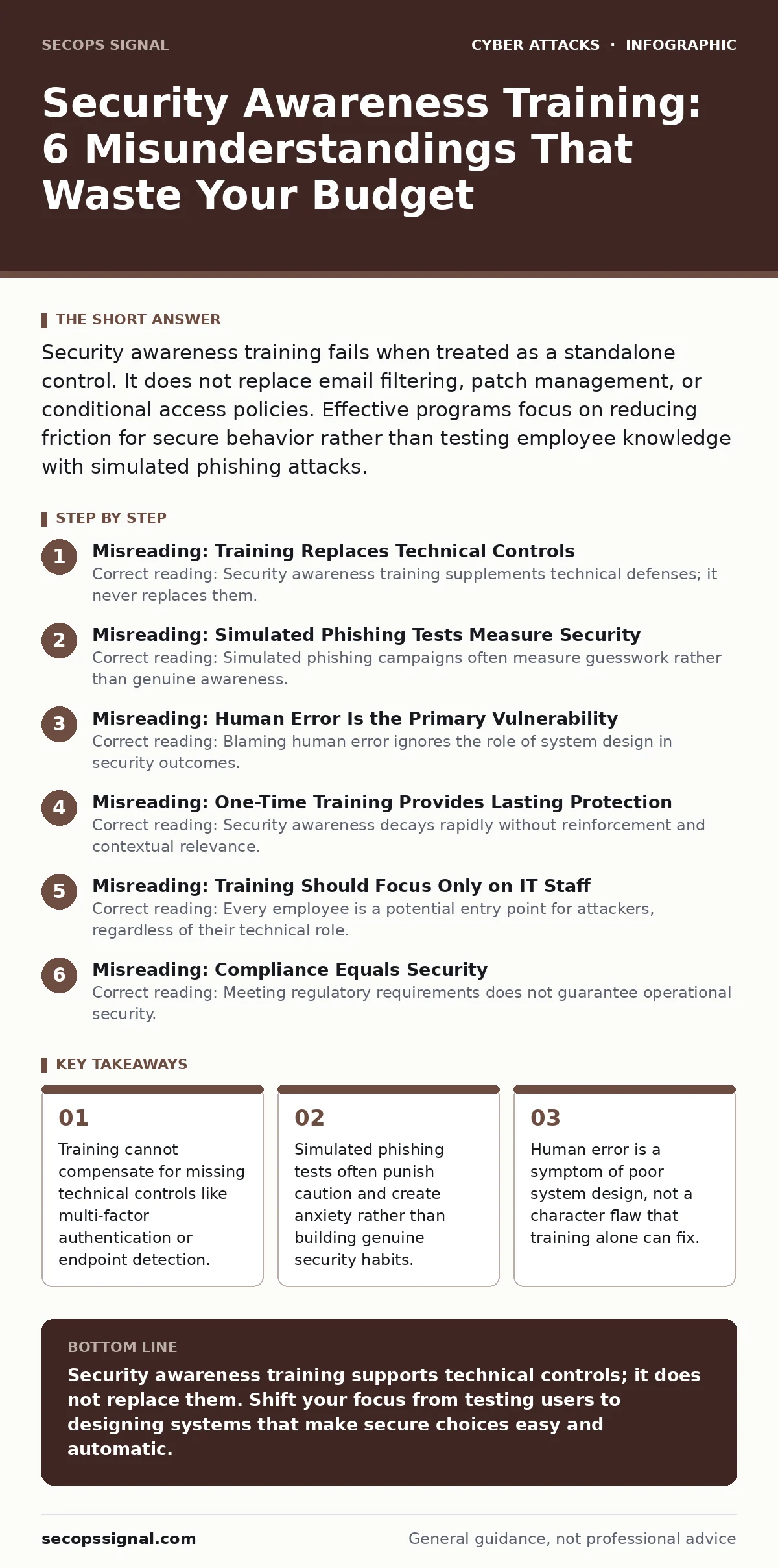
Misreading: Simulated Phishing Tests Measure Security
Correct reading: Simulated phishing campaigns often measure guesswork rather than genuine awareness. When users receive frequent fake emails, they begin to treat all messages with suspicion, including legitimate alerts from IT or vendors. This behavior increases friction and slows business operations. Some users learn to look for subtle cues in the simulation, such as specific sender domains or footer text, rather than learning to analyze content critically.
This skill does not transfer to real-world attacks that use different tactics. Testing users this way creates a culture of fear and punishment. It shifts the focus from helping people work securely to catching them making mistakes. A better approach involves teaching users how to verify unexpected requests through out-of-band communication.
Misreading: Human Error Is the Primary Vulnerability
Correct reading: Blaming human error ignores the role of system design in security outcomes. People make mistakes because interfaces are confusing or workflows are inefficient. If a system makes it easy to do the wrong thing, training will only delay the inevitable incident. You must design systems that fail safely. For example, if a user accidentally sends a sensitive file to the wrong recipient, technical controls should block the transmission or require confirmation.
Training addresses the "why" of behavior, but engineering addresses the "how" of action. When you remove the opportunity for catastrophic error, the impact of human mistake drops significantly. Focus on reducing the complexity of security tasks. Simplify authentication flows and automate routine protections. This reduces the cognitive load on your staff.
Misreading: One-Time Training Provides Lasting Protection
Correct reading: Security awareness decays rapidly without reinforcement and contextual relevance. A single annual seminar or compliance checkbox does not change long-term behavior. Threats evolve constantly, introducing new techniques like QR code phishing or sophisticated tech support scams. Static training materials become obsolete quickly. You need continuous, micro-learning interventions that align with current events and organizational changes.
Brief, frequent reminders are more effective than lengthy, infrequent sessions. Integrate security concepts into existing workflows. Mention safe practices during regular team meetings or include them in onboarding processes for new hires. Contextual learning sticks better than abstract theory. Users remember lessons when they apply them immediately to their daily tasks.
Misreading: Training Should Focus Only on IT Staff
Correct reading: Every employee is a potential entry point for attackers, regardless of their technical role. Finance teams handle wire transfers, while executive assistants manage calendar access and communications. Marketing staff may fall victim to watering hole attacks when visiting industry forums. Supply chain attacks often target vendors who have less rigorous security postures than large enterprises.
A breach in any department can compromise the entire organization. You must tailor training content to specific roles. Teach finance teams how to verify payment changes. Train sales staff on data handling during client meetings. Broad, generic training misses these critical nuances. Role-based education ensures that each team understands their specific risks and responsibilities. This targeted approach increases engagement and practical application.
Misreading: Compliance Equals Security
Correct reading: Meeting regulatory requirements does not guarantee operational security. Many standards mandate annual training hours but do not specify quality or effectiveness. Checking a compliance box satisfies auditors but leaves vulnerabilities open. Attackers do not care about your certification status. They exploit weak points in your process and technology.
You must distinguish between administrative compliance and actual risk reduction. Measure outcomes, not just participation rates. Track whether secure behaviors increase after training. Monitor if users report suspicious activities more frequently. Use these metrics to refine your program. Compliance is a minimum baseline. True security requires ongoing adaptation to emerging threats and continuous improvement of both people and processes.
Misreading: Punishment Improves Security Behavior
Correct reading: Penalizing users for falling for simulations creates secrecy rather than safety. When employees fear repercussions, they hide mistakes. They do not report suspicious emails or unusual system behavior. This silence prevents early detection of real incidents. A blame-free culture encourages transparency. Users who feel safe reporting errors help security teams identify trends and improve controls.
Positive reinforcement works better than negative consequences. Celebrate when users correctly identify threats or follow secure procedures. Provide clear, immediate feedback when mistakes occur. Explain what went wrong and how to prevent it next time. Learning happens through reflection, not shame. Build trust by supporting your team rather than policing them.
Key takeaways
- Training cannot compensate for missing technical controls like multi-factor authentication or endpoint detection.
- Simulated phishing tests often punish caution and create anxiety rather than building genuine security habits.
- Human error is a symptom of poor system design, not a character flaw that training alone can fix.
Security awareness training supports technical controls; it does not replace them. Shift your focus from testing users to designing systems that make secure choices easy and automatic.
Frequently asked questions
How often should security awareness training occur?
Training should be continuous with brief, frequent updates rather than annual events. Align content with current threats and organizational changes to maintain relevance and engagement.
Does training stop ransomware attacks?
Training reduces the likelihood of initial compromise but cannot stop all ransomware. You need endpoint detection, regular backups, and network segmentation to contain and recover from ransomware incidents effectively.
What is the best way to measure training effectiveness?
Measure behavioral changes such as increased reporting of suspicious emails or reduced successful phishing clicks. Avoid relying solely on test scores or completion rates as indicators of security posture.
Should I train contractors and third-party vendors?
Yes, third parties often have access to your systems or data. Ensure they follow similar security practices and understand your specific requirements to prevent supply chain attacks and external breaches.
How this guide was produced: written by the SecOps Signal editorial team with AI assistance, checked against the public references listed below, and reviewed when the facts change. See our editorial policy or report an error.