Supply Chain Attack Prevention Checklist for Secure Operations
Third-party software dependencies create hidden entry points that bypass perimeter defenses and require continuous verification of integrity.

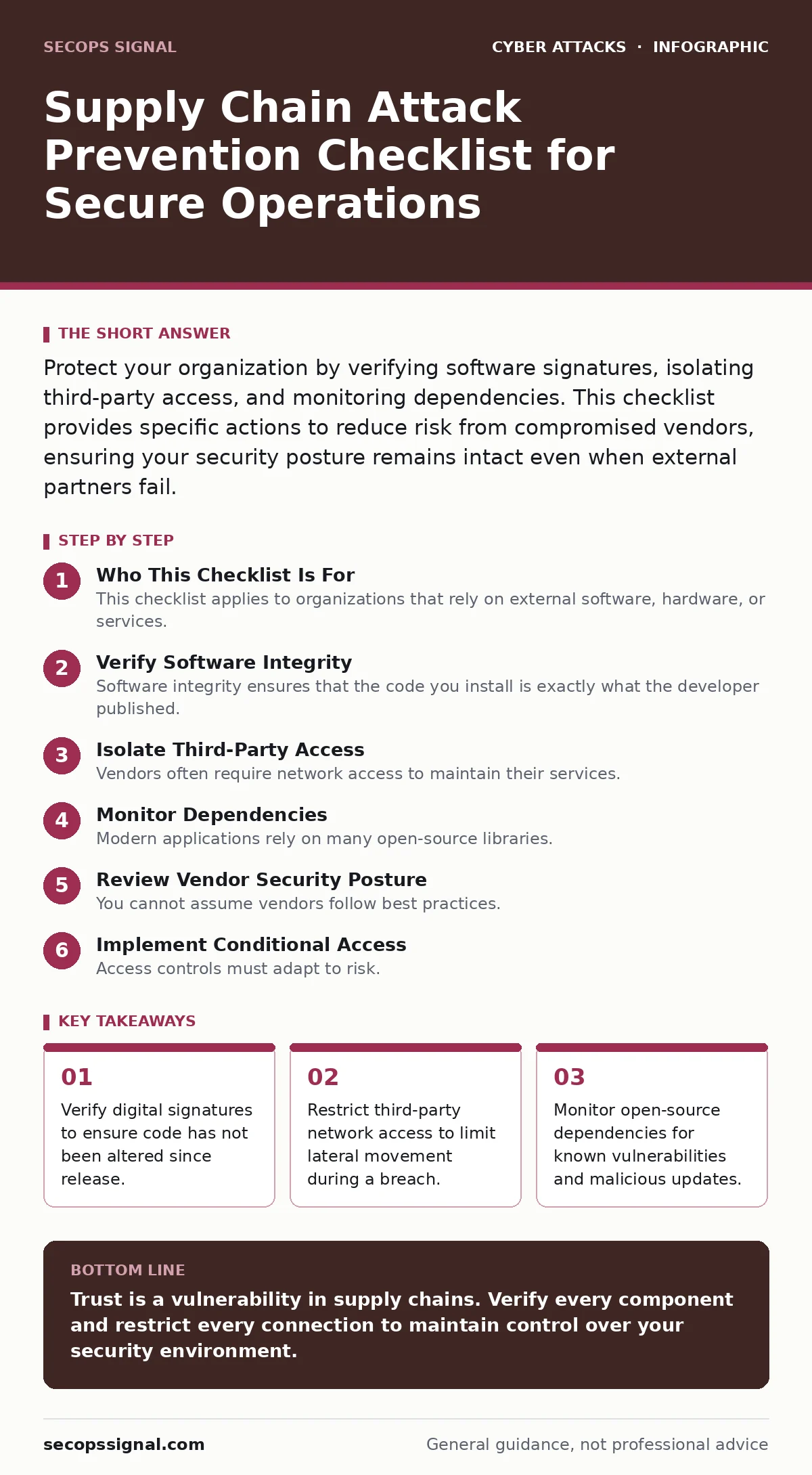
Protect your organization by verifying software signatures, isolating third-party access, and monitoring dependencies. This checklist provides specific actions to reduce risk from compromised vendors, ensuring your security posture remains intact even when external partners fail.
Who This Checklist Is For
This checklist applies to organizations that rely on external software, hardware, or services. You do not need a large security team to implement these measures. The goal is to reduce the surface area where a vendor failure becomes your failure. Supply chain attacks exploit trust in third parties. You cannot control their security practices directly. You can control how you integrate their products. This guide provides specific steps to harden that integration.
Verify Software Integrity
Software integrity ensures that the code you install is exactly what the developer published. Attackers often insert malicious code into legitimate updates. You must verify this identity before installation.
- Enforce digital signature verification: Confirms the software origin and detects tampering during transit.
- Validate hash checksums: Detects any change in the file content after download.
- Use trusted repositories only: Prevents installation from mirrored or fake sites prone to typosquatting.
- Disable auto-update for critical systems: Allows review of changes before they affect production environments.
Digital signatures are cryptographic proofs tied to a specific publisher. If the signature is invalid, the software has been altered. Do not bypass these warnings. They are the primary defense against modified binaries. Hash checksums provide an additional layer of verification. They create a unique fingerprint of the file. If the fingerprint does not match the official record, the file is compromised.
Isolate Third-Party Access
Vendors often require network access to maintain their services. This access must be strictly limited. Unrestricted access allows attackers to move laterally into your internal networks. You must define the minimum necessary permissions.
- Implement network segmentation: Separates vendor systems from sensitive internal data and core operations.
- Use jump servers for remote access: Centralizes and logs all administrative connections from external parties.
- Apply least privilege principles: Grants vendors only the specific permissions required for their tasks.
- Review access logs regularly: Detects unusual activity patterns that may indicate a compromise.
Network segmentation creates barriers within your infrastructure. If a vendor system is breached, the attacker cannot easily reach your database servers. Jump servers act as a choke point. All remote administration passes through this single server. This allows for detailed logging and monitoring. You can review who accessed what and when. This visibility is critical for incident response.
Monitor Dependencies
Modern applications rely on many open-source libraries. These libraries are public and can be modified by anyone. Attackers often inject malicious code into popular libraries. You must track these dependencies.
- Maintain a software bill of materials: Lists all components and versions used in your applications.
- Subscribe to vulnerability alerts: Provides timely notifications of known issues in your dependencies.
- Automate dependency scanning: Identifies vulnerable libraries during the build process.
- Patch dependencies promptly: Reduces the window of opportunity for exploitation.
A software bill of materials is a detailed inventory of your software components. It helps you understand what you are running. Without this inventory, you cannot know if you are affected by a new vulnerability. Automated scanning integrates security checks into your development workflow. It prevents vulnerable code from reaching production. This shifts security left in the development lifecycle.
Review Vendor Security Posture
You cannot assume vendors follow best practices. You must verify their security measures. This requires asking specific questions and reviewing their documentation. Do not rely on marketing claims.
- Require security questionnaires: Assesses the vendor's security controls and incident response capabilities.
- Review audit reports: Validates compliance with industry standards and regulatory requirements.
- Define breach notification timelines: Ensures you are informed quickly if the vendor is compromised.
- Conduct regular security assessments: Evaluates the ongoing effectiveness of their security measures.
Security questionnaires provide a baseline understanding of the vendor's practices. They reveal gaps in their security posture. Audit reports offer independent verification. They show whether the vendor meets stated standards. Breach notification clauses are critical for timely response. You need to know immediately if their data is exposed. Regular assessments keep the relationship accountable.
Implement Conditional Access
Access controls must adapt to risk. Static passwords are insufficient. You must evaluate the context of each login attempt. This includes device health and location.
- Enforce multi-factor authentication: Adds a second layer of verification beyond passwords.
- Require device compliance: Ensures connecting devices meet security standards.
- Monitor for impossible travel: Detects logins from geographically distant locations in short timeframes.
- Integrate with identity providers: Centralizes access management and policy enforcement.
Conditional access policies allow you to define rules based on user and environment attributes. For example, you can require additional verification for logins from new devices. This reduces the risk of credential theft. Identity providers manage these policies centrally. They ensure consistent enforcement across all applications. This integration simplifies management and improves security.
Detect Anomalous Behavior
Traditional defenses focus on known threats. Advanced attacks often evade these controls. You must monitor for unusual activity. Behavior-based detection identifies threats that bypass signature-based tools.
- Monitor for unusual data transfers: Detects exfiltration attempts to external services.
- Track process execution anomalies: Identifies unexpected software behavior on endpoints.
- Analyze network traffic patterns: Reveals connections to known malicious infrastructure.
- Review authentication failures: Detects brute-force attacks and credential stuffing.
Anomalous behavior indicates a potential compromise. For example, a sudden increase in data transfer to a cloud storage service may indicate exfiltration. Process execution monitoring detects when legitimate software behaves unexpectedly. Network traffic analysis identifies connections to command-and-control servers. Authentication failure monitoring reveals attempted unauthorized access. These signals provide early warning of an incident.
Maintain Incident Response Plans
Preparation is key to effective response. You must have clear procedures for supply chain incidents. These plans should be tested regularly.
- Define roles and responsibilities: Clarifies who does what during an incident.
- Establish communication channels: Ensures timely updates to stakeholders and customers.
- Document recovery procedures: Guides the restoration of affected systems and data.
- Conduct tabletop exercises: Tests the plan's effectiveness and identifies gaps.
Incident response plans provide a structured approach to handling breaches. They reduce confusion and delay during a crisis. Clear roles ensure efficient coordination. Communication channels keep everyone informed. Recovery procedures minimize downtime. Tabletop exercises simulate real-world scenarios. They reveal weaknesses in the plan before an actual incident occurs. Regular updates keep the plan relevant.
Key takeaways
- Verify digital signatures to ensure code has not been altered since release.
- Restrict third-party network access to limit lateral movement during a breach.
- Monitor open-source dependencies for known vulnerabilities and malicious updates.
Trust is a vulnerability in supply chains. Verify every component and restrict every connection to maintain control over your security environment.
Frequently asked questions
How do I verify if a software update is legitimate?
Check the digital signature and compare the file hash with the official publisher record. If either fails, do not install the update.
What is the biggest risk of using open-source libraries?
Malicious actors can inject code into popular libraries, affecting all applications that use them without your knowledge.
Can conditional access policies prevent supply chain attacks?
They limit damage by restricting access based on context, but they do not prevent the initial compromise of a vendor's system.
How often should I review vendor security practices?
Review them annually and immediately after any reported security incident involving the vendor or their infrastructure.
How this guide was produced: written by the SecOps Signal editorial team with AI assistance, checked against the public references listed below, and reviewed when the facts change. See our editorial policy or report an error.