Ephemeral Infrastructure: Secure Short-Lived Cloud Assets
Ephemeral infrastructure shifts security from static patching to automated verification, requiring you to trust code over human memory.

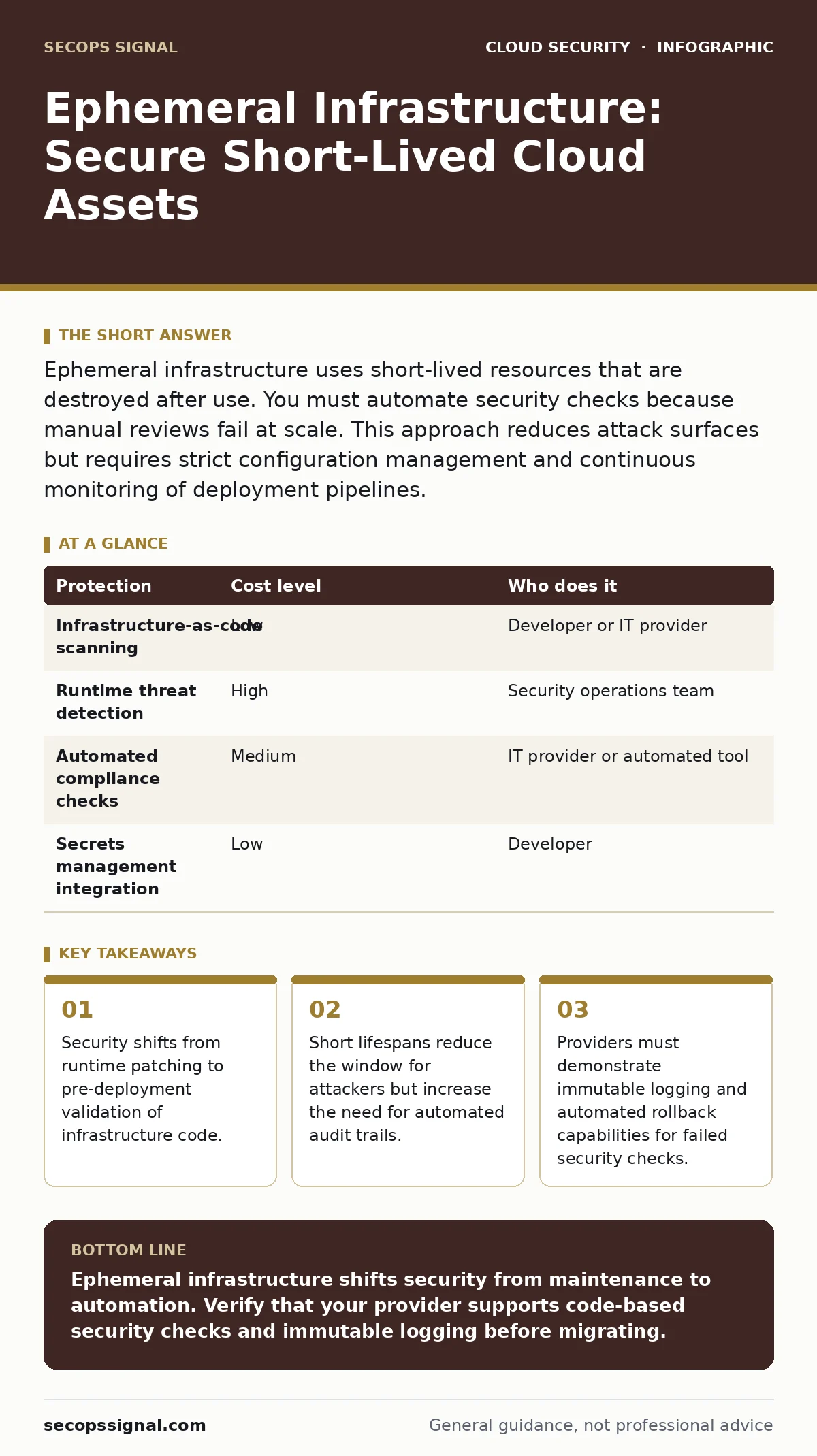
Ephemeral infrastructure uses short-lived resources that are destroyed after use. You must automate security checks because manual reviews fail at scale. This approach reduces attack surfaces but requires strict configuration management and continuous monitoring of deployment pipelines.
Why Ephemeral Infrastructure Matters for Small Teams
Ephemeral infrastructure refers to computing resources that exist for a limited time and are discarded after use. Traditional servers remain online for years, accumulating unpatched vulnerabilities and configuration drift. You face a growing attack surface with every month a server stays active. Ephemeral systems reset to a known good state with every deployment. This reset eliminates accumulated technical debt. It also removes the need for ongoing maintenance tasks like OS updates or library upgrades on the live system.
The trade-off is a shift in responsibility. You no longer secure the running server. You secure the process that creates it. If the creation process is flawed, every instance is flawed. This model demands precision in your initial configuration. A single error in the setup script propagates to every new instance. You cannot fix the error on one server and expect the next one to be safe. The flaw must be corrected in the source definition. This requirement aligns well with the operational constraints of smaller organizations that lack large maintenance teams.
The Mechanics of Statelessness
Statelessness means the system holds no persistent data between sessions. All data lives in external storage or databases, while the compute layer remains disposable. This separation simplifies security boundaries. You protect the data storage with traditional methods. You protect the compute layer by ensuring it cannot be compromised in the first place. The compute layer has no secrets, no user data, and no history.
This architecture introduces a hidden cost in complexity. You must manage the external dependencies carefully. If the external database is misconfigured, the ephemeral servers are useless. The security burden moves from the application server to the network and storage layers. You must ensure that only authorized services can connect to these persistent resources. Network segmentation becomes the primary control for the data layer. The compute layer relies on least-privilege access to connect to the data.
Automating Security Checks
Manual security reviews fail in ephemeral environments. You cannot inspect a server that lives for minutes. Security checks must be embedded in the deployment pipeline. This approach is known as shift-left security. You validate the infrastructure definition before any resource is created. Tools scan the code for misconfigurations, such as open ports or excessive permissions. If the scan fails, the deployment stops. No insecure instance is ever created.
This automation requires a reliable source of truth. You store your infrastructure definitions in version control. This practice prevents shadow IT, where employees create resources outside the approved pipeline. Every change is recorded and reviewed. You can trace any security issue back to the specific code change that introduced it. This traceability is critical for incident response. You know exactly what was deployed, when, and by whom. The audit trail is immutable and complete.
| Protection | Cost level | Who does it |
|---|---|---|
| Infrastructure-as-code scanning | Low | Developer or IT provider |
| Runtime threat detection | High | Security operations team |
| Automated compliance checks | Medium | IT provider or automated tool |
| Secrets management integration | Low | Developer |
Managing Secrets and Credentials
Ephemeral servers must access databases, APIs, and other services. They need credentials to do so. Hardcoding secrets into the infrastructure definition is a critical error. Secrets in source code are exposed to anyone with repository access. They persist in version history even after deletion. You must use a dedicated secrets management service. This service injects credentials at runtime. The servers never store the secrets locally.
The secrets manager enforces rotation policies. Credentials expire frequently, limiting the damage if one is stolen. The ephemeral server requests a short-lived token when it starts. The token expires when the server terminates. This mechanism ensures that no long-lived credentials exist on the compute layer. You must configure the secrets manager to grant only the minimum necessary permissions. Overly broad access increases the risk of lateral movement by an attacker.
What to Ask Your IT Provider
Small businesses often outsource infrastructure management. You must verify that your provider supports ephemeral workflows. Many providers still manage static servers, which creates a mismatch in security expectations. You need a partner who understands automation and code-based infrastructure. Ask specific questions about their deployment and monitoring practices.
- How do you prevent infrastructure-as-code misconfigurations before deployment?
- Do you provide immutable logs of all infrastructure changes and deployments?
- How do you handle secrets management for short-lived resources?
- What is your process for detecting and responding to runtime anomalies?
- Do you support automated compliance checks for cloud compliance frameworks?
These questions reveal whether the provider treats infrastructure as code or as a static asset. A provider who manages static servers will struggle with ephemeral workflows. They may introduce manual steps that break automation and increase risk. You need a partner who integrates security into the deployment pipeline, not as an afterthought.
See also: 7 Code Repository Mistakes That Leak Secrets · Shadow IT Definition: How to Find Hidden Cloud Risks
Monitoring and Incident Response
Traditional monitoring tools look for known signatures on long-lived systems. These tools are less effective in ephemeral environments. The systems change too quickly for signature-based detection to keep up. You need behavioral monitoring. This approach looks for unusual activity, such as unexpected network connections or resource usage spikes. It does not rely on knowing the specific version of the software running.
Incident response in ephemeral environments focuses on containment and forensics. You cannot patch a compromised ephemeral server. You must terminate it immediately. The goal is to stop the attack and preserve evidence. You analyze the logs and metrics from the terminated instance. This analysis helps you understand the attack vector and update your security checks. You then redeploy a clean instance. The cycle repeats, ensuring continuous security.
The Hidden Costs of Ephemeral Security
Ephemeral infrastructure reduces operational overhead but increases upfront complexity. You must invest in tooling and expertise. The cost of failure is higher because errors propagate instantly. A misconfiguration affects all new instances until fixed. You must have robust testing processes in place. This includes unit tests for infrastructure code and integration tests for the deployed systems.
You also face the risk of container image scanning gaps. If you use containers, you must scan the base images for vulnerabilities. A vulnerable base image compromises every instance built from it. You must ensure that your provider or team scans images regularly and blocks deployment if vulnerabilities are found. This adds a layer of security but requires careful management of the image registry.
Integrating with Existing Security Practices
Ephemeral infrastructure does not replace traditional security. It complements it. You still need strong identity and access management. You still need network segmentation to isolate sensitive data. You still need incident response plans. The difference is in the implementation. Security controls are automated and embedded in the deployment process. This integration reduces the chance of human error and ensures consistency.
You must also address public code repository leaks. If your infrastructure code is public, attackers can analyze it for weaknesses. You must keep infrastructure code private and restrict access. Use private repositories and enforce strict access controls. This prevents attackers from gaining insights into your security posture. It also protects your intellectual property and business logic.
Key takeaways
- Security shifts from runtime patching to pre-deployment validation of infrastructure code.
- Short lifespans reduce the window for attackers but increase the need for automated audit trails.
- Providers must demonstrate immutable logging and automated rollback capabilities for failed security checks.
Ephemeral infrastructure shifts security from maintenance to automation. Verify that your provider supports code-based security checks and immutable logging before migrating.
Frequently asked questions
Does ephemeral infrastructure eliminate the need for firewalls?
No. Firewalls still protect the network perimeter and segment internal traffic. Ephemeral infrastructure reduces the attack surface of individual servers, but network controls remain necessary to protect data and services.
How do I handle updates in an ephemeral environment?
You do not update running instances. You update the infrastructure definition or container image. The next deployment creates new instances with the updates. Old instances are terminated and replaced automatically.
Is ephemeral infrastructure suitable for all applications?
No. Applications that require persistent local storage or long-running stateful processes are not ideal candidates. Stateless applications, such as web servers and API endpoints, work best with this model.
What happens if a deployment fails security checks?
The deployment is blocked. No new instances are created. You must fix the issue in the infrastructure code and redeploy. This prevents insecure resources from reaching production.
How this guide was produced: written by the SecOps Signal editorial team with AI assistance, checked against the public references listed below, and reviewed when the facts change. See our editorial policy or report an error.