Preventing Data Exposure Seen By Dark Web Monitoring
Commercial monitoring tools alert you to leaked credentials only after the exposure has already occurred somewhere else.
Preventing data from appearing on illicit marketplaces requires eliminating persistent credential reuse and enforcing strict authentication boundaries. You stop monitoring alerts by removing the raw material attackers harvest from compromised systems.
Eliminating Password Reuse Across Business Applications
Password reuse remains the primary vector feeding automated credential harvesters. Enterprise environments require centralized identity providers that enforce cryptographic hardware tokens instead of memorized secrets. Memorized passwords drift across personal and professional boundaries, creating invisible exposure pathways that standard policies fail to govern.
Single sign-on architectures reduce attack surfaces by consolidating authentication events into managed perimeters. Centralized session handling ensures that revoking access in one portal terminates lingering connections elsewhere. Tactical threat intelligence feeds often highlight how credential stuffers exploit orphaned accounts left active after employee departures.
Securing Authentication Tokens Against Theft
Session cookies represent high-value targets for malicious actors seeking to bypass multi-factor prompts entirely. Attackers deploy information stealers to extract valid browser session tokens directly from local storage directories. Hardware-bound security keys mitigate this risk by cryptographically tying authentication sessions to specific physical devices.
Browser isolation technologies prevent local malware from reading active memory spaces where decrypted cookies reside. Digital forensics and incident response investigations frequently reveal that compromised session states persist long after users close their browsers. Limiting token lifetimes forces frequent re-authentication, disrupting unauthorized access attempts before data extraction occurs.
Restricting Outbound Data Exfiltration Channels
Compromised endpoints require external communication paths to transmit harvested data back to collection servers. Network firewalls must enforce strict egress filtering that blocks unauthorized protocols and unapproved destination ports. Data loss prevention systems inspect outbound payloads to identify corporate intellectual property leaving the perimeter.
Log management solutions aggregate firewall events to highlight anomalous outbound traffic volumes originating from non-standard workstations. Attackers frequently utilize encrypted tunneling protocols to bypass basic perimeter inspections during the exfiltration phase. Restricting outbound connections to verified corporate destinations starves unauthorized data collectors of delivery routes.
Auditing Third-Party Vendor Data Storage Practices
External partners frequently maintain independent copies of your corporate data within unsecured cloud environments. Supply chain vulnerabilities expose sensitive records through third-party misconfigurations rather than direct network intrusions. Vendor risk assessments demand continuous validation of how partners encrypt and store shared corporate information.
Contractual obligations must mandate strict data retention limits and secure deletion protocols for former partners. Unmonitored vendor integrations create hidden blind spots that evade internal log management visibility. Requiring regular access reviews ensures that external entities lose system privileges immediately upon project completion.
Deploying Endpoint Visibility for Early Detection
Endpoint detection agents monitor system behavior for anomalies associated with credential harvesting software execution. Process monitoring identifies unauthorized binaries attempting to read browser credential databases or memory structures. Early detection stops credential theft before data reaches the underground forums tracked by commercial scanning tools.
Behavioral indicators of attack highlight unusual process invocation chains indicative of automated reconnaissance tools. Security teams must configure automated isolation responses for endpoints exhibiting known credential dumping signatures. Rapid containment prevents local compromises from escalating into widespread organizational data leaks.
See also: Database Security: What It Is and How It Protects Your Data
Ranking Risk Reduction Measures for Maximum Impact
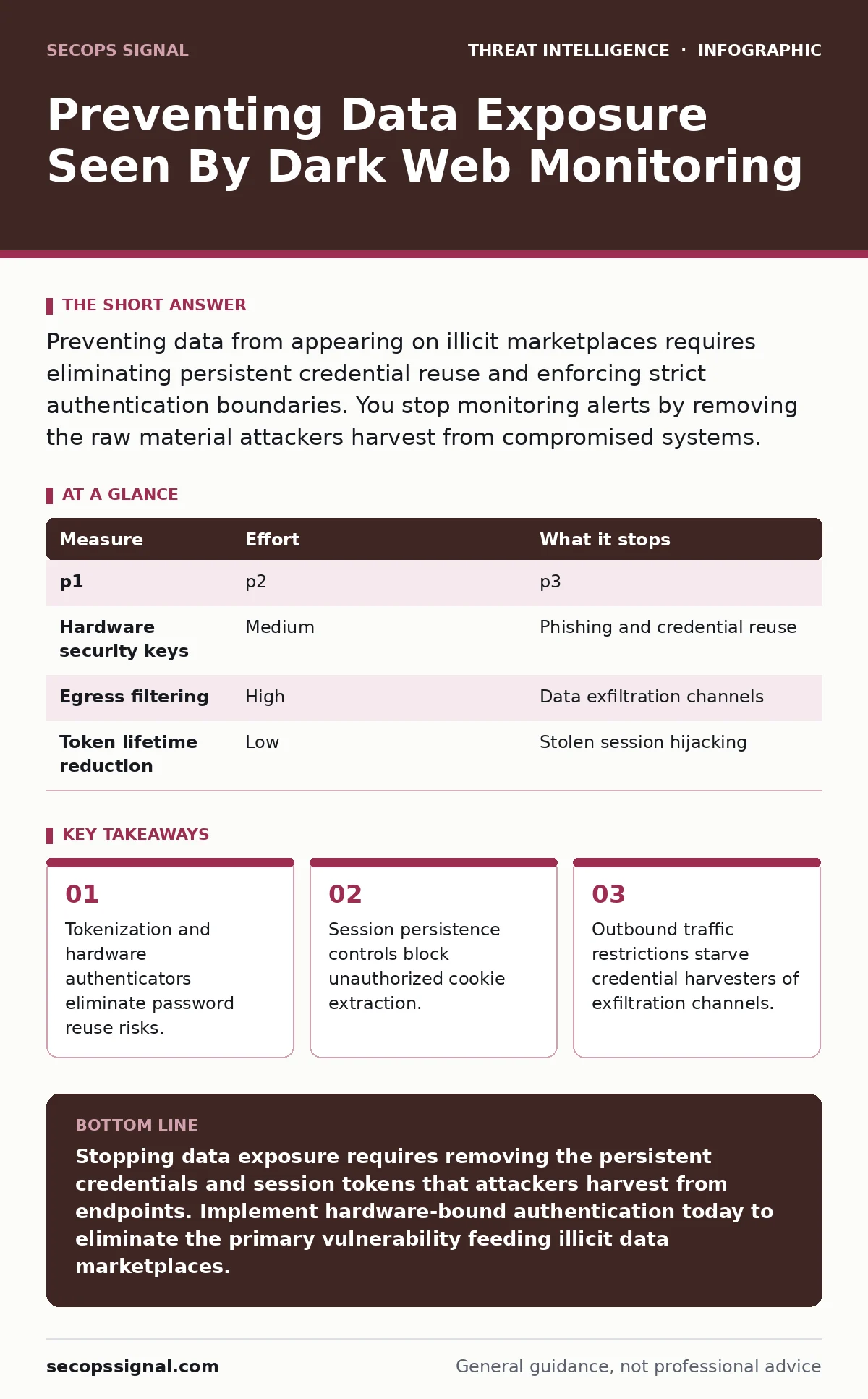
Prioritizing defensive investments ensures limited resources target the highest-risk exposure vectors first. Hardware-bound authentication provides the greatest risk reduction by eliminating credential theft viability entirely. Egress filtering and session management follow closely by halting data transit and invalidating stolen tokens.
| Measure | Effort | What it stops |
|---|---|---|
| p1 | p2 | p3 |
| Hardware security keys | Medium | Phishing and credential reuse |
| Egress filtering | High | Data exfiltration channels |
| Token lifetime reduction | Low | Stolen session hijacking |
Actionable Steps for Today
- Audit all active enterprise accounts to identify inactive users and stale administrative privileges.
- Enforce hardware-based multi-factor authentication across primary productivity and cloud platforms.
- Review outbound firewall rules to block unapproved communication ports and external tunneling protocols.
- Revoke unused third-party API tokens and integrations.
- Configure strict session timeout thresholds for corporate applications.
- Verify that endpoint monitoring agents report consistently to central consoles.
Key takeaways
- Tokenization and hardware authenticators eliminate password reuse risks.
- Session persistence controls block unauthorized cookie extraction.
- Outbound traffic restrictions starve credential harvesters of exfiltration channels.
Stopping data exposure requires removing the persistent credentials and session tokens that attackers harvest from endpoints. Implement hardware-bound authentication today to eliminate the primary vulnerability feeding illicit data marketplaces.
Frequently asked questions
Why do dark web monitoring services find credentials if employees use unique passwords?
Monitoring services often index data leaks originating from third-party vendor platforms rather than direct compromises of your primary infrastructure.
Can browser extensions protect corporate accounts from credential harvesting malware?
Standard consumer browser extensions offer minimal defense against sophisticated malware designed to scrape system memory directly at the operating system level.
How do session cookies bypass multi-factor authentication requirements?
Stolen session cookies represent already-authenticated states, allowing malicious actors to impersonate legitimate users without triggering secondary verification prompts.
What is the main limitation of relying on dark web alerts?
Monitoring services operate reactively, notifying you of an exposure only after sensitive data has already been published on illicit forums.
How this guide was produced: written by the SecOps Signal editorial team with AI assistance, checked against the public references listed below, and reviewed when the facts change. See our editorial policy or report an error.