Subdomain Takeover Myths: 6 Beliefs That Leave Your DNS Open
You do not need to own the main domain to seize control of its subdomains, and passive monitoring often misses these silent takeover opportunities entirely.

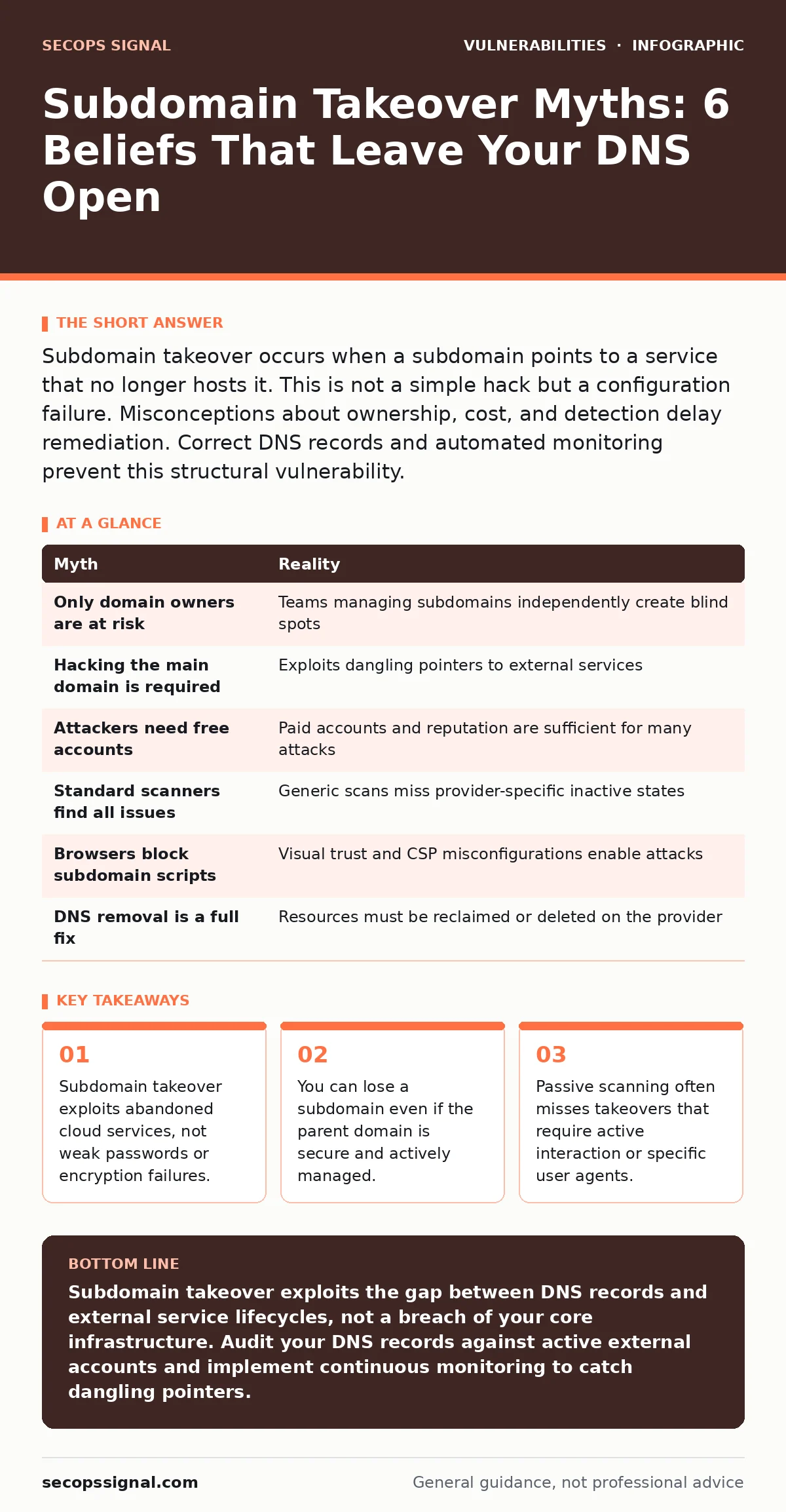
Subdomain takeover occurs when a subdomain points to a service that no longer hosts it. This is not a simple hack but a configuration failure. Misconceptions about ownership, cost, and detection delay remediation. Correct DNS records and automated monitoring prevent this structural vulnerability.
Myth: Only the Domain Owner Can Be Compromised
Reality: The person who manages the primary domain often has no visibility into the subdomains created by other teams. A marketing department might register a subdomain for a campaign hosted on a third-party platform. When the campaign ends, the team deletes the account but forgets to update the DNS record. The DNS still points to the external provider. An attacker registers the same handle on that provider and now controls the subdomain.
This separation of duties creates a blind spot. The domain administrator sees a valid DNS record pointing to a valid IP address. They assume the service is active. The external provider sees an inactive account and releases the namespace for new registrations. The attack happens in the gap between these two systems.
Myth: It Requires Hacking the Main Domain
Reality: Subdomain takeover does not involve breaking into your web server or cracking your domain registrar account. It exploits the trust relationship between your DNS configuration and an external hosting provider. Your DNS says "serve this content from CloudProvider X." CloudProvider X says "I no longer host this content." The result is a dangling pointer.
An attacker does not need credentials for your main domain. They only need to claim the resource on the external provider. Many providers allow anyone to register a unique identifier that matches your dangling DNS record. Once claimed, the provider serves the attacker's content under your subdomain. This is a configuration error, not an intrusion.
Myth: It Is Free for Attackers to Claim
Reality: While some platforms allow free registration, others require a paid plan or a verified business account. Attackers often maintain pools of accounts across multiple services to maximize their reach. They do not create a new account for every target. They rotate through existing accounts that meet the minimum requirements for hosting content.
The cost barrier is low enough to ignore for large-scale attackers. The reward is higher. A taken-over subdomain can host phishing pages that appear to come from your organization. It can host malicious scripts that are whitelisted by your browser because they share your domain. The attacker gains your reputation with minimal financial investment.
Myth: Vulnerability Scanning Catches All Takeovers
Reality: Standard vulnerability scanning tools often fail to detect subdomain takeover opportunities. They check if a DNS record resolves to an IP address. If it does, the scanner assumes the service is healthy. It does not probe the external provider to see if the account is active. Many scanners lack the logic to interpret specific HTTP error codes that indicate a missing application.
Some providers return a generic "404 Not Found" page for both inactive accounts and active accounts with missing paths. A scanner cannot distinguish between a broken link on an active site and a dangling DNS record. This ambiguity leads to false negatives. You need specialized enumeration tools that check for specific provider headers or error messages.
Myth: Subdomains Are Inherently Trusted by Browsers
Reality: Browsers treat subdomains as separate origins from the main domain. A script on evil.example.com cannot directly read cookies from example.com due to same-origin policy. However, users do not parse URLs with technical precision. They see "example.com" and assume safety. This visual trust is the primary vector for exploitation.
Attackers use this trust to bypass skepticism. A phishing page on login.example.com looks identical to the real login page. Users enter credentials without checking the full URL. Additionally, some security features like CSP (Content Security Policy) may inadvertently allow scripts from subdomains if the policy is too broad. This can lead to cross-site scripting if the attacker controls the subdomain.
For more on configuring browser protections, review our guide on HTTP security headers. Proper headers can mitigate some risks, but they cannot stop a user from trusting a familiar-looking URL.
See also: Container Image Scanning: 6 Misconceptions That Leave Gaps · Mitigations and Workarounds: Practical Steps for Small Teams
Myth: It Is a One-Time Incident
Reality: Subdomain takeover is a persistent risk. New subdomains are created daily for testing, marketing, and development. When these projects end, the cleanup process is often inconsistent. One team deletes the cloud instance; another forgets to remove the DNS entry. The gap reopens immediately.
This is not a bug to be patched once. It is a process failure. Without continuous monitoring, new takeovers will appear as fast as new subdomains are created. You must treat DNS hygiene as an ongoing operational task, not a one-time security project.
Integrate this check into your broader risk-based vulnerability management strategy. Prioritize subdomains that host sensitive functions or handle user data. A takeover on a static marketing page is less severe than one on an API endpoint.
Myth: Removing the DNS Record Is the Only Fix
Reality: Removing the DNS record stops the traffic from reaching the external provider. It does not prevent the attacker from retaining control if they have already claimed the resource. If the attacker has registered the handle on the provider, they still own that namespace. You must also reclaim or delete the resource on the external provider.
If you simply remove the DNS record, the attacker may still host malicious content on their claimed resource. This content can be accessed directly via the provider's URL or through other means. You need to coordinate with the external provider to ensure the resource is fully deprovisioned or transferred back to your control.
| Myth | Reality |
|---|---|
| Only domain owners are at risk | Teams managing subdomains independently create blind spots |
| Hacking the main domain is required | Exploits dangling pointers to external services |
| Attackers need free accounts | Paid accounts and reputation are sufficient for many attacks |
| Standard scanners find all issues | Generic scans miss provider-specific inactive states |
| Browsers block subdomain scripts | Visual trust and CSP misconfigurations enable attacks |
| DNS removal is a full fix | Resources must be reclaimed or deleted on the provider |
Key takeaways
- Subdomain takeover exploits abandoned cloud services, not weak passwords or encryption failures.
- You can lose a subdomain even if the parent domain is secure and actively managed.
- Passive scanning often misses takeovers that require active interaction or specific user agents.
Subdomain takeover exploits the gap between DNS records and external service lifecycles, not a breach of your core infrastructure. Audit your DNS records against active external accounts and implement continuous monitoring to catch dangling pointers.
Frequently asked questions
How do I find dangling DNS records?
Use specialized subdomain enumeration tools that check for specific error codes or headers indicating an inactive service on the target provider.
Can I prevent takeovers on free services?
Ensure your internal process requires DNS record removal before deleting accounts on external providers, regardless of cost.
Does HTTPS prevent subdomain takeover?
No. HTTPS encrypts the connection but does not validate that the content served is authorized by the domain owner. The attacker serves valid TLS certificates for their claimed resource.
Should I block all subdomains?
Blocking subdomains is impractical for most organizations. Instead, enforce strict lifecycle management and monitor for changes in DNS records.
How this guide was produced: written by the SecOps Signal editorial team with AI assistance, checked against the public references listed below, and reviewed when the facts change. See our editorial policy or report an error.