Difference Between Sensitive and Personal Data: Classification Rules
Not all personal data carries the same risk weight; sensitive data triggers stricter handling rules because its misuse causes irreversible harm to identity and autonomy.

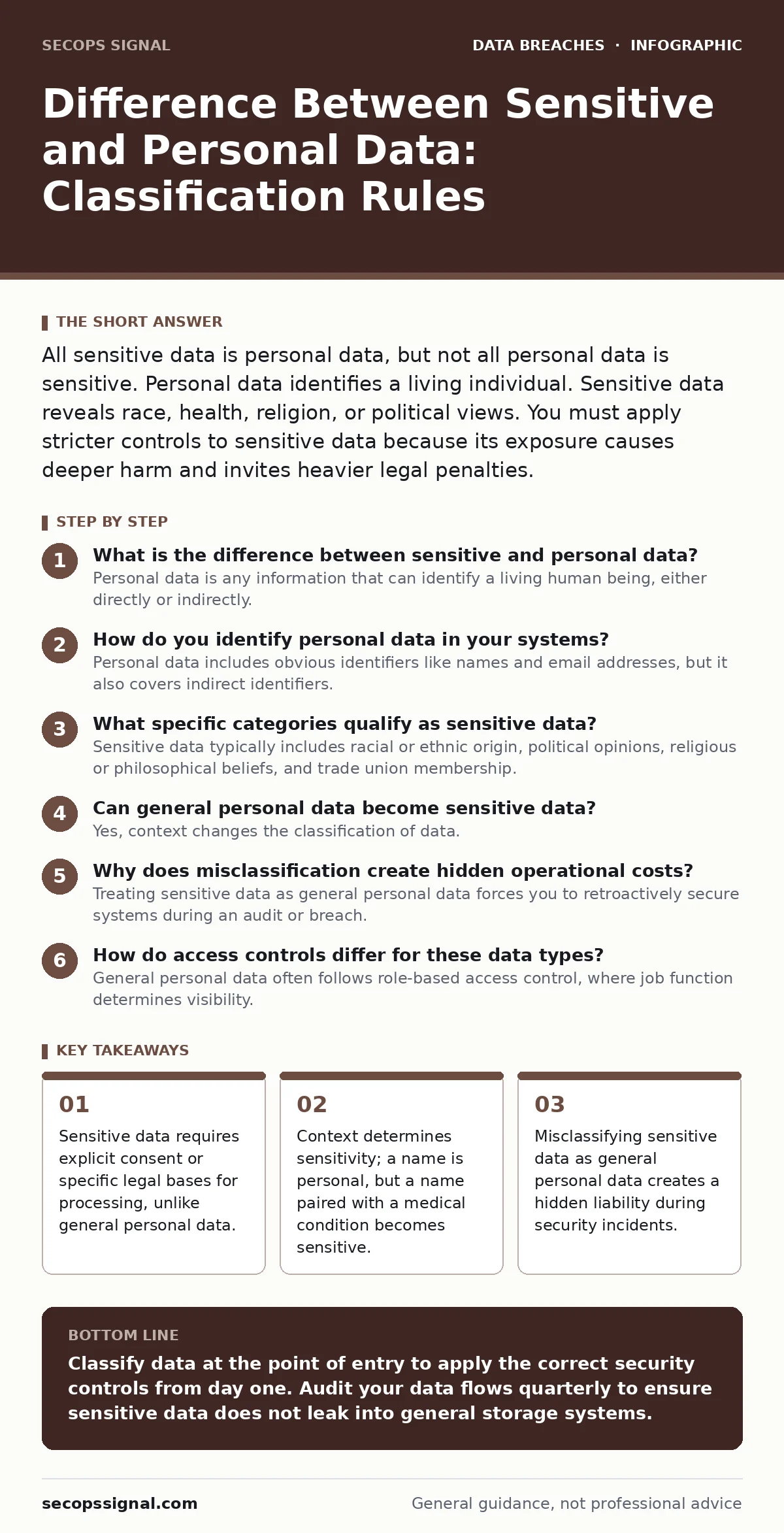
All sensitive data is personal data, but not all personal data is sensitive. Personal data identifies a living individual. Sensitive data reveals race, health, religion, or political views. You must apply stricter controls to sensitive data because its exposure causes deeper harm and invites heavier legal penalties.
What is the difference between sensitive and personal data?
Personal data is any information that can identify a living human being, either directly or indirectly. Sensitive data is a specific subset of personal data that reveals intimate details about an individual’s identity, beliefs, or biology. The distinction matters because sensitive data demands higher security standards and stricter legal compliance. You cannot treat them as equivalent categories in your data inventory.
How do you identify personal data in your systems?
Personal data includes obvious identifiers like names and email addresses, but it also covers indirect identifiers. An IP address, a cookie identifier, or a device MAC address can qualify as personal data if they allow you to single out an individual. You must map every data field in your database to determine if it links back to a human. This mapping prevents you from ignoring low-value fields that actually carry privacy weight.
What specific categories qualify as sensitive data?
Sensitive data typically includes racial or ethnic origin, political opinions, religious or philosophical beliefs, and trade union membership. It also covers genetic data, biometric data used for identification, health data, and data concerning a person’s sex life or sexual orientation. These categories are fixed in most major privacy frameworks. You must tag these fields explicitly in your data architecture to apply the correct access controls.
Can general personal data become sensitive data?
Yes, context changes the classification of data. A home address is personal data, but if it is linked to a domestic violence shelter, it becomes sensitive due to the risk of harm. Similarly, a financial account number is personal data, but if it reveals a person’s religious donations, it may take on sensitive characteristics. You must evaluate the combination of data points, not just individual fields. Aggregation can elevate the risk profile of otherwise benign information.
| Data Type | Examples | Risk Level | Control Requirement |
|---|---|---|---|
| General Personal | Name, email, job title | Medium | Standard encryption, access logs |
| Sensitive Personal | Health records, political views | High | Explicit consent, strict access limits |
| Public Personal | Published business contact info | Low | Basic availability, spam protection |
Why does misclassification create hidden operational costs?
Treating sensitive data as general personal data forces you to retroactively secure systems during an audit or breach. You may need to re-encrypt databases, revoke access permissions, and notify affected individuals. This reactive approach costs more than proactive classification. Furthermore, you risk losing customer trust if they discover their intimate data was stored alongside casual marketing preferences. Proper classification from the start reduces technical debt and legal exposure.
See also: Medical Identity Theft Warning Signs and Response Steps · Tax Identity Theft Description: How Fraudsters Steal Your Refund
How do access controls differ for these data types?
General personal data often follows role-based access control, where job function determines visibility. Sensitive data requires attribute-based access control or strict need-to-know principles. You should implement multi-factor authentication for any user accessing sensitive fields. Additionally, you must log every access event to sensitive data for forensic auditing. These measures prevent insider threats and unauthorized external access.
What happens when a breach involves sensitive data?
A breach involving sensitive data triggers more severe notification requirements and potential regulatory scrutiny. You must assess the potential for identity theft, discrimination, or harassment. The harm to the individual is often irreversible, unlike a leaked password which can be reset. This reality underscores the importance of data masking in non-production environments. Masking ensures that developers and testers work with realistic data structures without exposing actual sensitive values.
How do you manage third-party handling of sensitive data?
You remain responsible for sensitive data even when a vendor processes it. You must verify that the vendor applies equivalent security measures. This verification often involves detailed questionnaires and on-site audits. Understanding the distinction between data controllers and data processors helps you draft clearer contracts. The controller defines the purpose, while the processor executes it. Both parties must adhere to strict data protection agreements to mitigate liability.
What technical measures reduce exposure to sensitive data?
Encryption at rest and in transit is mandatory for sensitive data. You should also consider tokenization, which replaces sensitive data with non-sensitive equivalents. This technique limits the value of stolen data. Regular penetration testing helps identify vulnerabilities in how you store and transmit this information. Combining these technical controls with rigorous user access provisioning ensures that only authorized personnel can view sensitive records.
How does this relate to other security practices?
Protecting sensitive data intersects with many security domains. For instance, credential exposure can lead to unauthorized access to sensitive records if multi-factor authentication is missing. Password reuse across systems increases the risk of account takeover, potentially exposing sensitive data.
While password rotation is less emphasized today, unique credentials remain vital. You must also consider medical identity theft when handling health data, as criminals target this information for fraud. Finally, data extortion tactics often focus on leaking sensitive data to force payment, making prevention critical.
Key takeaways
- Sensitive data requires explicit consent or specific legal bases for processing, unlike general personal data.
- Context determines sensitivity; a name is personal, but a name paired with a medical condition becomes sensitive.
- Misclassifying sensitive data as general personal data creates a hidden liability during security incidents.
Classify data at the point of entry to apply the correct security controls from day one. Audit your data flows quarterly to ensure sensitive data does not leak into general storage systems.
Frequently asked questions
Is an employee’s salary sensitive personal data?
Salary information is generally considered personal data, but not always sensitive. However, if it reveals union membership or is linked to health accommodations, it may become sensitive. Treat it with high caution.
Do I need consent for all personal data?
No, you can process personal data for legitimate interests or contractual necessity. Sensitive data usually requires explicit consent or a specific legal exception. Always verify the legal basis for each data type.
How long should I keep sensitive data?
Keep sensitive data only as long as necessary for its stated purpose. Longer retention increases risk. Define clear deletion schedules and automate data purging where possible to minimize exposure.
Can I use sensitive data for marketing?
Generally, no. Using sensitive data for marketing often violates privacy laws and ethical standards. Stick to general personal data for marketing and ensure you have clear opt-in consent for all communications.
How this guide was produced: written by the SecOps Signal editorial team with AI assistance, checked against the public references listed below, and reviewed when the facts change. See our editorial policy or report an error.