Tax Identity Theft Description: How Fraudsters Steal Your Refund
Tax identity theft often occurs before you file, meaning your clean status with the revenue agency is the primary defense against lost refunds.

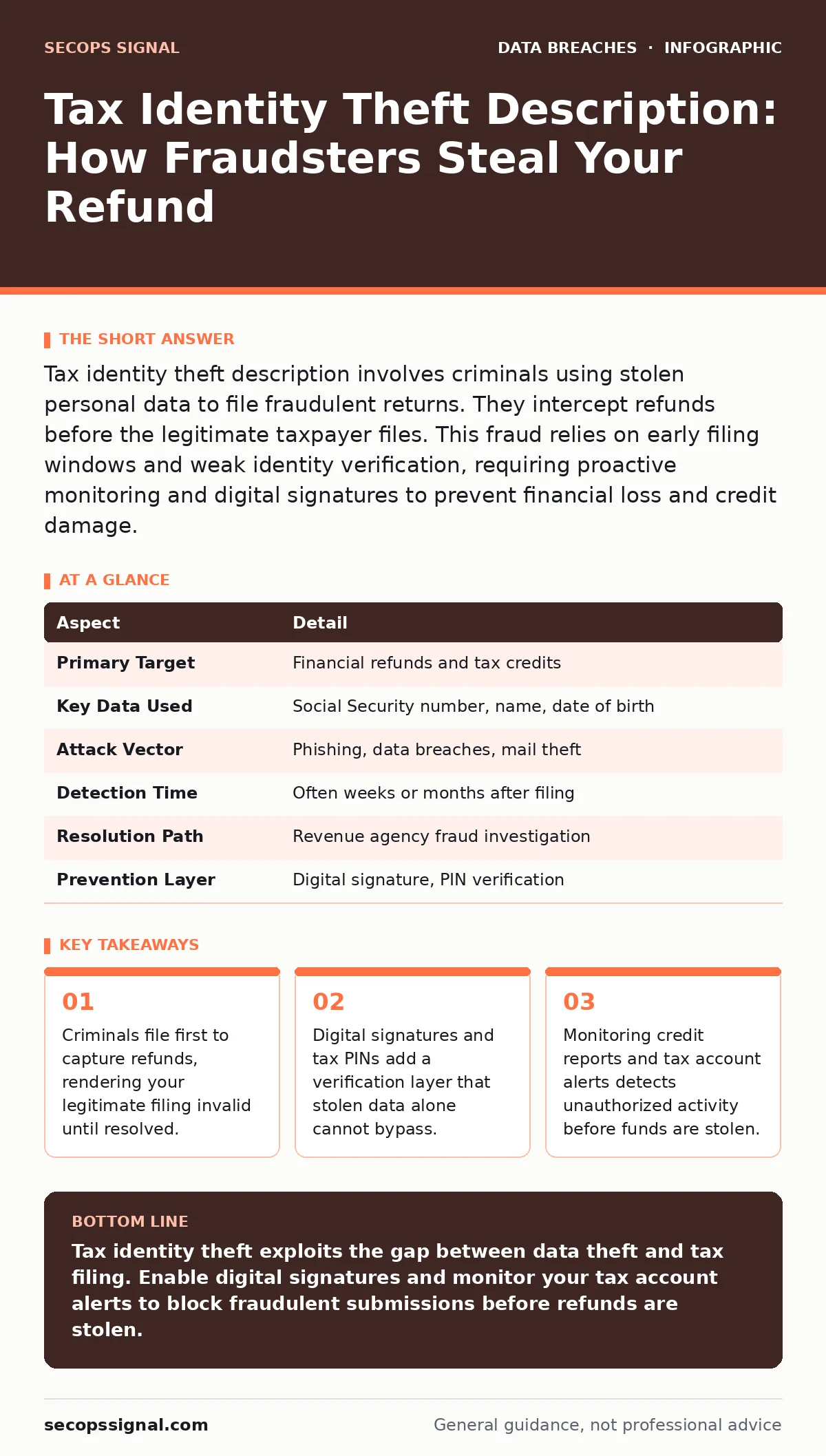
Tax identity theft description involves criminals using stolen personal data to file fraudulent returns. They intercept refunds before the legitimate taxpayer files. This fraud relies on early filing windows and weak identity verification, requiring proactive monitoring and digital signatures to prevent financial loss and credit damage.
The Mechanics of Tax Identity Theft
Imagine a postal worker intercepting a sealed envelope before the intended recipient ever sees it. That is the core mechanic of tax identity theft. A fraudster uses your Social Security number and name to submit a return to the tax authority before you do. The system accepts the first valid submission. Your legitimate return is rejected as a duplicate. The fraudster captures the refund. This process exploits the speed of electronic filing and the lag in identity verification.
| Aspect | Detail |
|---|---|
| Primary Target | Financial refunds and tax credits |
| Key Data Used | Social Security number, name, date of birth |
| Attack Vector | Phishing, data breaches, mail theft |
| Detection Time | Often weeks or months after filing |
| Resolution Path | Revenue agency fraud investigation |
| Prevention Layer | Digital signature, PIN verification |
This crime affects individuals and small businesses alike. Small entities often lack dedicated fraud departments. They rely on standard administrative checks. These checks fail when the attacker possesses accurate personal data. The fraudster does not need your password. They need your identity. This distinction matters. Passwords protect accounts. Identity protects your financial standing with the government.
Why Standard Security Fails Here
Most security advice focuses on protecting devices and accounts. This approach misses the root cause of tax fraud. The attacker already has your data. They obtained it from a breach at a different company. This is where credential exposure becomes dangerous. A leak at a retailer or hospital gives criminals the raw materials. They do not attack your computer. They attack the trust the tax authority places in your data.
Traditional antivirus software cannot stop this. It scans for malware. It does not scan for stolen data being used remotely. You must shift your focus from device security to identity security. This aligns with the CIA triad, specifically the integrity component. If the data submitted is not what you intended, integrity is broken. You must verify that only you can authorize filings.
The Hidden Cost of Detection
Detecting tax identity theft is slow. The tax authority processes millions of returns. Automated systems flag duplicates, but manual review takes time. You may not know you are a victim until you try to file your own return. The system blocks you. It states a return was already filed. By then, the fraudster has likely cashed the check or transferred the funds.
This delay creates a hidden cost. You must spend hours on hold with the revenue agency. You must fill out forms. You must prove your identity. This administrative burden distracts from business operations. For a small entity, this downtime is expensive. It is not just the lost money. It is the labor required to fix the record. The fraudster gains; you lose time and trust.
What People Usually Get Wrong
Many believe that filing early prevents theft. This is only partially true. If you file before the criminal, you block them. But you cannot predict when they will act. Filing early is a tactic, not a shield. The real protection comes from adding a second factor to the filing process.
Another common error is assuming the tax authority verifies identity deeply. It does not. It matches the Social Security number to the name. If the criminal has both, the system accepts the filing. This is why data masking is critical for organizations holding your data. If companies hide your full Social Security number in their systems, breaches yield less usable data. You must push for better data handling practices at the source.
Proactive Defense Strategies
You can build a defense that works even if your data is stolen. Start by enabling a digital signature or PIN for tax filings. This creates a secret key that only you know. The tax authority requires this code to process the return. Even with your Social Security number, the criminal cannot file without it. This is a simple but effective barrier.
Monitor your credit reports regularly. Look for new accounts or inquiries you did not make. While this does not stop tax fraud directly, it helps you spot identity misuse early. If you see unauthorized activity, freeze your credit. This stops criminals from opening new lines of credit, which often accompanies tax fraud.
Use compliance audits to check how your own business handles employee data. If you pay payroll, you generate tax documents. If these are not secure, you become a source of fraud material. Secure your internal records. Encrypt files containing personal data. Limit access to only those who need it. This reduces the risk of your own data being leaked and used against you or your clients.
See also: Romance Scams: How Fraudsters Bypass Trust and What to Do · Password Rotation Explained: Why Changing Passwords Rarely Stops Hackers
The Role of Data Controllers
Understanding who handles your data changes how you protect it. Your employer is a data controller for your tax information. They collect, store, and transmit it. If their security is weak, your data is at risk. You have limited control over their systems. You can, however, request information about their security practices.
Ask about their database security measures. Do they encrypt data at rest? Do they use multi-factor authentication for access? These questions show you take security seriously. It may prompt them to improve their practices. You are not responsible for their security, but you are responsible for knowing your risks.
Resolving the Fraud
If you are a victim, act quickly. Contact the tax authority. File the necessary fraud forms. Report the theft to the Federal Trade Commission. This creates a paper trail. It helps clear your record faster. Update your personal information with financial institutions. Change your passwords. Enable two-factor authentication on all accounts.
The resolution process is bureaucratic. It requires patience. Keep records of all communications. Note dates and case numbers. This documentation speeds up future interactions. It proves you are acting in good faith. The system is designed to process volume, not nuance. You must provide clear, consistent information.
Long-Term Identity Hygiene
Tax identity theft is a symptom of broader identity management failures. You must treat your personal data as a high-value asset. Limit where you share your Social Security number. Do not carry your card. Shred documents containing sensitive data. Use secure, encrypted methods for transmitting personal information.
Regularly review your financial statements. Look for small, unauthorized charges. These can be signs of larger identity misuse. Address them immediately. The sooner you detect an issue, the easier it is to contain. This proactive stance reduces the impact of any future breach. It builds resilience against evolving threats.
Key takeaways
- Criminals file first to capture refunds, rendering your legitimate filing invalid until resolved.
- Digital signatures and tax PINs add a verification layer that stolen data alone cannot bypass.
- Monitoring credit reports and tax account alerts detects unauthorized activity before funds are stolen.
Tax identity theft exploits the gap between data theft and tax filing. Enable digital signatures and monitor your tax account alerts to block fraudulent submissions before refunds are stolen.
Frequently asked questions
Can tax identity theft happen if I never file a return?
Yes. Criminals can file a false return claiming you are a dependent or filing a joint return. This uses your data to increase their refund. You may discover this when you receive a notice about tax activity you did not initiate.
How long does it take to resolve tax identity theft?
Resolution varies. Simple cases may take weeks. Complex cases with large refunds can take months. The tax authority must verify your identity and reverse the fraudulent transaction. Patience and documentation are key.
Does freezing my credit stop tax identity theft?
Not directly. Credit freezes stop new accounts from being opened. They do not stop criminals from filing taxes using existing data. You must use tax-specific protections like digital signatures or PINs to block fraudulent filings.
Should I change my Social Security number?
Generally no. The government advises against this unless you have severe, ongoing harassment. Changing your SSN is a major administrative burden. Focus on securing your identity and monitoring for misuse. It is a last resort, not a first step.
How this guide was produced: written by the SecOps Signal editorial team with AI assistance, checked against the public references listed below, and reviewed when the facts change. See our editorial policy or report an error.