Data Controllers vs Processors: Why the Distinction Stops Breaches
Defining who controls data and who processes it shifts liability, forces stricter vendor vetting, and prevents silent data leakage that standard contracts miss.

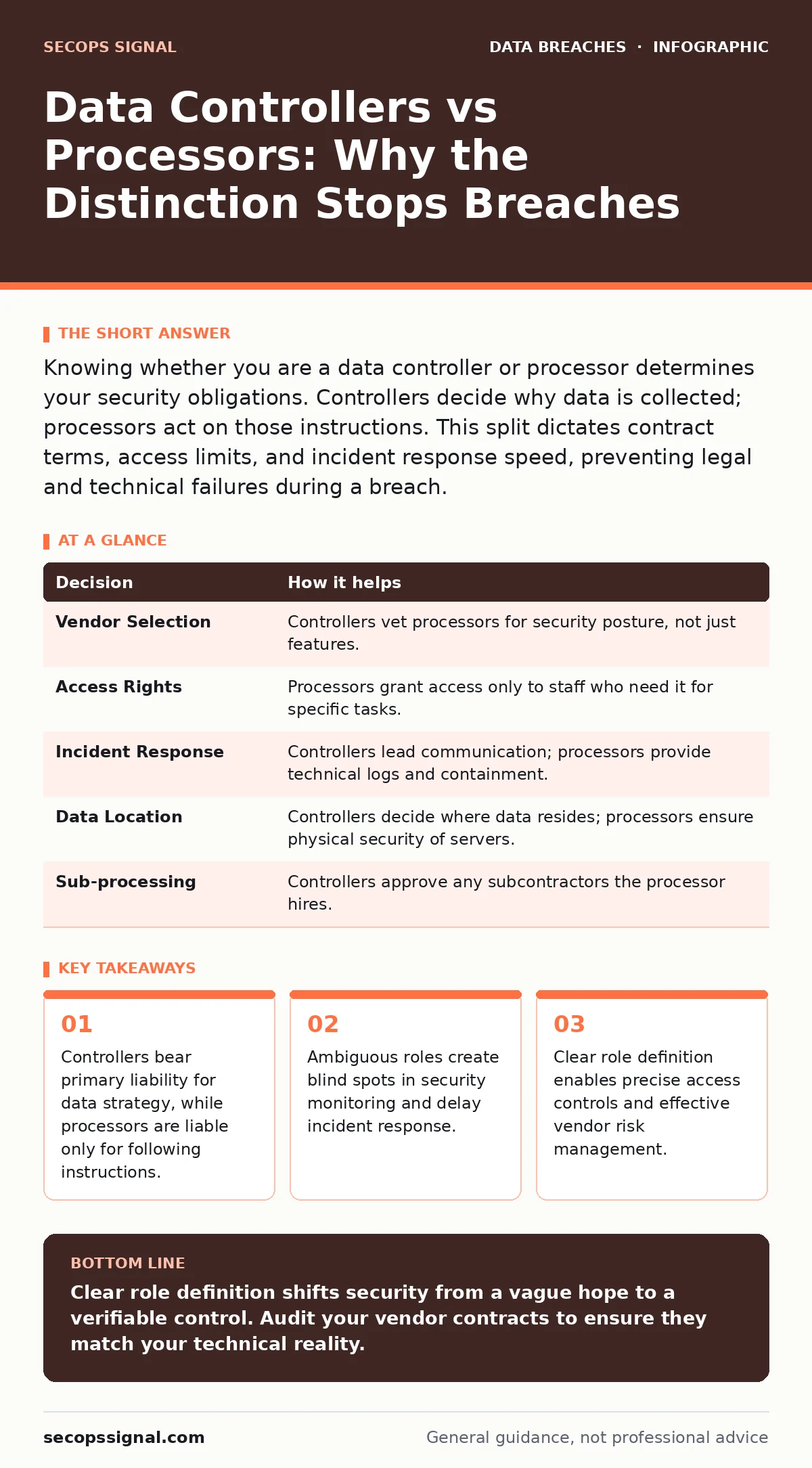
Knowing whether you are a data controller or processor determines your security obligations. Controllers decide why data is collected; processors act on those instructions. This split dictates contract terms, access limits, and incident response speed, preventing legal and technical failures during a breach.
The Architecture of Responsibility
Security fails when teams assume responsibility is shared equally. In reality, the law and security frameworks draw a hard line between two roles. A data controller determines the purpose and means of processing personal data. A data processor processes that data only on the controller’s behalf. This distinction is not merely legal; it is a technical boundary. It dictates who holds the keys, who writes the rules, and who answers when things break.
Imagine a small business using a third-party email marketing tool. The business decides who receives emails and what data is collected. They are the controller. The marketing tool stores and sends the emails. They are the processor. If the marketing tool is hacked, the business still faces regulatory scrutiny because they chose the vendor. If the business leaks data by sending it to the wrong person, the vendor is not at fault. Understanding this split changes how you design your security stack.
Decisions Driven by Role
Your role dictates your security architecture. Controllers must ensure data minimization and purpose limitation. Processors must ensure confidentiality and integrity during transmission and storage. These different mandates lead to different technical controls. A controller might focus on user consent mechanisms and data retention policies. A processor focuses on encryption at rest, network segmentation, and strict access logs.
| Decision | How it helps |
|---|---|
| Vendor Selection | Controllers vet processors for security posture, not just features. |
| Access Rights | Processors grant access only to staff who need it for specific tasks. |
| Incident Response | Controllers lead communication; processors provide technical logs and containment. |
| Data Location | Controllers decide where data resides; processors ensure physical security of servers. |
| Sub-processing | Controllers approve any subcontractors the processor hires. |
This table shows that security is not a monolith. It is a series of handoffs. Each handoff requires a specific control. If you do not know your role, you cannot choose the right control. You might encrypt data that should be deleted, or leave unencrypted data that should be locked down.
The Cost of Ambiguity
When roles are unclear, security gaps emerge. Suppose a company uses a cloud storage provider but treats it as a simple utility. They do not define who controls the encryption keys. They assume the provider handles everything. This is a processor acting with controller-like powers. If the provider suffers an insider threat, the company has no visibility. They cannot audit the provider’s internal access because they never claimed the right to do so.
This ambiguity extends to breach dwell time. Without clear roles, teams do not know who is responsible for monitoring logs. The controller waits for the processor to alert them. The processor waits for the controller to define what constitutes an alert. Days are lost. In that time, attackers move laterally. The lack of a defined boundary allows the breach to expand silently.
Technical Implementation of Boundaries
How do teams enforce these roles technically? It starts with access provisioning. A user access provisioning system must distinguish between controller accounts and processor accounts. Controller accounts have broader permissions to view and manage data. Processor accounts have limited, task-specific permissions. This separation prevents privilege creep. If a processor employee can view raw data without a specific job reason, the processor is acting as a controller. That is a violation of the role agreement.
Encryption keys offer another boundary. In a strong model, the controller holds the encryption keys. The processor sees only ciphertext. If the processor is compromised, the data remains unreadable. This is known as customer-managed keys. It shifts the cryptographic burden to the controller but provides superior security. The processor cannot access the data even if they want to. This technical control enforces the legal role.
Vendor Risk and Supply Chain
Controllers must manage their processors. This is not a one-time check. It is an ongoing process. You must review the processor’s security certifications annually. You must require them to notify you of any sub-processors they engage. A sub-processor is a third party hired by the processor to handle part of the work. If your processor hires a cheap hosting provider in an unstable region, you are exposed. You did not vet that hosting provider. But you are liable for the data loss.
This connects to database security. If your processor uses weak database configurations, your data is at risk. You must require them to provide evidence of secure configurations. This might include automated patching, intrusion detection systems, and regular penetration testing. Do not accept a generic statement of compliance. Ask for the specific controls. If they cannot explain how they protect your data, you cannot trust them with it.
See also: 7 Code Repository Mistakes That Leak Secrets · Shadow IT Definition: How to Find Hidden Cloud Risks
Incident Response Clarity
When a breach occurs, speed matters. But speed requires clarity. If roles are defined, the response is immediate. The controller decides whether to notify regulators and affected individuals. The processor provides the technical details: what data was accessed, when, and how. They work together to contain the breach. Without this clarity, teams argue over responsibility. They delay notification. They lose evidence.
Consider data extortion. Attackers often target processors because they hold large volumes of data for many clients. If the processor is compromised, multiple controllers are affected. Each controller must assess their own exposure. Did they share sensitive data with this processor? If the roles were clear, the controller knows exactly what data was in scope. If the roles were blurred, the controller must guess. Guessing leads to under-reporting or over-reporting. Both are costly.
Preventing Silent Leakage
Ambiguous roles lead to silent data leakage. Processors often need to analyze data for service improvement. If not restricted, they might use your data for machine learning training. This is a form of secondary processing. The controller did not consent to this. But if the contract does not forbid it, the processor can do it. This is a privacy violation. It is also a security risk. The data is now in a new system, with new vulnerabilities.
To prevent this, controllers must enforce strict data usage policies. They must require processors to delete data after the service is complete. They must audit the processor’s data retention practices. This ties into data masking. If processors need to test systems, they should use masked data, not real personal data. Masking removes identifying information while preserving structure. This allows testing without risk. If processors use real data for testing, they increase the attack surface unnecessarily.
The Human Element
Technology alone cannot enforce roles. People must understand them. Train your staff on the difference between controller and processor responsibilities. Ensure they know who to contact when a vendor asks for data. Ensure they know how to verify a vendor’s security claims. This training should be part of your user access provisioning process. New hires should understand these roles before they get system access.
Also, consider credential exposure. If a processor employee’s credentials are leaked, your data is at risk. Require processors to use multi-factor authentication for all staff with data access. Require them to rotate credentials regularly. These are basic controls, but they are often neglected. Do not assume your vendor is doing the right thing. Verify it.
Conclusion of Roles
The distinction between controller and processor is a security tool. It forces you to define boundaries. It clarifies responsibility. It enables precise technical controls. Without it, you are flying blind. You do not know who protects your data. You do not know who to blame when it leaks. Define your role. Define your vendors’ roles. Enforce those roles with contracts and technology. This is the foundation of a secure data strategy.
Key takeaways
- Controllers bear primary liability for data strategy, while processors are liable only for following instructions.
- Ambiguous roles create blind spots in security monitoring and delay incident response.
- Clear role definition enables precise access controls and effective vendor risk management.
Clear role definition shifts security from a vague hope to a verifiable control. Audit your vendor contracts to ensure they match your technical reality.
Frequently asked questions
Who is liable if a cloud provider is hacked?
The data controller is primarily liable for the breach, even if the processor was the point of entry. The controller chose the vendor and is responsible for due diligence.
Can a company be both a controller and a processor?
Yes. A company may be a controller for its own employee data but a processor for its clients’ customer data. Each role requires separate security controls and compliance efforts.
How do I verify a processor’s security?
Request their security certifications, penetration test reports, and data flow diagrams. Ask specific questions about encryption, access controls, and incident response procedures.
What if a processor uses sub-processors?
You must approve all sub-processors in writing. You are liable for their actions. Ensure your contract requires prior notification and consent for any sub-processing.
How this guide was produced: written by the SecOps Signal editorial team with AI assistance, checked against the public references listed below, and reviewed when the facts change. See our editorial policy or report an error.