Session Cookie Theft: How Attackers Hijack Accounts Without Passwords
Stolen session cookies grant attackers immediate access to your accounts, bypassing multi-factor authentication and password protections entirely.

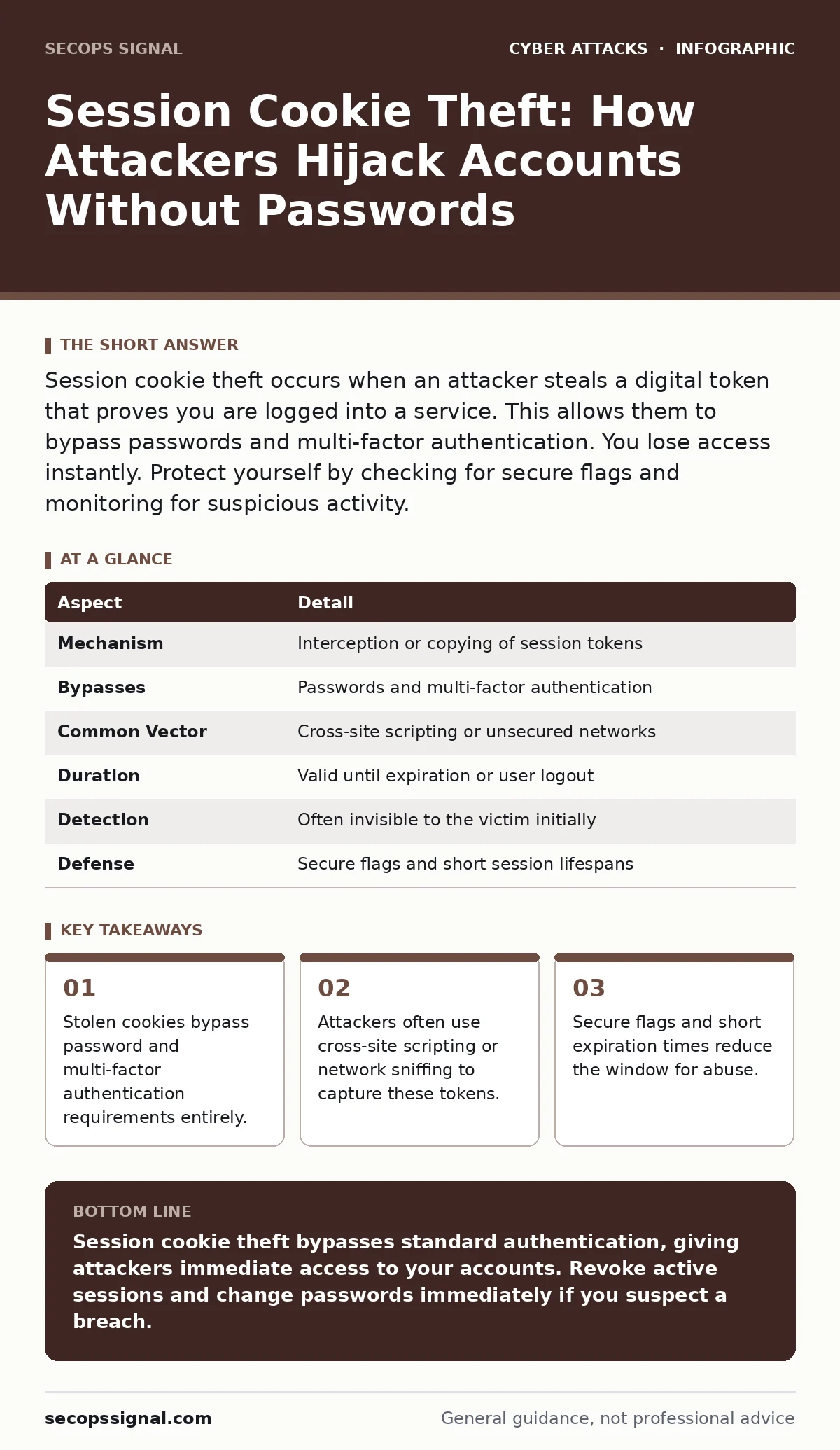
Session cookie theft occurs when an attacker steals a digital token that proves you are logged into a service. This allows them to bypass passwords and multi-factor authentication. You lose access instantly. Protect yourself by checking for secure flags and monitoring for suspicious activity.
The Library Card Analogy
Imagine you enter a library using a special keycard. Once inside, you do not need to show your ID again. You simply carry that card. If someone steals your card, they can walk in and access your private files without ever knowing your ID number. Session cookies work the same way. They are digital keys that tell a website you have already proven who you are.
What Is Session Cookie Theft?
Session cookie theft is the unauthorized capture of a token that maintains your login state on a web service. When you log into an application, the server creates a unique string of characters. It sends this string to your browser. Your browser stores it and sends it back with every request. The server sees the cookie and grants access. If an attacker intercepts or copies this string, they can impersonate you.
| Aspect | Detail |
|---|---|
| Mechanism | Interception or copying of session tokens |
| Bypasses | Passwords and multi-factor authentication |
| Common Vector | Cross-site scripting or unsecured networks |
| Duration | Valid until expiration or user logout |
| Detection | Often invisible to the victim initially |
| Defense | Secure flags and short session lifespans |
How Attackers Capture Session Tokens
Attackers use several methods to steal these tokens. Cross-site scripting is the most common. An attacker injects malicious code into a trusted website. When you visit the site, the code runs in your browser. It sends your active session cookie to the attacker's server. You see nothing unusual. The attacker now holds your digital key.
Network sniffing is another method. If you connect to an unsecured public Wi-Fi network, your data travels in plain text. Attackers on the same network can listen to the traffic. They capture the cookie as it travels between your device and the server. This works only if the connection lacks encryption.
Supply chain attacks can also introduce these vulnerabilities. If a trusted software component contains a flaw, it can expose session data. This connects to broader risks discussed in our guide on supply chain attacks.
Who Is Affected by Cookie Theft?
Anyone who logs into web applications is affected. Business owners are particularly vulnerable because their accounts often contain sensitive financial data or customer records. Attackers target these accounts to steal money or data. They do not need to guess your password. They only need your active session.
This threat extends to personal accounts. Social media, email, and banking apps all use session cookies. A stolen email account can lead to password resets for other services. This creates a domino effect. The attacker gains access to multiple systems using one stolen token.
What People Usually Get Wrong
Many users believe multi-factor authentication stops all account takeovers. It does not stop session cookie theft. Multi-factor authentication verifies your identity at the start of a session. Once you pass that check, the server issues a cookie. The attacker uses that cookie to enter. They never trigger the second factor. This is a critical misunderstanding.
Another mistake is assuming logout fixes the problem. Logging out destroys the cookie on your device. It does not stop the attacker from using the copy they already stole. The server still accepts the stolen cookie until it expires. You must revoke the session from the server side.
How to Prevent Session Cookie Theft
You can reduce the risk by configuring your browser and habits. Use strong HTTPS connections. This encrypts the traffic between your browser and the server. It prevents network sniffing. Never enter credentials on sites that lack this encryption.
Check for secure flags. Developers should set the Secure flag on cookies. This ensures the browser only sends the cookie over encrypted connections. They should also set the HttpOnly flag. This prevents scripts from accessing the cookie. This mitigates cross-site scripting attacks. You can read more about this in our guide on web skimming.
Limit session duration. Short-lived cookies expire quickly. This reduces the time an attacker has to use a stolen token. If you leave a device, log out. This invalidates the session on the server. Do not rely on closing the browser tab. Some browsers restore sessions automatically.
Detecting and Responding to a Breach
Detection is difficult. The attacker uses your credentials and your session. The server sees a valid login. Look for unusual activity. Check for logins from strange locations or devices. Review recent changes to account settings. Look for new devices added to trusted lists.
If you suspect theft, act immediately. Log out of all sessions. This forces the server to invalidate all active cookies. Change your password. This does not stop the current session, but it prevents new logins with old credentials. Enable multi-factor authentication for future logins. This adds a layer of protection for new sessions.
Monitor your accounts for a few weeks. Attackers may wait before acting. Look for unauthorized transactions or data exports. Report the incident to the service provider. They may have additional logs to help identify the breach.
Strengthening Your Defense Posture
Prevention requires a layered approach. Technical controls are primary. Ensure your applications use secure cookie settings. Use intrusion prevention systems to block known malicious traffic. These tools can detect some forms of injection attacks.
User behavior is secondary but important. Do not click on suspicious links. These links may lead to pages that steal cookies. This relates to the risks in tech support scams and romance scams, where trust is exploited.
Regular security awareness training helps staff recognize threats. Teach them to verify URLs and check for encryption. Educate them on the risks of public Wi-Fi. This reduces the likelihood of accidental exposure.
Key takeaways
- Stolen cookies bypass password and multi-factor authentication requirements entirely.
- Attackers often use cross-site scripting or network sniffing to capture these tokens.
- Secure flags and short expiration times reduce the window for abuse.
Session cookie theft bypasses standard authentication, giving attackers immediate access to your accounts. Revoke active sessions and change passwords immediately if you suspect a breach.
Frequently asked questions
Does two-factor authentication prevent session cookie theft?
No. Two-factor authentication only protects the initial login. Once a session is established, the cookie allows access without further verification.
How long does a stolen session cookie remain valid?
It remains valid until it expires or the user logs out. Expiration times vary by service, ranging from minutes to weeks.
Can clearing my browser history stop an attacker?
No. Clearing history removes the cookie from your device, but the attacker still holds a copy. You must log out from the server.
Is public Wi-Fi dangerous for session cookies?
Yes. Unencrypted public Wi-Fi allows attackers to sniff network traffic and capture session cookies in transit.
How this guide was produced: written by the SecOps Signal editorial team with AI assistance, checked against the public references listed below, and reviewed when the facts change. See our editorial policy or report an error.