Romance Scams: How Fraudsters Bypass Trust and What to Do
Romance scams exploit psychological manipulation rather than technical exploits, making traditional security tools largely ineffective against the human element.
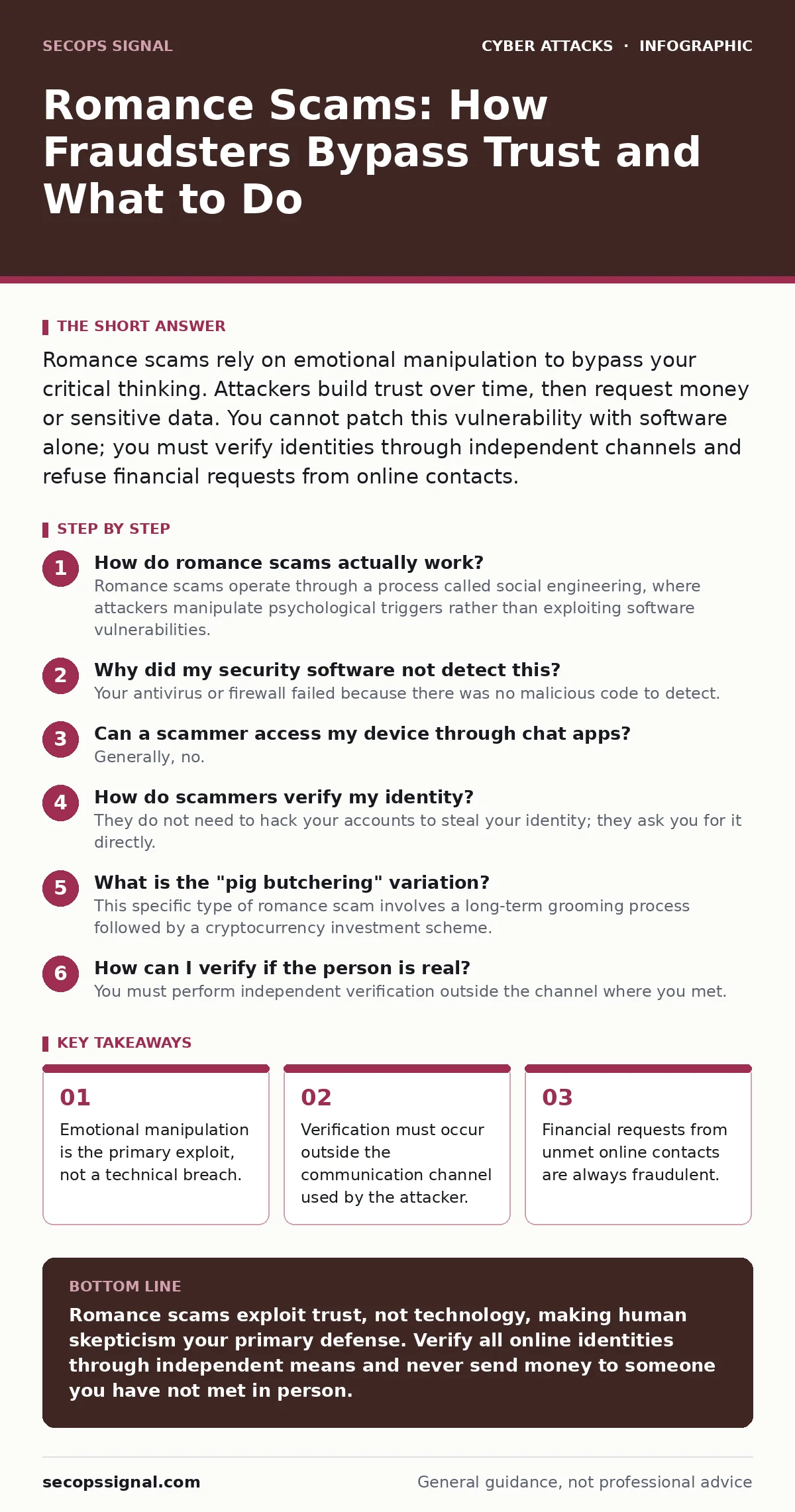
Romance scams rely on emotional manipulation to bypass your critical thinking. Attackers build trust over time, then request money or sensitive data. You cannot patch this vulnerability with software alone; you must verify identities through independent channels and refuse financial requests from online contacts.
How do romance scams actually work?
Romance scams operate through a process called social engineering, where attackers manipulate psychological triggers rather than exploiting software vulnerabilities. The attacker creates a false persona and builds an emotional connection with you over weeks or months. This duration is intentional, designed to lower your defenses and create a sense of obligation or intimacy. Once trust is established, the attacker introduces a crisis that requires immediate financial assistance.
The mechanism relies on isolation. The attacker encourages you to move conversations away from public platforms to private messaging apps. This reduces the chance of third-party intervention and allows the scammer to control the narrative completely. You are not being hacked; you are being persuaded.
Why did my security software not detect this?
Your antivirus or firewall failed because there was no malicious code to detect. These tools look for known signatures of malware or suspicious network traffic patterns. A romance scam involves legitimate communication protocols and standard email or messaging services. The threat is the content of the conversation, not the carrier.
Imagine you receive an email from a new friend. The email contains no links, no attachments, and no viruses. It simply asks how your day was. Your security software sees this as benign traffic. The danger lies in the subsequent interactions, which are invisible to technical defenses. This is why behavioral analysis by humans is the only real defense.
Can a scammer access my device through chat apps?
Generally, no. Modern messaging applications are secure against remote exploitation via text messages. However, attackers often try to shift the attack vector by sending malicious files. They might claim to send a photo or a document that contains malware.
If you open a file sent by an unverified contact, you risk drive-by downloads or executable malware installing on your system. This malware can then steal credentials or monitor your activity. The romance narrative is the hook; the file is the payload. Never open files from someone you have not met in person, regardless of the context.
How do scammers verify my identity?
They do not need to hack your accounts to steal your identity; they ask you for it directly. During the relationship building phase, the scammer will subtly probe for personal details. They may ask for your full name, birthdate, or address under the guise of sending a gift or planning a future meeting.
This information is used to create a synthetic identity or to apply for credit in your name. The scammer knows that people are more likely to share sensitive data with someone they trust emotionally. This is a direct extraction of data, bypassing any need for technical intrusion.
What is the "pig butchering" variation?
This specific type of romance scam involves a long-term grooming process followed by a cryptocurrency investment scheme. The attacker introduces you to a fake investment platform that appears legitimate. You are encouraged to deposit funds and see initial "profits" to build confidence.
Eventually, the scammer convinces you to invest a large sum. The platform then freezes your account, citing regulatory issues or technical errors. They demand additional fees to release the funds. This is a total loss. The platform does not exist; the profits were fabricated numbers.
| Scam Type | Primary Goal | Method of Payment | Timeframe |
|---|---|---|---|
| Traditional Romance | Immediate Cash | Wire Transfer, Gift Cards | Weeks to Months |
| Pig Butchering | Investment Loss | Cryptocurrency | Months to Years |
| Emergency Relief | Quick Funds | Digital Wallets | Days to Weeks |
See also: Invoice Fraud Response: Stop Payments and Secure Accounts · Fake Software Updates Explained: How to Spot Counterfeit Patches
How can I verify if the person is real?
You must perform independent verification outside the channel where you met. If the person refuses a video call or claims their camera is broken, this is a significant red flag. Reverse image search their profile pictures to see if they appear on other websites or stock photo sites.
Do not rely on their excuses for not meeting. If they are real, they will find a way to prove their existence. If they are a scammer, they will create more obstacles. Conditional access policies for your own accounts ensure that even if credentials are stolen, access is restricted by location or device, adding a layer of protection.
Why do they ask for gift cards?
Gift cards are preferred because they are nearly impossible to trace and reverse. Once you provide the code, the value is transferred instantly to the scammer. Unlike bank transfers, which may be flagged or reversed, gift card transactions are treated as cash equivalents.
They may also ask for cryptocurrency for the same reasons. These assets are decentralized and anonymous. The scammer knows that once the transaction is confirmed on the blockchain, it cannot be undone. This is a one-way street with no recourse for the victim.
What should I do if I have sent money?
Stop all communication immediately. Do not engage in arguments or attempts to negotiate the return of funds. Contact your financial institution to report the transaction. They may be able to freeze the account or dispute the charge, though success is not guaranteed.
Report the incident to law enforcement and the platform where you met the person. This helps create a record and may prevent others from being targeted. The emotional toll is significant, but acting quickly limits further financial damage.
How do I protect my digital footprint?
Scammers often harvest data from social media profiles to make their persona believable. They look for your location, interests, and relationships. Adjust your privacy settings to limit who can see your posts and personal information.
Use a password manager to ensure that your accounts are secured with unique, complex passwords. This prevents a breach on one site from compromising your others. Regularly review connected apps and remove any that you do not use.
Can I recover stolen personal information?
If you have shared sensitive data, you must act to mitigate identity theft. Place a fraud alert on your credit reports with the major credit bureaus. This requires potential creditors to verify your identity before issuing credit.
Monitor your bank and credit card statements for unauthorized transactions. Consider freezing your credit entirely, which prevents any new accounts from being opened in your name. This is a proactive measure that stops scammers from leveraging your stolen data for financial gain.
Key takeaways
- Emotional manipulation is the primary exploit, not a technical breach.
- Verification must occur outside the communication channel used by the attacker.
- Financial requests from unmet online contacts are always fraudulent.
Romance scams exploit trust, not technology, making human skepticism your primary defense. Verify all online identities through independent means and never send money to someone you have not met in person.
Frequently asked questions
Can I track down a romance scammer?
Law enforcement agencies have limited resources for individual cases, especially if the scammer is overseas. Focus on reporting the incident to financial institutions and platforms to stop further fraud.
Is it possible to get my money back?
Recovery is rare, especially if cryptocurrency or gift cards were used. Bank transfers may sometimes be reversed if reported immediately, but do not count on this outcome.
Do romance scams happen on dating apps?
Yes, any platform that allows personal communication can be used for romance scams. The risk is not the platform, but the behavior of the person on the other end.
How long does grooming take?
Grooming can take weeks, months, or even years. The duration depends on the scammer's patience and the amount of money they are trying to extract.
How this guide was produced: written by the SecOps Signal editorial team with AI assistance, checked against the public references listed below, and reviewed when the facts change. See our editorial policy or report an error.