Misconfigured IAM Roles: Answers to the Questions You Are Asking
Most identity failures stem from implicit deny rules being overridden by overly broad resource wildcards in policy statements.

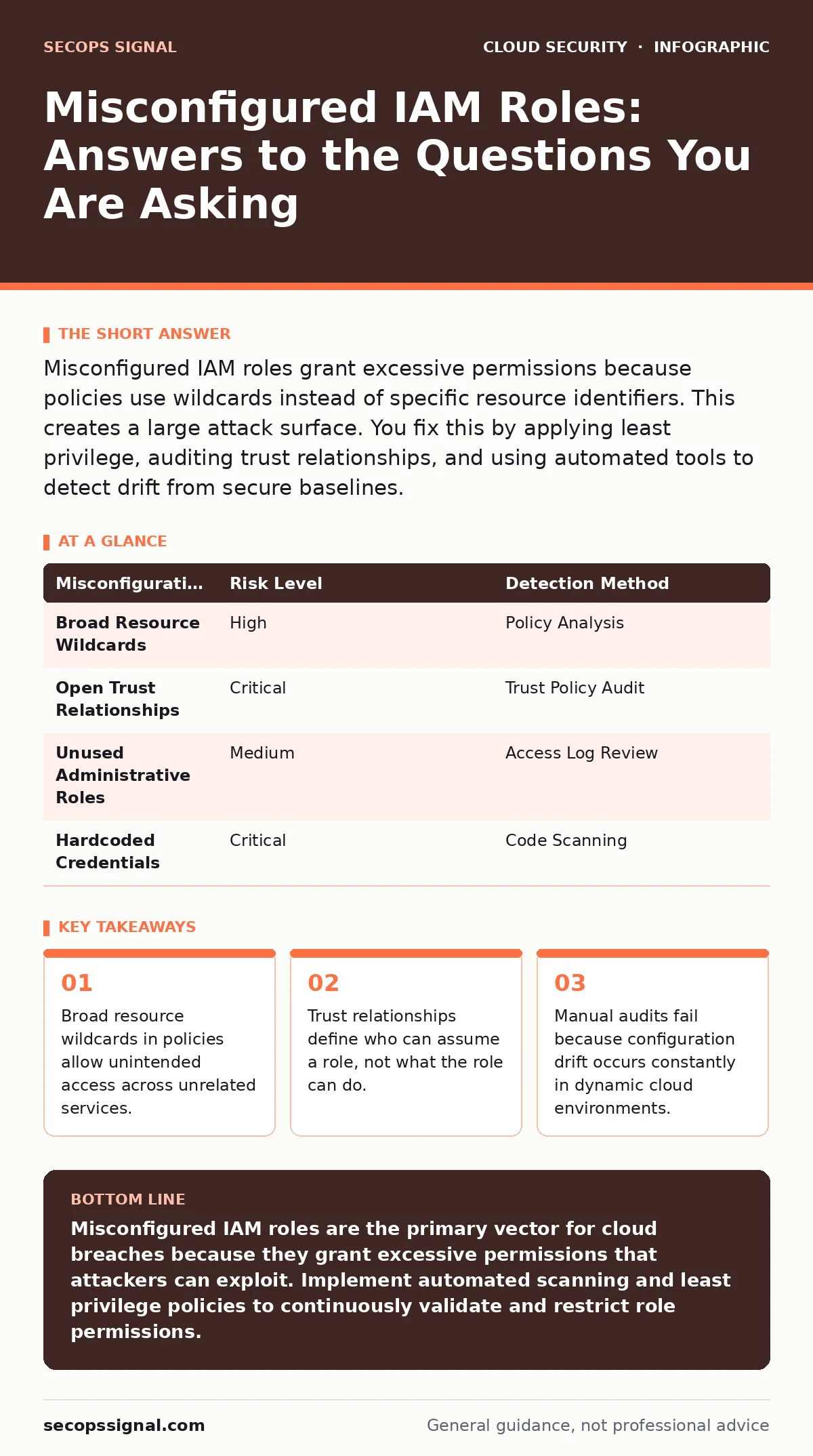
Misconfigured IAM roles grant excessive permissions because policies use wildcards instead of specific resource identifiers. This creates a large attack surface. You fix this by applying least privilege, auditing trust relationships, and using automated tools to detect drift from secure baselines.
What exactly is an IAM role?
An IAM role is a temporary set of permissions that you assign to a service, user, or application. It does not have long-term credentials like passwords or access keys. Instead, it provides temporary security credentials that expire after a set time. This mechanism allows resources to act on your behalf without storing sensitive secrets permanently.
Why do roles get misconfigured in the first place?
Misconfiguration usually happens when administrators prioritize speed over precision during deployment. It is easier to grant broad permissions to a new service than to map out every specific API call it needs. This shortcut creates a policy that allows more actions than necessary. Over time, these permissive policies accumulate and expand the potential damage of a breach.
How do wildcards create hidden security gaps?
Using the asterisk symbol in policy statements grants access to all resources or all actions within a service. Imagine a policy that allows s3: on arn:aws:s3:::. This grants full control over every bucket in your account. If an attacker compromises that role, they can read, delete, or exfiltrate data from any bucket. Specific resource identifiers limit the blast radius of a compromise.
What is the difference between a policy and a trust relationship?
A policy defines what actions the role can perform, such as reading a file. The trust relationship defines who can assume the role, such as a specific application or user. Many security failures occur because teams secure the policy but neglect the trust relationship. An open trust relationship allows any external entity to assume the role, bypassing the policy restrictions entirely.
How can I detect misconfigurations before they are exploited?
You must use automated scanning tools that compare current configurations against a secure baseline. Manual reviews are ineffective because cloud environments change constantly. These tools identify roles with administrative privileges or broad resource access. They also flag roles that have not been used in a long time, which indicates they may be orphaned and risky.
See also: Shadow IT Definition: How to Find Hidden Cloud Risks · Cloud Security Examples: How Security Groups Enforce Zero Trust
Why does manual auditing always fail?
Cloud infrastructure is dynamic, with resources being created and destroyed frequently. By the time a human reviewer finishes checking a configuration, the environment has likely changed. This lag creates windows of vulnerability where misconfigurations exist undetected. Automation provides continuous monitoring that matches the speed of infrastructure changes.
What is configuration drift and why does it matter?
Configuration drift occurs when the actual state of your resources diverges from your intended secure state. This happens when developers make emergency changes or when automated tools modify permissions without approval. Drift introduces unauthorized access paths that were not part of the original design. Detecting drift early prevents small changes from becoming major security incidents.
How do I implement least privilege effectively?
Start by granting no permissions and then adding only what is necessary for the role to function. Use permission boundaries to set a maximum limit on what a role can do, even if the policy grants more. Regularly review logs to see which permissions are actually used. Remove any permissions that are not actively required by the application.
| Misconfiguration Type | Risk Level | Detection Method |
|---|---|---|
| Broad Resource Wildcards | High | Policy Analysis |
| Open Trust Relationships | Critical | Trust Policy Audit |
| Unused Administrative Roles | Medium | Access Log Review |
| Hardcoded Credentials | Critical | Code Scanning |
What happens when a role is compromised?
An attacker who assumes a misconfigured role can perform any action allowed by its policy. They can pivot to other services, exfiltrate data, or deploy malicious code. Because roles often have broad access, the damage can spread quickly across your entire environment. The temporary nature of the credentials makes tracking the attacker difficult without detailed logging.
How do I secure roles in ephemeral environments?
Ephemeral infrastructure creates and destroys resources rapidly, often using automated scripts. Traditional static security controls cannot keep up with this pace. You must embed security checks into your deployment pipeline. This ensures that every new role is validated against security rules before it becomes active. Automated remediation can also fix misconfigurations instantly.
Can I automate the remediation of misconfigurations?
Yes, you can use infrastructure-as-code tools to enforce correct configurations automatically. These tools define the desired state of your roles and policies. If a change deviates from this state, the tool can revert it or alert you. This reduces the mean time to remediation and prevents human error from persisting in your environment.
What is the role of just-in-time access?
Just-in-time access grants permissions only for the time they are needed. Instead of having permanent administrative roles, users request access for a specific task. The system grants the permission for a short window and then revokes it. This significantly reduces the window of opportunity for attackers to exploit compromised credentials.
How do I balance security with developer productivity?
Security controls should be integrated into the development workflow, not added as a separate step. Provide developers with pre-approved, secure role templates that they can use. This allows them to deploy quickly without waiting for security reviews. Automate the validation of these templates to ensure they remain secure over time.
What logs should I monitor for IAM anomalies?
Monitor for unusual patterns in role assumption and permission usage. Look for assumptions from unexpected IP addresses or regions. Alert on the use of rarely used permissions or administrative actions. Combine these logs with identity and access management events to get a complete picture of activity. Correlating these signals helps distinguish between normal operations and malicious activity.
How does federated identity affect role security?
Federated identity allows users from external identity providers to access your cloud resources. This expands the trust boundary beyond your internal directory. You must ensure that the external provider enforces strong authentication and that the trust relationship is tightly scoped. Misconfigurations here can allow external attackers to assume roles using compromised external accounts.
Key takeaways
- Broad resource wildcards in policies allow unintended access across unrelated services.
- Trust relationships define who can assume a role, not what the role can do.
- Manual audits fail because configuration drift occurs constantly in dynamic cloud environments.
Misconfigured IAM roles are the primary vector for cloud breaches because they grant excessive permissions that attackers can exploit. Implement automated scanning and least privilege policies to continuously validate and restrict role permissions.
Frequently asked questions
How do I know if my IAM roles are misconfigured?
Use automated scanning tools to analyze policies for broad permissions, open trust relationships, and unused administrative roles.
What is the least privilege principle?
It is the practice of granting only the minimum permissions necessary for a role to perform its specific tasks, nothing more.
Can I use IAM roles for human users?
No, IAM roles are designed for applications and services. Human users should use IAM users or federated identity with multi-factor authentication.
How often should I review IAM policies?
Continuously, using automated tools. Manual reviews should occur quarterly to assess broader access patterns and policy effectiveness.
How this guide was produced: written by the SecOps Signal editorial team with AI assistance, checked against the public references listed below, and reviewed when the facts change. See our editorial policy or report an error.