Open Redirect Myths: Why Your Assumptions About This Flaw Are Wrong
Open redirects rarely cause direct data theft, but they enable credential harvesting attacks that bypass traditional security controls by exploiting user trust in known domains.

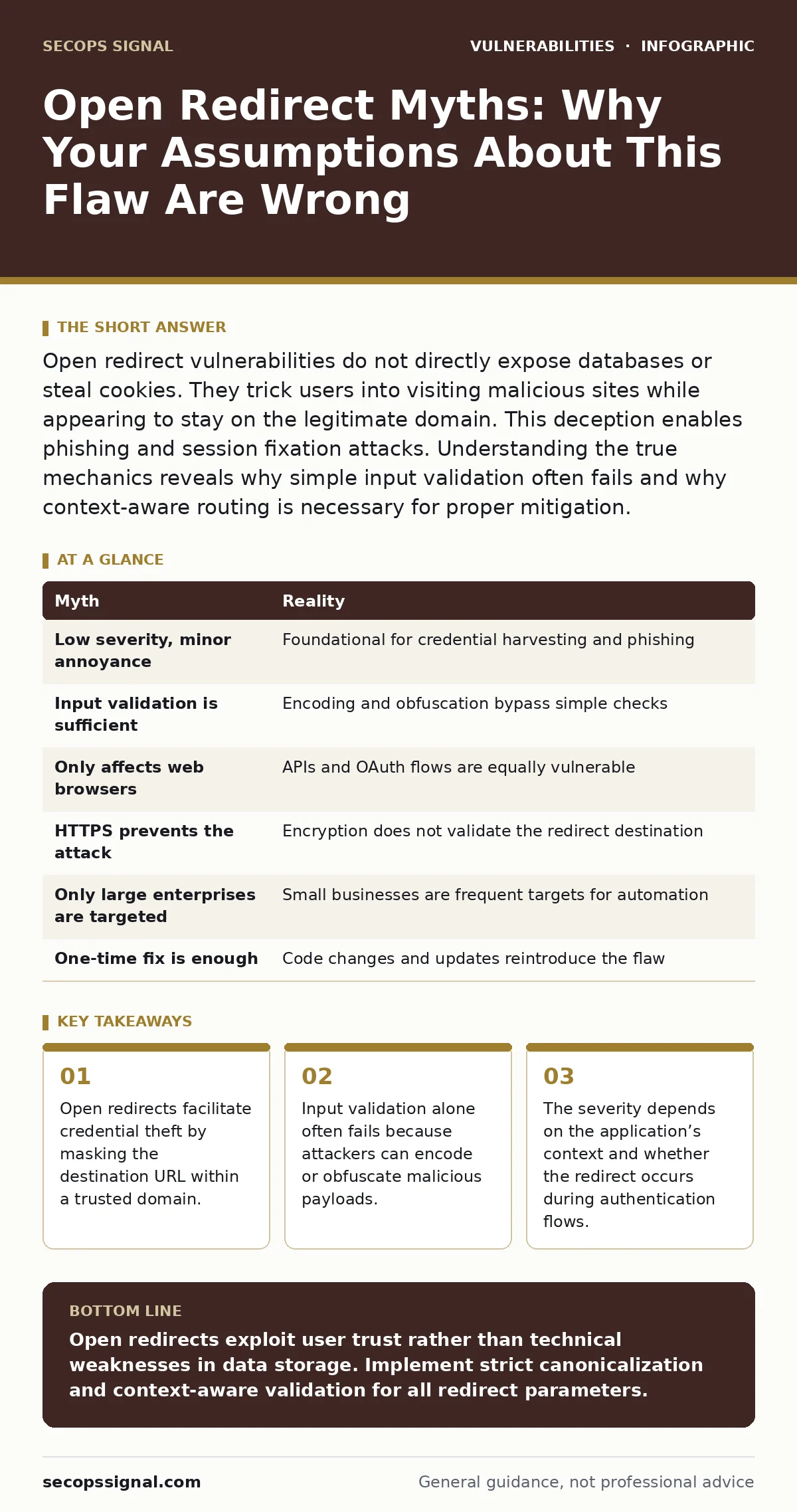
Open redirect vulnerabilities do not directly expose databases or steal cookies. They trick users into visiting malicious sites while appearing to stay on the legitimate domain. This deception enables phishing and session fixation attacks. Understanding the true mechanics reveals why simple input validation often fails and why context-aware routing is necessary for proper mitigation.
Myth: Open redirects are low-severity issues that only cause minor annoyances
Reality: Open redirects serve as the foundational mechanism for sophisticated credential harvesting campaigns. Attackers use these flaws to create phishing links that appear to originate from your trusted domain. When a user clicks a link from your legitimate site, the browser address bar initially displays your domain. The server then redirects the user to an external attacker-controlled site. The user believes they are still interacting with your service. This deception bypasses psychological defenses that users rely on to detect phishing attempts.
The flaw does not directly expose your database or allow code execution. It exploits the implicit trust users place in the URL bar. If your application handles authentication, payment processing, or sensitive account settings, an open redirect becomes a high-severity vulnerability. The attacker gains access to user credentials by mimicking your login page. You must treat open redirects in authentication contexts with the same urgency as SQL injection or cross-site scripting flaws.
Myth: Input validation completely prevents open redirect vulnerabilities
Reality: Standard input validation often fails because attackers use encoding techniques to bypass simple string checks. Many developers implement rules that block obvious external domains like "evil.com". Attackers circumvent these filters by using URL encoding, double encoding, or fragment identifiers. For example, an attacker might submit "%2F%2Fevil.com" or "//evil.com". The server decodes the input and processes the redirect, sending the user to the malicious site.
Some applications validate that the input starts with a specific path. Attackers exploit this by appending query parameters or using relative path traversal techniques. A request for "/page?redirect=../evil.com" might resolve to an external domain depending on how the server constructs the final URL. Relying solely on blacklisting domains or whitelisting paths without canonicalization creates blind spots. You need a defense-in-depth approach that normalizes URLs before validation.
Myth: Open redirects only affect web browsers and not API endpoints
Reality: Application Programming Interfaces are equally vulnerable to open redirect flaws. APIs often accept redirect parameters for OAuth flows, webhook configurations, or callback URLs. An attacker can manipulate these parameters to intercept sensitive tokens or session identifiers. Unlike browser-based attacks, API exploitation does not require user interaction. Automated scripts can exploit these flaws at scale to harvest credentials or hijack accounts.
Consider an API that accepts a "return_url" parameter after a successful authentication. If the API does not validate this parameter, an attacker can set it to a malicious server. When a legitimate user authenticates via the API, the response is sent to the attacker’s server. This allows the attacker to capture authentication tokens or session cookies. You must apply the same strict validation rules to API endpoints as you do to user-facing web pages.
Myth: Using HTTPS eliminates the risk of open redirect attacks
Reality: Transport Layer Security encrypts the data in transit but does not validate the destination of a redirect. An HTTPS connection ensures that the communication between the user and your server is secure. It does not prevent your server from instructing the user to visit an external, malicious site. The redirect itself is a valid HTTP response code, typically 302 or 303. The browser obeys this instruction regardless of the encryption status of the initial request.
Attackers often host their phishing pages on HTTPS-enabled domains to further deceive users. The browser displays a secure padlock icon, reinforcing the illusion of legitimacy. Users see the secure icon and the familiar domain name from the initial click, lowering their suspicion. You must understand that encryption protects data integrity, not logical flow control. Secure transport does not mitigate the risk of being redirected to a fraudulent site.
Myth: Open redirects are only a problem for large enterprise applications
Reality: Small business applications and custom-built tools are frequent targets for open redirect exploitation. Attackers use automated scanners to identify vulnerable endpoints across the internet. They do not distinguish between large corporations and small businesses. If your application accepts user input and uses it to construct a redirect URL, you are at risk. The complexity of your application does not determine the presence of this flaw.
Small businesses often lack dedicated security teams to perform regular vulnerability assessments. This makes them attractive targets for attackers seeking easy wins. An open redirect in a small business application can lead to significant reputational damage and financial loss. Users trust your brand, and a successful phishing campaign erodes that trust quickly. You should treat security with the same rigor as larger organizations, regardless of your size.
See also: Authentication Bypass Mistakes That Leave Systems Exposed
Myth: Fixing open redirects is a one-time task that never needs revisiting
Reality: Open redirect vulnerabilities often reappear due to code changes, new features, or third-party integrations. Developers may introduce new redirect logic without applying the same validation rules. Library updates can change how URLs are parsed, creating new bypass opportunities. You must adopt a continuous monitoring approach to ensure that existing protections remain effective.
Changes to your application architecture can inadvertently weaken redirect validation. For example, moving from a monolithic structure to microservices might introduce new endpoints that handle redirects differently. Each new service requires its own validation logic. You should treat redirect handling as a critical security control that requires regular review. Incorporate this into your risk-based vulnerability management strategy to ensure ongoing protection.
| Myth | Reality |
|---|---|
| Low severity, minor annoyance | Foundational for credential harvesting and phishing |
| Input validation is sufficient | Encoding and obfuscation bypass simple checks |
| Only affects web browsers | APIs and OAuth flows are equally vulnerable |
| HTTPS prevents the attack | Encryption does not validate the redirect destination |
| Only large enterprises are targeted | Small businesses are frequent targets for automation |
| One-time fix is enough | Code changes and updates reintroduce the flaw |
Key takeaways
- Open redirects facilitate credential theft by masking the destination URL within a trusted domain.
- Input validation alone often fails because attackers can encode or obfuscate malicious payloads.
- The severity depends on the application’s context and whether the redirect occurs during authentication flows.
Open redirects exploit user trust rather than technical weaknesses in data storage. Implement strict canonicalization and context-aware validation for all redirect parameters.
Frequently asked questions
How do I detect an open redirect vulnerability?
Look for parameters that accept URLs, such as "redirect", "url", or "next". Test by submitting external domains and encoded variants to see if the server redirects you.
What is the best way to fix an open redirect?
Validate that the redirect URL belongs to your allowed domains. Use a whitelist approach and canonicalize the URL before comparison to prevent encoding bypasses.
Are open redirects considered a critical vulnerability?
Severity depends on context. In authentication flows, they are high severity. In less critical areas, they may be medium, but they always facilitate social engineering attacks.
Can a Content Security Policy prevent open redirects?
CSP controls resource loading but does not prevent HTTP redirects. You must validate redirect logic on the server side. CSP complements but does not replace input validation.
How this guide was produced: written by the SecOps Signal editorial team with AI assistance, checked against the public references listed below, and reviewed when the facts change. See our editorial policy or report an error.