CIA Triad Definition: The 3 Pillars of Information Security
Most security failures occur not because hackers broke encryption, but because organizations ignored the trade-offs between keeping data secret and keeping it available.

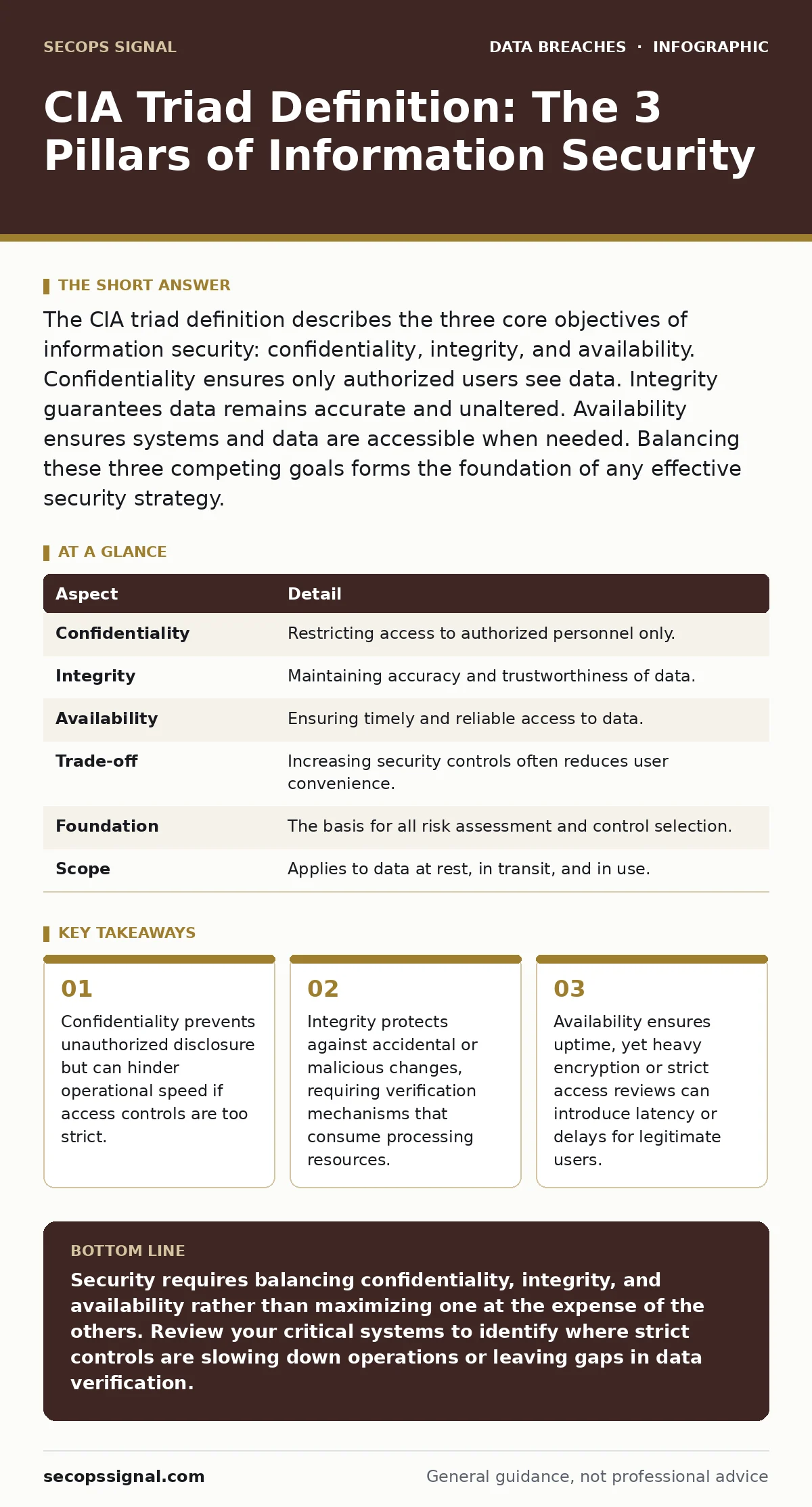
The CIA triad definition describes the three core objectives of information security: confidentiality, integrity, and availability. Confidentiality ensures only authorized users see data. Integrity guarantees data remains accurate and unaltered. Availability ensures systems and data are accessible when needed. Balancing these three competing goals forms the foundation of any effective security strategy.
An Everyday Analogy for Security
Imagine a locked safe in a bank vault. The combination lock ensures confidentiality by keeping contents hidden from anyone without the code. The tamper-evident seal on the door provides integrity, proving no one opened it to swap contents. The bank’s operating hours guarantee availability, ensuring you can access your funds when the doors are open. If the vault is locked forever, you have confidentiality and integrity but zero availability. If the door is left open, you have availability but lose the other two pillars.
The CIA Triad Definition Explained
The CIA triad definition serves as the conceptual model for designing security policies. It forces you to evaluate every system against three distinct requirements. These requirements often conflict. Strengthening one pillar usually weakens another. You must find the balance point that matches your business risk tolerance. Ignoring this balance leads to security measures that either fail to protect assets or break business processes entirely.
| Aspect | Detail |
|---|---|
| Confidentiality | Restricting access to authorized personnel only. |
| Integrity | Maintaining accuracy and trustworthiness of data. |
| Availability | Ensuring timely and reliable access to data. |
| Trade-off | Increasing security controls often reduces user convenience. |
| Foundation | The basis for all risk assessment and control selection. |
| Scope | Applies to data at rest, in transit, and in use. |
How Confidentiality Works in Practice
Confidentiality relies on access controls and encryption. You define who can see what using role-based permissions. Encryption transforms readable data into ciphertext, which is unreadable without a decryption key. This protects data even if physical devices are stolen. However, encryption adds computational overhead. Decrypting large datasets slows down search queries and application performance. You must manage keys carefully. Lost keys mean lost data, which is a form of availability failure.
Integrity Beyond Simple Backups
Integrity ensures that data has not been altered in an unauthorized manner. This includes protection against accidental deletion, corruption, or malicious tampering. Hash functions create a unique digital fingerprint for a file. If a single bit changes, the hash value changes completely. You compare the current hash to the stored hash to verify integrity. This detects changes but does not prevent them. You need immutable storage or version control to restore correct data. Relying solely on backups for integrity is risky. Backups can be corrupted or altered before you detect the breach.
Availability and the Cost of Downtime
Availability means systems are operational when users need them. This requires redundancy, failover systems, and robust power supplies. Network outages, hardware failures, and denial-of-service attacks threaten availability. You must design systems to handle peak loads. Overloading a system with security scans can reduce availability. Scanning every file entry for malware slows down file access. You must schedule intensive security tasks during off-peak hours. Balancing security scanning with user experience is a constant operational challenge.
See also: Shadow IT Definition: How to Find Hidden Cloud Risks
What People Usually Get Wrong
Many organizations treat the triad as a checklist rather than a balancing act. They assume maximum security means maximum protection. This is incorrect. Excessive controls can paralyze operations. Another common error is focusing only on confidentiality. Ignoring integrity allows data to be corrupted silently. Ignoring availability leaves systems vulnerable to simple outages. Security is not about building an impenetrable wall. It is about managing risk across all three dimensions. You must prioritize based on the value of the data. Not all data requires the same level of protection.
Managing the Trade-offs Effectively
You must assess the impact of each control on the other pillars. Implementing data masking can protect confidentiality in test environments without affecting production availability. Regular backup testing ensures that your recovery plans actually work, supporting both integrity and availability. Understanding data controllers and data processors helps you assign responsibility for maintaining these standards across third-party vendors. If you outsource data storage, you must verify that the provider maintains the same integrity and availability standards you require.
Integrating with Broader Security Practices
The triad applies to every layer of your infrastructure. Physical security protects hardware availability. Logical security protects data confidentiality and integrity. You must align security measures with your business continuity plans. Consider breach dwell time when designing detection mechanisms. The longer an attacker remains undetected, the more likely they are to compromise integrity. Reducing dwell time helps maintain trust in your data. You should also monitor for credential exposure to prevent unauthorized access that threatens confidentiality.
Practical Steps for Implementation
Start by classifying your data. Identify what requires high confidentiality, high integrity, or high availability. Apply controls accordingly. Use user access provisioning to ensure employees only have the access they need. Regularly audit these permissions. Implement logging to track changes to critical data. This supports integrity verification. Test your disaster recovery plans regularly. Tax identity theft often results from poor confidentiality controls on personal data. Protecting sensitive information reduces the risk of such incidents. Balance your controls to avoid unnecessary friction.
Conclusion on Security Balance
The CIA triad is not a static set of rules. It is a dynamic framework for decision-making. Every security decision involves a trade-off. You must evaluate the cost of a control against the risk it mitigates. Over-engineering security creates hidden costs in time and resources. Under-engineering it leaves you vulnerable to loss. Regularly review your balance. Adjust controls as your business evolves. Security is a continuous process of calibration, not a one-time project.
Key takeaways
- Confidentiality prevents unauthorized disclosure but can hinder operational speed if access controls are too strict.
- Integrity protects against accidental or malicious changes, requiring verification mechanisms that consume processing resources.
- Availability ensures uptime, yet heavy encryption or strict access reviews can introduce latency or delays for legitimate users.
Security requires balancing confidentiality, integrity, and availability rather than maximizing one at the expense of the others. Review your critical systems to identify where strict controls are slowing down operations or leaving gaps in data verification.
Frequently asked questions
Does the CIA triad apply to cloud computing?
Yes, the triad applies to any environment where data exists. Cloud providers handle infrastructure availability, but you remain responsible for data confidentiality and integrity through proper configuration and access management.
How does the CIA triad differ from risk management?
The triad defines the security objectives you want to achieve. Risk management is the process of identifying threats that could violate those objectives and selecting controls to mitigate them. The triad is the goal; risk management is the method.
Can a system have high confidentiality but low integrity?
Yes, a system can be perfectly secure from unauthorized access but still suffer from data corruption due to software bugs or hardware failures. Confidentiality protects against unauthorized reading, while integrity protects against unauthorized or accidental modification.
Is availability only about preventing outages?
No, availability also includes performance and latency. A system that is technically online but too slow to be useful is not available. Security controls like deep packet inspection can impact performance, thereby affecting availability.
How this guide was produced: written by the SecOps Signal editorial team with AI assistance, checked against the public references listed below, and reviewed when the facts change. See our editorial policy or report an error.