Sigma Rules Cyber Security: How Open Detection Logic Works
Sigma rules separate detection logic from platform syntax, allowing you to write once and deploy detection across multiple security tools without rewriting code.

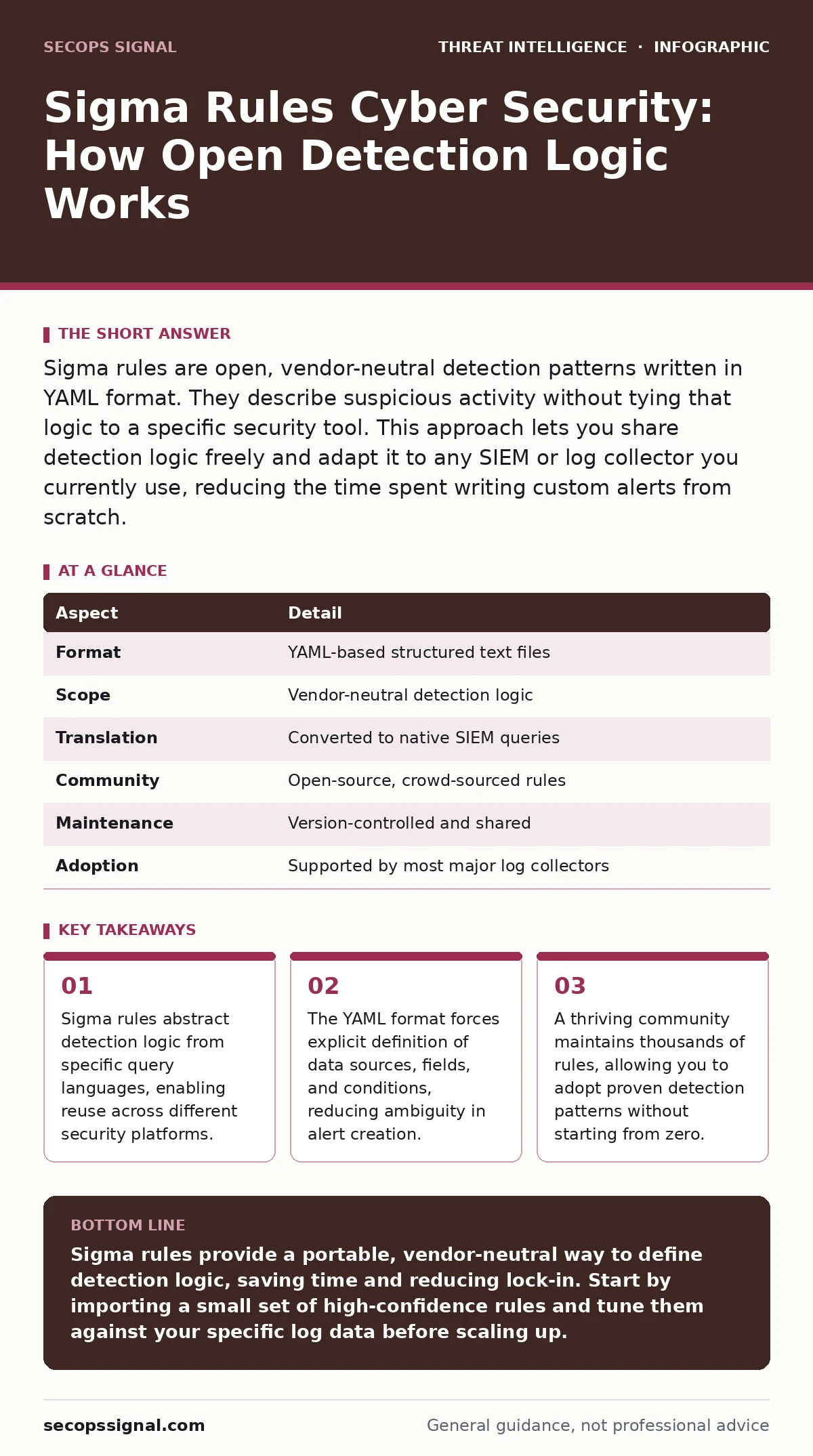
Sigma rules are open, vendor-neutral detection patterns written in YAML format. They describe suspicious activity without tying that logic to a specific security tool. This approach lets you share detection logic freely and adapt it to any SIEM or log collector you currently use, reducing the time spent writing custom alerts from scratch.
Everyday Analogy for Detection Logic
Imagine you are writing a recipe for a cake. The recipe lists ingredients and steps, but it does not specify which brand of oven you must use. You can follow that same recipe in a gas oven, an electric oven, or a convection oven. Sigma rules operate on this same principle. The rule defines the "recipe" for detecting malicious activity, such as a specific sequence of system events. Your security tool acts as the oven, translating that generic recipe into its own native language to search through your logs.
What Are Sigma Rules in Cyber Security?
Sigma rules are structured detection definitions written in YAML, a human-readable data serialization language. They capture the intent of a detection, such as "alert when a user modifies system files," without requiring you to write complex query syntax for every tool. This separation of logic from implementation is the core benefit. You define what you want to find, and a converter translates that definition into the specific query language your environment understands, such as Splunk SPL, Elastic KQL, or Microsoft KQL.
| Aspect | Detail |
|---|---|
| Format | YAML-based structured text files |
| Scope | Vendor-neutral detection logic |
| Translation | Converted to native SIEM queries |
| Community | Open-source, crowd-sourced rules |
| Maintenance | Version-controlled and shared |
| Adoption | Supported by most major log collectors |
How the Translation Mechanism Works
The power of Sigma lies in its translation layer. When you create a rule, you specify the log source, such as Windows Security Logs, and the conditions, such as a specific event ID and value. The Sigma framework includes parsers that understand these generic fields. When you deploy the rule, the parser maps the generic field name to the actual field name in your target system. For example, a generic field like user might map to UserName in one system and actor_user in another. This mapping ensures the detection logic remains identical even though the underlying query syntax changes completely.
Who Benefits from Open Detection
Organizations that rely on a single security tool often write custom queries that cannot be reused if they switch vendors. Sigma rules solve this lock-in problem. Small teams benefit most because they can import hundreds of community-maintained rules instantly. Instead of spending weeks writing custom detections for common threats, you install a converter and import a library of existing rules. This accelerates the detection engineering process, allowing your team to focus on tuning alerts rather than writing basic syntax. It also standardizes how your team thinks about threats, creating a common language for security operations.
Common Misconceptions About Sigma
Many teams assume that importing Sigma rules provides immediate protection. This is a dangerous assumption. A rule is only as good as the data it searches and the context it provides. If your logs do not contain the specific fields a rule references, the rule will fail silently or generate errors. You must verify that your log collectors are capturing the necessary data before deploying any rule. Another mistake is treating community rules as finished products. They often require tuning to reduce noise in your specific environment. Blindly enabling thousands of rules creates alert fatigue, drowning your analysts in false positives.
See also: Preventing Data Exposure Seen By Dark Web Monitoring · Endpoint Telemetry Explained: The Hidden Signals That Reveal Threats
Practical Application Scenario
Imagine your organization wants to detect attempts to bypass security controls via script execution. You find a Sigma rule that looks for PowerShell commands containing encoded strings. The rule specifies the event ID for process creation and the condition that the command line contains specific keywords. You feed this rule into your converter, which outputs a query for your specific log management system. You deploy this query, and it begins scanning your logs in real-time. When a script runs with an encoded payload, the system generates an alert. You investigate the alert, confirming it is a test script, and then tune the rule to exclude known safe scripts.
Integration with Existing Defenses
Sigma rules fit into a broader security strategy. They are not a replacement for SIEM correlation engines or behavioral analytics. Instead, they provide the foundational detection logic that feeds into those systems. You can use Sigma rules to identify initial access attempts, such as PowerShell abuse or remote desktop abuse, which are common entry points for attackers. By standardizing your detection logic, you make it easier to integrate with other frameworks, such as the intelligence cycle, where you map detected indicators to known threat tactics. This creates a cohesive defense that is easier to maintain and scale.
Managing Detection Quality
Quality control is vital when using open-source rules. You should establish a process for testing rules before they go live. This involves running the rule against historical data to check for false positives. If a rule triggers on normal administrative activity, you must modify the conditions or exclude specific users. This tuning process is part of defense evasion mitigation, ensuring that attackers cannot hide their activities by mimicking normal behavior. You should also document why certain rules are disabled or modified, creating an audit trail for your detection strategy. This documentation helps new team members understand the rationale behind your security controls.
Future-Proofing Your Security Stack
Technology changes rapidly, and security tools evolve. By decoupling your detection logic from specific vendors, you future-proof your security operations. If you decide to switch from one log collector to another, you do not need to rewrite thousands of queries. You simply re-run your Sigma rules through the new converter. This flexibility reduces the total cost of ownership for your security infrastructure. It also encourages collaboration, as you can share your custom rules with other organizations, contributing to the collective security knowledge. This shared ecosystem raises the baseline of security across the industry, making it harder for attackers to rely on obscurity.
Key takeaways
- Sigma rules abstract detection logic from specific query languages, enabling reuse across different security platforms.
- The YAML format forces explicit definition of data sources, fields, and conditions, reducing ambiguity in alert creation.
- A thriving community maintains thousands of rules, allowing you to adopt proven detection patterns without starting from zero.
Sigma rules provide a portable, vendor-neutral way to define detection logic, saving time and reducing lock-in. Start by importing a small set of high-confidence rules and tune them against your specific log data before scaling up.
Frequently asked questions
Do Sigma rules work with all security tools?
Sigma rules work with any tool that has a Sigma converter or supports the Sigma format natively. Most major SIEM and log management platforms support this, but you must verify compatibility for niche or custom tools.
How do I write my own Sigma rules?
You write Sigma rules in YAML format, defining the log source, event ID, and detection conditions. The Sigma documentation provides templates and examples to help you structure your rules correctly for your specific use case.
Are community rules safe to use?
Community rules are generally safe but require validation. You should test them in a non-production environment first to ensure they do not generate excessive false positives or miss critical alerts in your specific context.
Can Sigma rules detect fileless malware?
Sigma rules can detect indicators of fileless malware, such as suspicious PowerShell commands or WMI queries, by analyzing log data for anomalous behavior patterns associated with these techniques.
How this guide was produced: written by the SecOps Signal editorial team with AI assistance, checked against the public references listed below, and reviewed when the facts change. See our editorial policy or report an error.