Tax Identity Theft Myths: What Actually Protects Your Financial Data
Filing early does not prevent tax identity theft because criminals file fraudulent returns long before the official tax season begins.

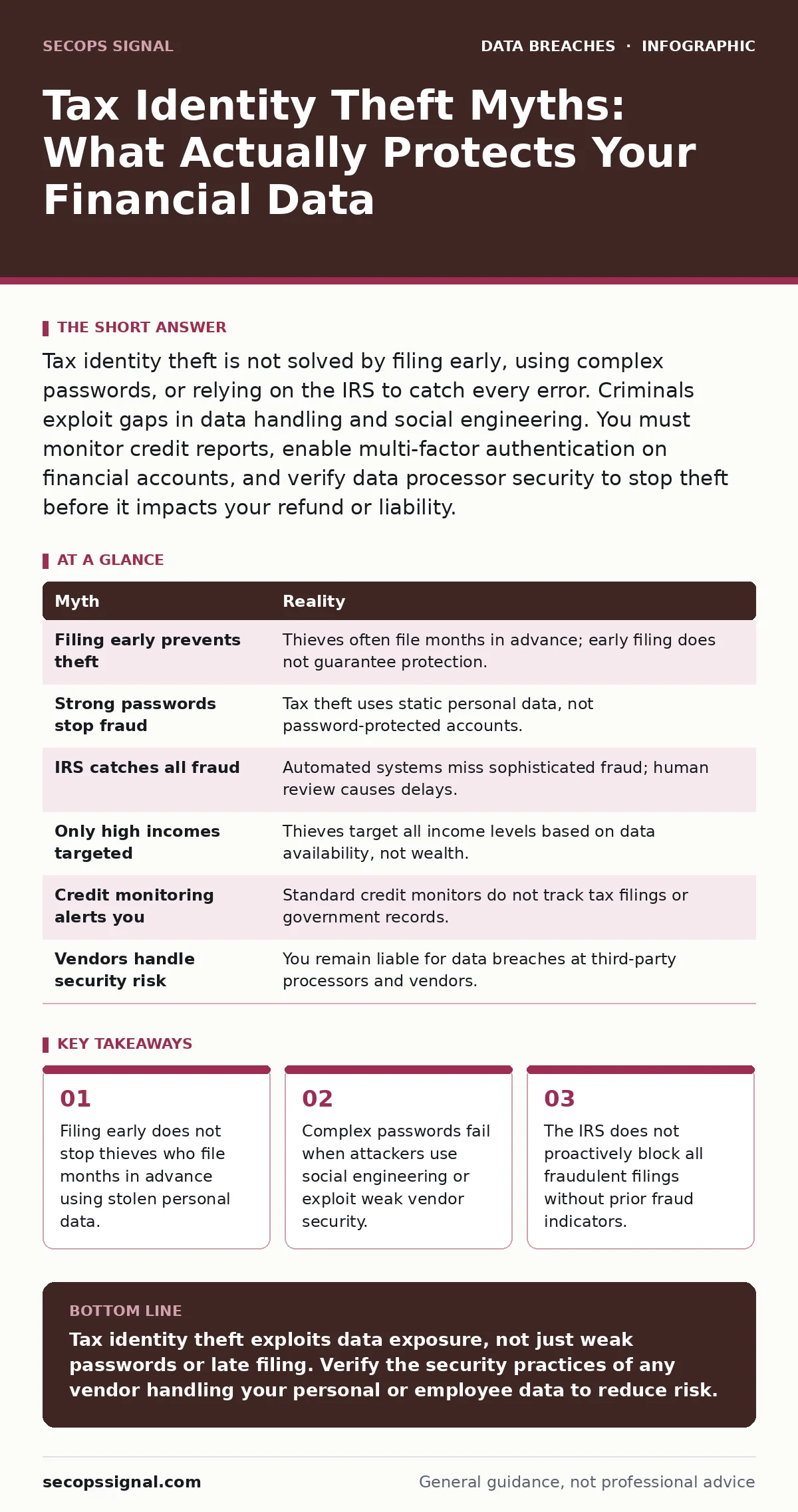
Tax identity theft is not solved by filing early, using complex passwords, or relying on the IRS to catch every error. Criminals exploit gaps in data handling and social engineering. You must monitor credit reports, enable multi-factor authentication on financial accounts, and verify data processor security to stop theft before it impacts your refund or liability.
Myth: Filing Early Prevents Tax Identity Theft
Reality: Filing your return on day one does not guarantee protection against identity theft. Criminals often file fraudulent returns months before the tax season officially opens. By the time you submit your legitimate return, the fraudulent one may have already been processed or flagged. The IRS system detects duplicate filings, but this creates a administrative burden for you.
You must wait for resolution while your legitimate refund is delayed. This delay can cause significant cash flow issues for small operations. The thief has already secured the refund or initiated a loan in your name. Filing early only helps if the criminal files after you, which is not always the case. The race to the finish line is often already lost before you start running.
The mechanism of tax identity theft relies on speed and data availability. Thieves gather Social Security numbers and dates of birth from data breaches or phishing. They use this information to prepare returns immediately upon system availability. Your early filing is just one data point in a larger attack. If the thief files first, the IRS flags your subsequent filing as suspicious. You then become the burdened party proving your identity. This process requires direct communication with tax authorities. It does not resolve the underlying data exposure. You remain vulnerable to other forms of financial fraud using the same stolen data.
Myth: Strong Passwords Stop Tax Fraud
Reality: Password complexity does not protect you from tax identity theft if the attacker already has your personal identifiers. Tax fraud requires your Social Security number, date of birth, and address. These details are rarely protected by password policies. Criminals obtain this data from breached databases or social media profiles. A complex password on your email account does not hide your Social Security number from a data broker. The thief does not need to guess your password to file a return. They need the static personal data that you have likely shared elsewhere. Password managers help protect account access, but they do not erase your digital footprint.
This misunderstanding leads to a false sense of security. You might spend hours creating complex passwords while ignoring the data you share online. Social engineering attacks bypass password requirements entirely. Attackers call you pretending to be the IRS or a bank. They ask for verification data that you provide voluntarily. This is a form of account takeover fraud where the attacker gains control through trust, not technical hacking. The password becomes irrelevant once the attacker has your identity. You must treat your personal identifiers as sensitive credentials. Limit where you store and share this information.
Myth: The IRS Will Catch Every Fraudulent Return
Reality: The IRS uses automated systems to detect anomalies, but these systems are not infallible. Automated checks look for duplicate Social Security numbers and unusual income patterns. However, sophisticated thieves use stolen data that matches legitimate records. They may use real employment data from a compromised employer. This makes the fraudulent return look authentic to automated filters. The system may accept the return before you file your legitimate one. Human review happens later, often after the refund has been issued. You are not protected by the assumption that the government will catch every error. You must monitor your financial statements independently.
The volume of tax returns is massive. Automated systems prioritize speed and common error patterns. They are not designed to catch every subtle identity theft attempt. If the thief uses accurate W-2 data, the return passes initial checks. The fraud is only detected when you file your correct return. At that point, the system flags a conflict. You must then prove your identity to the tax authority. This process can take weeks or months. Your refund is held during this investigation. The thief may have already spent the stolen funds. The financial damage is done before the system reacts.
Myth: Only High-Income Individuals Are Targets
Reality: Tax identity theft affects individuals across all income levels. Criminals often target low-to-median income earners because they are less likely to file complex returns. Simple returns are easier to replicate with stolen data. High-income individuals may have more scrutiny, but they are not immune.
Thieves adjust their tactics based on data availability. If a data breach exposes employee records from a small business, those employees become targets. Your income level does not determine your risk. The availability of your data does. Small business owners often handle payroll data, making their employees attractive targets. You must protect the data you collect from others.
The misconception that only the wealthy are targeted leads to complacency. You might assume you are not worth the effort of a criminal. This is incorrect. Criminals use automated tools to process large volumes of stolen data. They do not carefully select victims based on wealth. They select based on data quality and ease of filing. If your data is clean and complete, you are a viable target. The return amount matters less than the speed of execution. Thieves want quick cash, not large sums that attract attention. Your personal data is the commodity, not your income.
Myth: Credit Monitoring Alerts You to Tax Theft
Reality: Standard credit monitoring services do not detect tax identity theft. These services track credit card applications and loan inquiries. They do not monitor filings with tax authorities. A thief can file a tax return without triggering a credit alert. You may not discover the theft until you attempt to file your own return. By then, the fraud has occurred. You need specific monitoring for tax-related activity. This includes checking for unexpected IRS notices or refund status changes. Standard credit reports are insufficient for this type of fraud. You must expand your monitoring beyond traditional credit bureaus.
The gap in monitoring creates a blind spot. You might feel secure because your credit score is unchanged. Meanwhile, a fraudulent return is being processed. The thief uses your identity to claim a refund. The money is deposited into an account they control. No alert is sent. The theft is complete. You only find out when you try to file. This delay compounds the problem. Recovering stolen refunds is difficult and time-consuming. Proactive monitoring of tax records is necessary. Do not rely on credit alerts alone.
See also: Romance Scams: How Fraudsters Bypass Trust and What to Do · Password Rotation Explained: Why Changing Passwords Rarely Stops Hackers
Myth: Data Processors Are Not Your Responsibility
Reality: If you use third-party services to handle payroll or tax data, you share liability for security. Data controllers and data processors have distinct roles in data protection. You control the data, but the processor handles it. If the processor suffers a breach, your data is exposed. You cannot outsource the risk entirely.
You must vet the security practices of any vendor handling your personal information. This includes checking for SOC 2 compliance or similar standards. A breach at a vendor is still a breach of your data. You must ensure that user access provisioning is strict at these vendors. Limit who can access your raw data.
Many small businesses outsource payroll to save time and cost. This creates a dependency on the vendor’s security posture. If the vendor has weak database security, your employees’ data is at risk. Thieves target these vendors because they hold concentrated amounts of sensitive data. A single breach can expose thousands of records. You must ask vendors about their security measures. Do not assume they are protected. Review their incident response plans. Understand how they handle breach dwell time. The longer a thief stays in a system, the more data they steal. Your due diligence reduces the risk.
| Myth | Reality |
|---|---|
| Filing early prevents theft | Thieves often file months in advance; early filing does not guarantee protection. |
| Strong passwords stop fraud | Tax theft uses static personal data, not password-protected accounts. |
| IRS catches all fraud | Automated systems miss sophisticated fraud; human review causes delays. |
| Only high incomes targeted | Thieves target all income levels based on data availability, not wealth. |
| Credit monitoring alerts you | Standard credit monitors do not track tax filings or government records. |
| Vendors handle security risk | You remain liable for data breaches at third-party processors and vendors. |
Key takeaways
- Filing early does not stop thieves who file months in advance using stolen personal data.
- Complex passwords fail when attackers use social engineering or exploit weak vendor security.
- The IRS does not proactively block all fraudulent filings without prior fraud indicators.
Tax identity theft exploits data exposure, not just weak passwords or late filing. Verify the security practices of any vendor handling your personal or employee data to reduce risk.
Frequently asked questions
How do I know if my tax identity was stolen?
You will likely receive a notice from the IRS stating you cannot file because a return was already filed. You may also see unexpected changes in your tax account or refund status.
What should I do if I suspect tax identity theft?
Contact the IRS immediately to report the fraud. File an Identity Theft Affidavit and place a fraud alert with credit bureaus. Monitor your financial accounts for other unauthorized activity.
Can I prevent tax identity theft completely?
No measure guarantees complete protection. Limit sharing your Social Security number, monitor your tax account status, and ensure vendors secure your data. These steps reduce risk significantly.
Does freezing my credit stop tax identity theft?
A credit freeze prevents new credit accounts from being opened in your name. It does not stop thieves from using your data to file tax returns. You must monitor tax records separately.
How this guide was produced: written by the SecOps Signal editorial team with AI assistance, checked against the public references listed below, and reviewed when the facts change. See our editorial policy or report an error.