Smishing vs Vishing: Which Attack Vector Threatens Your Business
Voice-based social engineering often bypasses modern email filtering tools and exploits human trust more effectively than text messages.
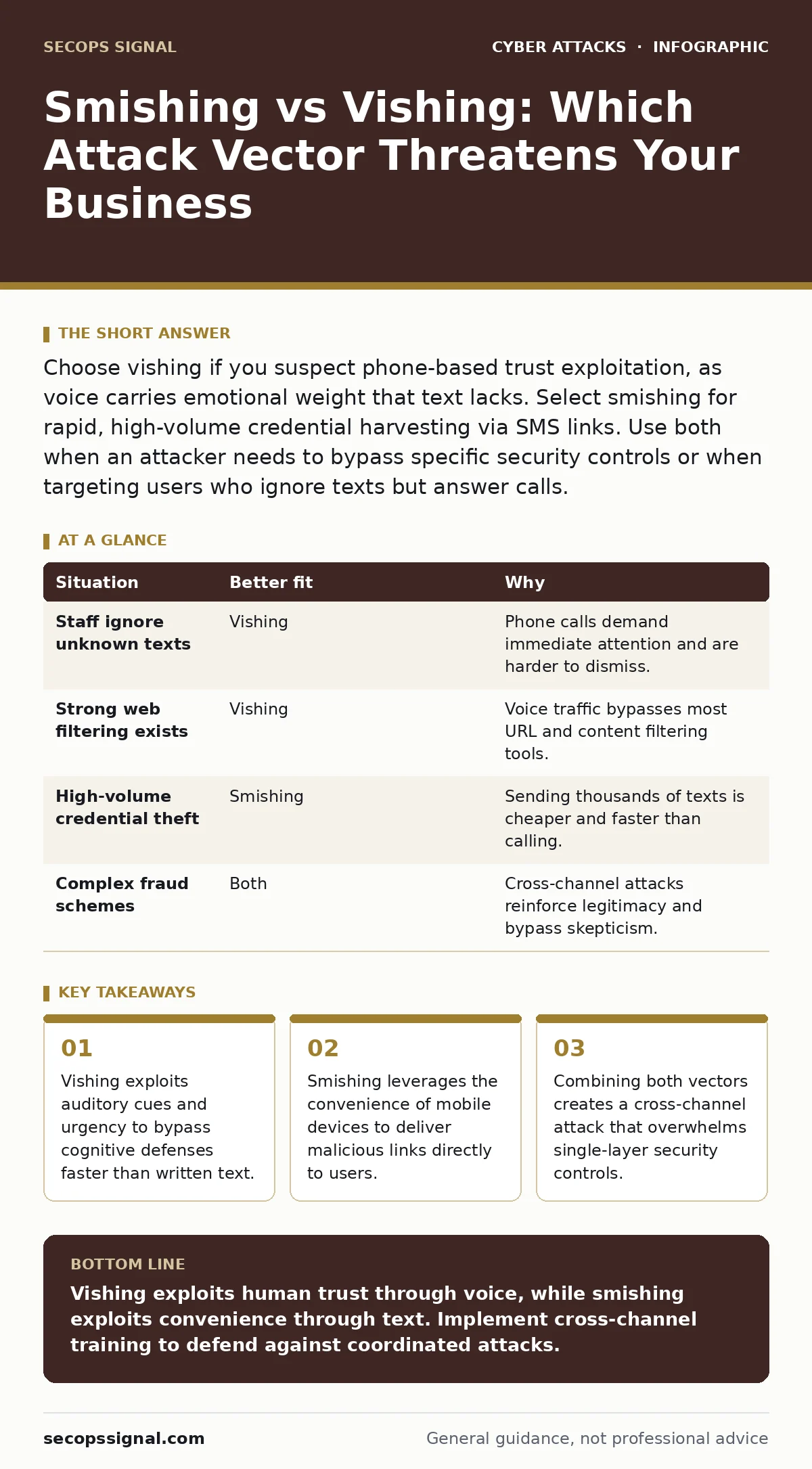
Choose vishing if you suspect phone-based trust exploitation, as voice carries emotional weight that text lacks. Select smishing for rapid, high-volume credential harvesting via SMS links. Use both when an attacker needs to bypass specific security controls or when targeting users who ignore texts but answer calls.
Does the Attack Vector Match User Behavior?
You must consider how your staff interacts with communication channels. Text messages often go unread if they appear suspicious, whereas phone calls demand immediate attention. When a call comes in, the social pressure to answer is higher. This behavioral difference dictates which vector an attacker will prioritize. If your team ignores unknown texts, smishing fails. If they answer unknown numbers, vishing succeeds.
Imagine a scenario where an employee receives a text claiming a package is delayed. They delete it. Minutes later, a "courier" calls to confirm the address. The call feels legitimate because the text primed the context. This coordination makes the attack harder to detect.
How Does the Attack Bypass Technical Defenses?
Technical controls vary significantly between voice and text. Email filtering often catches malicious links in messages, but standard firewalls rarely inspect voice traffic for social engineering cues. Vishing operates outside the perimeter of most network security tools. Smishing relies on the user clicking a link, which can be blocked by URL reputation services. However, if the user types the address manually, those controls fail.
You need to evaluate which controls are weaker in your environment. If you have strong web filtering but weak voice monitoring, vishing is the easier path for an adversary. If you have robust call screening but poor SMS filtering, smishing becomes the primary threat. Understanding these gaps helps you allocate security resources effectively.
Suppose your organization uses conditional access policies to restrict login locations. A smishing attack might trick a user into logging in from a compromised device, bypassing location checks. Vishing might extract the password directly, rendering the policy useless if the attacker has the credentials.
What Is the Cost of Detection and Response?
Detecting smishing is often easier because the malicious link leaves a digital trail. You can analyze the URL, check for typos, and block the sender. Vishing leaves no such trail. The interaction happens in real-time audio, which is difficult to record and analyze automatically. This lack of forensic data makes vishing harder to investigate after the fact.
The cost of response also differs. A smishing incident might require resetting passwords and blocking a domain. A vishing incident might involve stolen credentials, unauthorized transactions, or installed malware. The remediation effort for voice-based attacks is typically higher because the damage is often more severe by the time it is discovered.
When Does the Attack Require Multi-Channel Coordination?
Sophisticated attackers often use both smishing and vishing together. This approach, known as cross-channel social engineering, increases the success rate by reinforcing the narrative. The text provides context, and the call provides authority. This combination exploits the human tendency to trust consistent information across multiple mediums.
You should suspect coordinated attacks if staff report receiving a text followed immediately by a call from an unknown number. These incidents require a different response than isolated events. Training must cover the interaction between channels, not just individual vectors. Ignoring the coordination allows attackers to bypass single-channel awareness.
| Situation | Better fit | Why |
|---|---|---|
| Staff ignore unknown texts | Vishing | Phone calls demand immediate attention and are harder to dismiss. |
| Strong web filtering exists | Vishing | Voice traffic bypasses most URL and content filtering tools. |
| High-volume credential theft | Smishing | Sending thousands of texts is cheaper and faster than calling. |
| Complex fraud schemes | Both | Cross-channel attacks reinforce legitimacy and bypass skepticism. |
How Do You Train for Both Vectors?
Training must address the specific mechanics of each attack. For smishing, focus on checking URLs before clicking and verifying the sender’s identity. For vishing, focus on hanging up and calling back using a known number. Emphasize that legitimate organizations do not ask for passwords or verification codes over the phone.
Avoid generic advice about "staying vigilant." Instead, teach specific verification steps. If an email filtering solution blocks a message, the attacker might switch to voice. Your training should reflect this shift. Regular simulations that include both text and voice components help staff recognize coordinated attacks.
See also: Invoice Fraud Response: Stop Payments and Secure Accounts · Fake Software Updates Explained: How to Spot Counterfeit Patches
What Is the Long-Term Strategy?
Integrate smishing and vishing defenses into your broader security posture. Monitor for anomalies in both call logs and SMS traffic. Look for spikes in failed login attempts after text messages are sent. Investigate reported incidents thoroughly to identify patterns.
Review your security awareness program annually. Update scenarios to reflect current tactics. Ensure that your incident response plan includes procedures for both voice and text-based attacks. Consistent evaluation and adaptation are necessary to stay ahead of evolving social engineering techniques.
Key takeaways
- Vishing exploits auditory cues and urgency to bypass cognitive defenses faster than written text.
- Smishing leverages the convenience of mobile devices to deliver malicious links directly to users.
- Combining both vectors creates a cross-channel attack that overwhelms single-layer security controls.
Vishing exploits human trust through voice, while smishing exploits convenience through text. Implement cross-channel training to defend against coordinated attacks.
Frequently asked questions
Can firewalls block smishing attempts?
Firewalls can block traffic to known malicious URLs, but they cannot stop the SMS message from being sent. User caution and URL filtering are more effective.
Is vishing harder to detect than smishing?
Yes, vishing leaves little digital evidence, making it harder to trace and analyze compared to smishing, which often involves clickable links.
How do I report a smishing attempt?
Report smishing to your IT security team immediately. They can block the number and analyze the link to prevent further distribution.
Does two-factor authentication stop vishing?
Two-factor authentication adds a layer of security, but if an attacker extracts the code via vishing, the protection is bypassed. Use app-based authenticators instead of SMS codes.
How this guide was produced: written by the SecOps Signal editorial team with AI assistance, checked against the public references listed below, and reviewed when the facts change. See our editorial policy or report an error.