SIEM Benefits and Limitations: When Security Monitoring Pays Off
SIEM systems aggregate data to reveal hidden patterns, but they generate noise that requires significant manual tuning to produce actionable security insights.

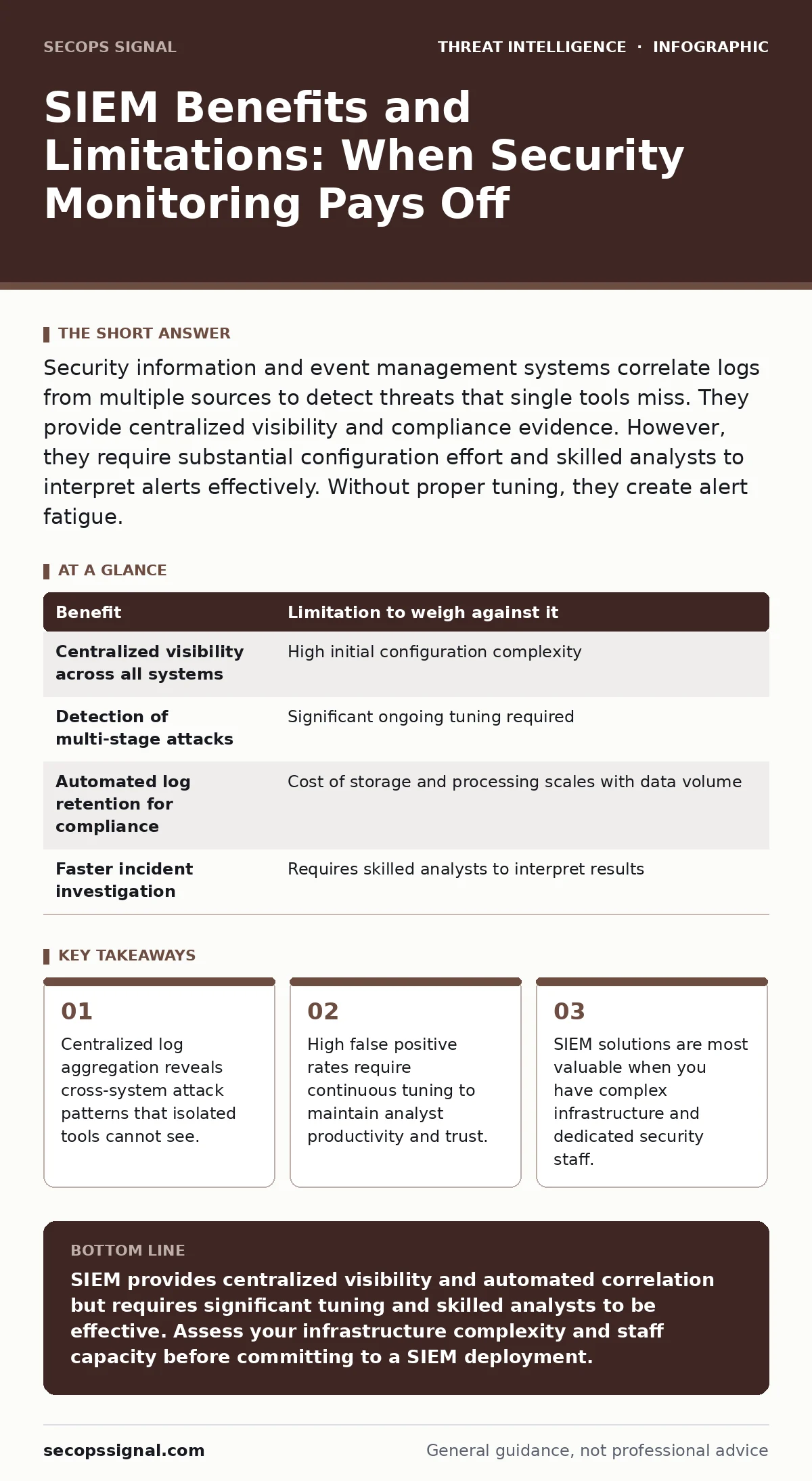
Security information and event management systems correlate logs from multiple sources to detect threats that single tools miss. They provide centralized visibility and compliance evidence. However, they require substantial configuration effort and skilled analysts to interpret alerts effectively. Without proper tuning, they create alert fatigue.
How SIEM Correlates Disparate Data Sources
Security information and event management, or SIEM, aggregates log data from servers, network devices, applications, and endpoints into a single repository. This centralization allows you to see connections between events that appear unrelated in isolation. A failed login attempt on a database server might seem minor alone. When correlated with a successful login from the same IP address on a web server minutes earlier, it suggests an attacker moving laterally through your network.
The system uses predefined rules and behavioral baselines to flag anomalies. It does not just store data; it processes it in real time or near-real time to identify potential security incidents. This capability transforms raw log noise into structured intelligence. You gain a unified view of your security posture, which is difficult to achieve with scattered point solutions.
The Reality of Alert Noise and Tuning
Every SIEM deployment generates a high volume of alerts, many of which are false positives. A false positive occurs when the system flags normal activity as malicious. If your system alerts on every failed login, you will receive hundreds of notifications daily from users mistyping passwords. This noise desensitizes analysts and causes them to ignore genuine threats.
Effective SIEM usage requires continuous tuning. You must adjust detection rules to exclude known benign activities and refine thresholds for anomaly detection. This process is iterative and never truly finished. As your business grows and new applications are deployed, you must update your correlation rules. The initial setup is only the beginning. Ongoing maintenance consumes significant analyst time.
| Benefit | Limitation to weigh against it |
|---|---|
| Centralized visibility across all systems | High initial configuration complexity |
| Detection of multi-stage attacks | Significant ongoing tuning required |
| Automated log retention for compliance | Cost of storage and processing scales with data volume |
| Faster incident investigation | Requires skilled analysts to interpret results |
When Centralized Monitoring Is Worth It
SIEM becomes a valuable investment when your infrastructure complexity outgrows manual monitoring capabilities. If you manage dozens of servers, multiple cloud environments, and numerous network devices, manual log review is impossible. You need automated correlation to spot subtle attack patterns. Organizations with strict regulatory requirements also benefit from the automated reporting and audit trails that SIEM provides.
The technology is worth it when you have dedicated security personnel to manage it. Analysts must review alerts, investigate findings, and tune rules. Without this human element, the system collects data but fails to protect you. If your team can dedicate time to understanding the alerts and improving detection logic, the SIEM will enhance your security posture significantly.
When Manual Monitoring Suffices
Small environments with limited endpoints and simple network architectures often do not need a full SIEM solution. If you have fewer than 10 servers and a straightforward firewall configuration, manual log review or basic monitoring tools may suffice. The cost of licensing, storage, and analyst time for a SIEM may exceed the value it provides. In these cases, the complexity introduces more risk than it mitigates.
SIEM is not worth it if you lack the staff to analyze its output. An unstaffed SIEM is a data hoarder, not a security tool. Alerts pile up without investigation, and critical incidents are missed in the noise. If you cannot assign personnel to review and act on alerts daily, you should focus on foundational security measures first.
Integrating with Broader Security Operations
SIEM does not operate in a vacuum. It works best when integrated with other security tools and processes. For example, combining SIEM data with log management best practices ensures you retain the right data for the right duration. Integrating with SOAR platforms allows you to automate responses to common alerts, reducing the burden on analysts. This automation can isolate infected endpoints or block malicious IPs automatically.
You can also enrich SIEM data with threat intelligence feeds. By correlating internal logs with external indicators of attack, you can identify compromises faster. This integration helps you understand whether a detected anomaly is part of a broader campaign. Understanding the intelligence cycle helps you determine what data to collect and how to use it for proactive defense.
See also: Behavior-Based Detection Best Practices for Endpoint Security · Deception Technology Explained: How Fake Assets Trap Attackers
Hidden Costs of SIEM Deployment
The financial cost of SIEM extends beyond software licenses. You must pay for data ingestion, storage, and processing. As your data volume grows, so do your costs. You also need to invest in training for your analysts. They must understand how to query the system, interpret complex alerts, and tune detection rules. This training takes time away from other security tasks.
There is also an opportunity cost. Time spent tuning SIEM rules is time not spent on proactive security measures like purple teaming exercises or vulnerability management. You must balance the investment in SIEM with other security priorities. If the SIEM consumes too much of your budget or staff time, it may not be the right solution for your current maturity level.
Making the Decision Based on Maturity
Deciding whether to implement SIEM depends on your organization's security maturity. Start by assessing your current monitoring capabilities. Can you detect a breach within a reasonable timeframe? If not, SIEM may help. But if you lack basic logging and access controls, fixing those first is more effective. SIEM amplifies your existing processes; it does not replace them.
Consider your ability to respond to incidents. If you detect a threat but cannot respond effectively, the detection is less valuable. Ensure you have incident response plans and procedures in place before adding complex detection tools. SIEM is a powerful tool, but it is only one part of a layered security strategy.
Key takeaways
- Centralized log aggregation reveals cross-system attack patterns that isolated tools cannot see.
- High false positive rates require continuous tuning to maintain analyst productivity and trust.
- SIEM solutions are most valuable when you have complex infrastructure and dedicated security staff.
SIEM provides centralized visibility and automated correlation but requires significant tuning and skilled analysts to be effective. Assess your infrastructure complexity and staff capacity before committing to a SIEM deployment.
Frequently asked questions
Does SIEM replace antivirus software?
No, SIEM aggregates logs and detects patterns, while antivirus software prevents and removes malware on endpoints. They serve different functions and work best together.
How much data should I ingest into my SIEM?
Start with high-value sources like firewalls, domain controllers, and critical servers. Add more sources gradually as you tune rules and manage storage costs.
What is the difference between SIEM and log management?
Log management focuses on storing and searching logs. SIEM adds real-time correlation, alerting, and threat detection capabilities to log data.
How this guide was produced: written by the SecOps Signal editorial team with AI assistance, checked against the public references listed below, and reviewed when the facts change. See our editorial policy or report an error.