Speculative Execution Vulnerabilities: Risks and Protection Strategies
Hardware optimizations that speed up processors can leak sensitive data through side-channel effects, requiring layered defenses beyond simple software patches.

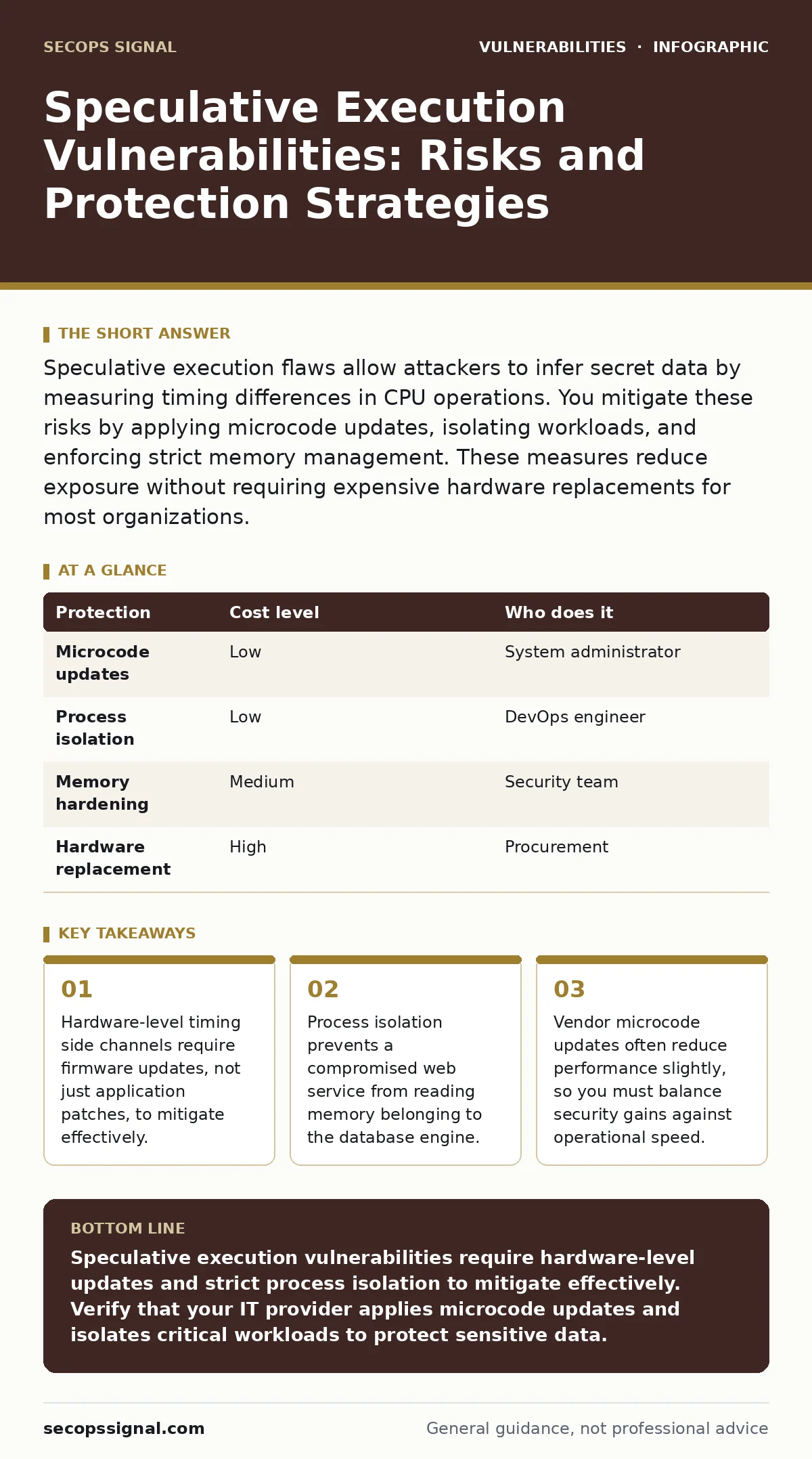
Speculative execution flaws allow attackers to infer secret data by measuring timing differences in CPU operations. You mitigate these risks by applying microcode updates, isolating workloads, and enforcing strict memory management. These measures reduce exposure without requiring expensive hardware replacements for most organizations.
How Speculative Execution Creates Hidden Risks
Modern processors use speculative execution to guess which instructions to run next, aiming to save time when the guess is correct. If the guess is wrong, the processor discards the result, but side effects remain in the cache. Attackers measure these cache side effects to reconstruct secret data, such as encryption keys or session tokens. This mechanism turns a performance feature into a privacy leak.
The risk extends beyond high-profile targets. Small organizations often run multiple services on a single virtual machine or physical server. When one service is compromised, speculative execution allows the attacker to probe the memory space of other services running on the same core. You face exposure even if your software has no known bugs, because the flaw lives in the silicon.
Why Small Organizations Face Disproportionate Exposure
Small teams frequently consolidate hardware to save costs, running web servers, databases, and email services on the same machine. This consolidation increases the attack surface for speculative execution vulnerabilities. If an attacker compromises a low-privilege web application, they can use the CPU’s speculative behavior to read memory from the high-privilege database process.
You likely lack dedicated security researchers to monitor hardware advisories. Large vendors patch their infrastructure rapidly, but small businesses often wait for critical updates. This delay leaves windows of vulnerability where timing attacks can succeed. Additionally, cloud providers may not isolate your workload from noisy neighbors, allowing cross-tenant data leaks through shared CPU resources.
Low-Cost Protections for Resource-Limited Teams
You do not need to replace your hardware to mitigate these risks. Applying microcode updates provided by CPU manufacturers is the first line of defense. These updates change how the processor handles speculative execution, often by disabling risky features or adding checks. You install these updates through your operating system’s firmware management tools.
Process isolation is another effective, low-cost measure. By ensuring that different applications run in separate containers or virtual machines, you limit the data an attacker can access. If one container is breached, the speculative execution attack cannot easily reach the memory of another container. This approach aligns with standard practices for container image scanning to ensure your isolated environments are secure.
| Protection | Cost level | Who does it |
|---|---|---|
| Microcode updates | Low | System administrator |
| Process isolation | Low | DevOps engineer |
| Memory hardening | Medium | Security team |
| Hardware replacement | High | Procurement |
Implementing Memory Hardening Techniques
Memory hardening reduces the amount of secret data available for speculation attacks to exploit. You achieve this by encrypting sensitive data in memory and clearing it immediately after use. This prevents attackers from reconstructing secrets even if they can observe cache states. You must ensure that your applications follow strict memory management practices to avoid leaving residual data.
Kernel-level protections, such as Kernel Page Table Isolation, separate user-space and kernel-space memory mappings. This prevents user-mode applications from speculatively accessing kernel memory. You enable these protections in your operating system settings. This step is vital when dealing with Linux kernel privilege escalation risks, as it limits the impact of a compromised user process.
Evaluating Your IT Provider’s Response
Your IT provider must understand speculative execution vulnerabilities at the hardware and software levels. You should ask them to demonstrate how they apply microcode updates and verify that these updates are active. They should also explain their strategy for isolating workloads to prevent cross-service data leaks.
Ask about their monitoring capabilities. Can they detect unusual cache behavior or timing anomalies that might indicate an active attack? While direct detection is difficult, they should have baseline performance metrics to spot deviations. This diligence complements your broader penetration testing efforts, ensuring that both software and hardware layers are assessed.
- Confirm that microcode updates are applied within 48 hours of release.
- Verify that critical services run in isolated containers or virtual machines.
- Request documentation on memory hardening policies for sensitive data.
The Trade-Off Between Security and Performance
Mitigating speculative execution vulnerabilities often comes with a performance cost. Disabling speculative features or adding memory checks can slow down processor operations. You must evaluate whether this slowdown impacts your business operations. For most small businesses, the security benefit outweighs the minor performance degradation.
You should monitor your application performance after applying updates. If you notice significant slowdowns, you may need to tune your applications or adjust your isolation strategies. This balance is similar to managing WordPress plugin update policies, where security updates must be tested to avoid breaking site functionality.
Looking Beyond Software Patches
Software patches alone cannot fix hardware-level speculative execution flaws. You must combine software updates with hardware microcode changes and architectural improvements. This layered approach ensures that even if one defense fails, others remain in place. It also protects against future variants of these attacks that may bypass current mitigations.
Consider the lifecycle of your hardware. Older processors may not receive microcode updates for newer speculative execution vulnerabilities. You should plan for hardware refreshes that include security improvements. This long-term view helps you avoid the pitfalls of disputed and rejected CVEs, where unclear vulnerability definitions lead to confusion about necessary actions.
Maintaining Ongoing Vigilance
Speculative execution vulnerabilities evolve as researchers discover new attack vectors. You must stay informed about hardware security advisories and update your systems promptly. Regularly review your isolation and memory hardening configurations to ensure they remain effective.
Engage with your IT provider to discuss emerging threats. Ask them to include speculative execution risks in their security reviews. This proactive stance helps you maintain a strong security posture without needing deep technical expertise in hardware design. It also supports your efforts in responsible disclosure, ensuring that any vulnerabilities found in your systems are handled correctly.
Key takeaways
- Hardware-level timing side channels require firmware updates, not just application patches, to mitigate effectively.
- Process isolation prevents a compromised web service from reading memory belonging to the database engine.
- Vendor microcode updates often reduce performance slightly, so you must balance security gains against operational speed.
Speculative execution vulnerabilities require hardware-level updates and strict process isolation to mitigate effectively. Verify that your IT provider applies microcode updates and isolates critical workloads to protect sensitive data.
Frequently asked questions
Do I need to replace my servers to fix speculative execution vulnerabilities?
No, most modern processors can be protected through microcode updates and software configurations. Hardware replacement is only necessary for very old systems that no longer receive firmware support.
How do I know if my microcode updates are working?
You can check your system’s firmware version and compare it to the latest version provided by your CPU manufacturer. System logs and management tools often report the active microcode level.
Can antivirus software protect against speculative execution attacks?
Antivirus software focuses on malware signatures and behavior, not hardware timing side channels. It cannot prevent speculative execution leaks, which require hardware and OS-level mitigations.
Is cloud hosting safe from speculative execution vulnerabilities?
Cloud providers implement mitigations, but you share hardware with other tenants. You must ensure your workloads are isolated and that the provider applies timely microcode updates to their infrastructure.
How this guide was produced: written by the SecOps Signal editorial team with AI assistance, checked against the public references listed below, and reviewed when the facts change. See our editorial policy or report an error.