Data Masking Explained: How to Hide Sensitive Information Safely
Data masking creates a functional replica of your database that preserves structure while permanently removing the ability to identify specific individuals or accounts.

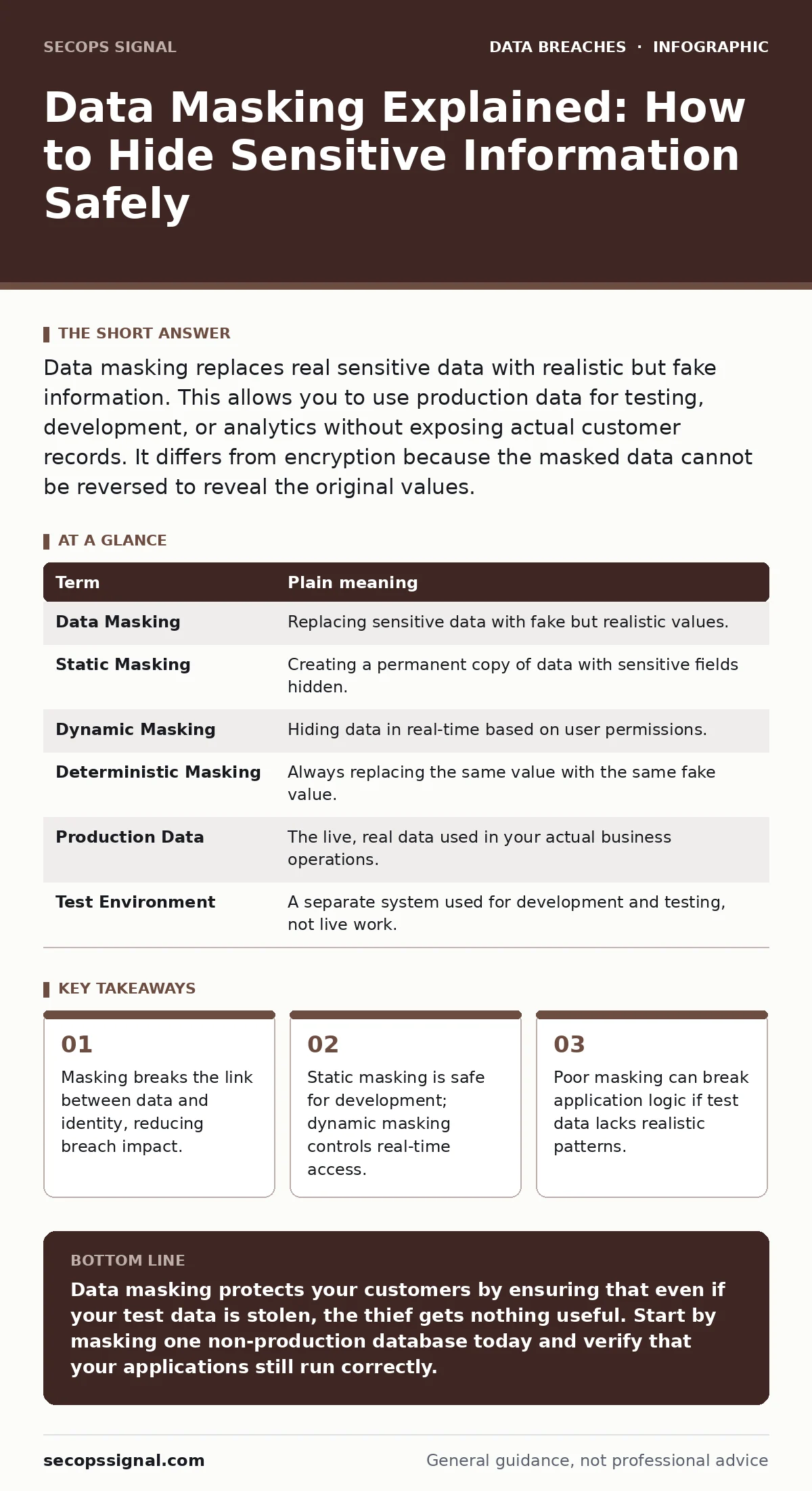
Data masking replaces real sensitive data with realistic but fake information. This allows you to use production data for testing, development, or analytics without exposing actual customer records. It differs from encryption because the masked data cannot be reversed to reveal the original values.
The Restaurant Kitchen Analogy
Imagine you run a high-volume restaurant. The kitchen staff needs to know exactly what to cook and when. They see the real orders, the real ingredients, and the real timing. Now imagine you hire a new line cook for training. You do not want them handling real customer orders yet. You do not want them seeing real credit card receipts or home addresses on delivery tickets.
Instead, you give them a batch of practice tickets. The tickets look real. They have order numbers, item names, and quantities. But the customer name is "Test User One". The phone number is a dummy sequence. The address is "123 Training Lane". The cook learns the workflow. They learn how to handle errors. They learn the system. But if those tickets were stolen, no real person would be harmed.
This is data masking. You keep the structure and the utility of the data. You remove the identity. The system works. The risk drops.
Why Masking Differs From Encryption
Many people confuse masking with encryption. They are not the same. Encryption scrambles data so only someone with a key can read it. The original data still exists, hidden behind a mathematical lock. If you lose the key, you lose the data. If a hacker steals the key, they have the data.
Masking destroys the original data in the copy. It replaces it with something else. You cannot "unmask" the data to get the original back. There is no key to steal. There is no decryption process. This makes masking superior for environments where you need to share data but do not need to recover the original values later.
Static Versus Dynamic Masking
There are two main ways to apply this protection. Static data masking happens before the data moves. You take a backup of your production database. You run a tool that replaces sensitive fields with fake values. You then give this clean copy to developers or testers. This is safe because the original data never left the secure production environment.
Dynamic data masking happens in real time. The data stays in the production database. When a user queries the data, the system checks their permissions. If they are authorized, they see the real data. If they are not, the system swaps the data on the fly as it displays it. The underlying data remains untouched. This is useful for support staff who need to see some details but not all.
The Hidden Cost of Bad Test Data
Masking is not just about swapping text. It is about preserving logic. If you mask a date field by replacing it with random characters, your software might crash. If you mask a phone number by using invalid formats, your validation scripts will fail. Good masking preserves the format, the length, and the logic of the data.
Suppose you mask credit card numbers. You must ensure the fake numbers still pass the checksum algorithm your payment processor uses. If they do not, your testing is useless. You will find bugs in the validation code, not in the business logic. This is a hidden cost. You spend time creating realistic fake data to ensure your tests are valid.
Integrating With Access Controls
Masking works best when combined with strict access policies. You should define who needs to see what. This relates closely to user access provisioning. If you provision access poorly, masking becomes a burden. You end up masking everything for everyone, which slows down work.
Instead, define roles. Developers get fully masked data. Security auditors might get partially masked data. Customer support gets dynamic masking. This layered approach reduces the attack surface. It also supports compliance frameworks like SOC 2, which require proof that you limit access to sensitive data.
See also: Password Reuse Risks: How Credential Stuffing Compromises Your Business · Neutralize Phishing Infrastructure: 3 Technical Controls That Work
Protecting Against Credential Exposure
When you move data to test environments, you often move credentials too. Database passwords, API keys, and service accounts travel with the data. If you do not mask or rotate these credentials, you create a backdoor. An attacker who compromises the test environment can jump to production.
This connects to credential exposure risks. Always treat test environments as hostile. Assume they will be breached. Masking the data helps, but you must also ensure the credentials used to access that data are unique and rotated. Do not reuse production passwords in test servers.
Try This Now
- Identify one non-production database that contains real customer data. Check if any field contains names, emails, or IDs.
- Apply a simple masking rule to replace the first half of ID numbers with zeros. Verify that the application still functions with this altered data.
- Document which roles have access to unmasked data. Remove access for any role that does not strictly require it for daily operations.
| Term | Plain meaning |
|---|---|
| Data Masking | Replacing sensitive data with fake but realistic values. |
| Static Masking | Creating a permanent copy of data with sensitive fields hidden. |
| Dynamic Masking | Hiding data in real-time based on user permissions. |
| Deterministic Masking | Always replacing the same value with the same fake value. |
| Production Data | The live, real data used in your actual business operations. |
| Test Environment | A separate system used for development and testing, not live work. |
Key takeaways
- Masking breaks the link between data and identity, reducing breach impact.
- Static masking is safe for development; dynamic masking controls real-time access.
- Poor masking can break application logic if test data lacks realistic patterns.
Data masking protects your customers by ensuring that even if your test data is stolen, the thief gets nothing useful. Start by masking one non-production database today and verify that your applications still run correctly.
Frequently asked questions
Does data masking comply with GDPR?
Yes, masking reduces personal data to a point where identification is no longer possible, which aligns with minimization principles.
Can masked data be used for machine learning?
Yes, if the masking preserves statistical distributions and relationships, the model can still learn valid patterns without seeing real identities.
Is masking enough to prevent data extortion?
No, masking reduces the value of stolen data, but you still need strong network security and monitoring to prevent attackers from entering your systems.
How does masking help with breach dwell time?
It does not reduce dwell time directly, but it limits the damage if an attacker stays in the system and exfiltrates test or development data.
How this guide was produced: written by the SecOps Signal editorial team with AI assistance, checked against the public references listed below, and reviewed when the facts change. See our editorial policy or report an error.